
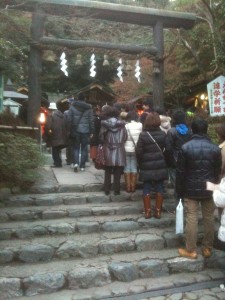
Nonomiya Shrine at festival time
The procession of the saigu to Ise was a grand affair involving several hundred people, and her palace was served by a Bureau staffed by hundreds of officials and female attendants. (The site of the palace near Ise can be visited, with a museum all about the saigu institution.) She only entered Ise Shrine three times a year, and the rest of the time was holed up in her palace doing rites and austerities much like the ancient shaman-queen Himiko. (The ‘virgin priestess’ was no doubt a carry-over of the female shaman tradition of ancient times.) She served in office until the accession of a new emperor, though death of relatives or poor health could also precipitate retirement. The practice came to an end during the reign of Emperor Godaigo (1318-39). The present appointment can thus be seen as part of the imperial nostalgia fostered by Jinja Honcho and the Ise hierarchy.
Tuesday, May 8, 2012
Emperor’s daughter becomes special priestess
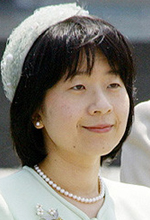
Sayako Kuroda, ex-princess and special priestess
(Kyodo) TSU, Mie Pref. — Ise Shrine said Monday that Sayako Kuroda, 43, the daughter of Emperor Akihito and Empress Michiko, has assumed the post of special sacred priestess it established for a notable event next year.
Kuroda, who was known as Princess Nori before she married commoner Yoshiki Kuroda, took the post on April 26 in order to assist 81-year-old Atsuko Ikeda, the Emperor’s older sister and the most sacred priestess at the Mie Prefecture shrine, which honors the ancestral gods of the Imperial family, in presiding over rituals.
Kuroda will serve until the October 2014 end of a series of festivities for the Shikinen Sengu event, in which symbols of the gods are transferred to a new shrine building that is reconstructed every 20 years. Ikeda took up her post in 1988. The new post was created to help her due to her advanced age.
Kuroda, who was also formerly known as Princess Sayako, left the Imperial family when she got married.
The most sacred priest or priestess serves the Sun Goddess, Amaterasu Omikami, on behalf of the Emperor and leads Shinto priests at the shrine. The post has been held by current or former Imperial family members.
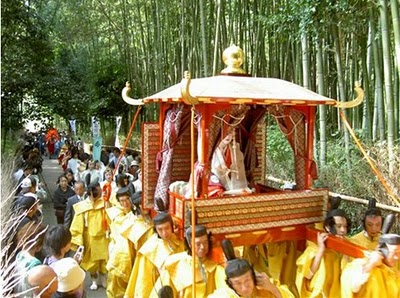
Recreation of the saigu procession from Nonomiya to Ise at the annual festival in October (photo courtesy of Kyotovisitors.blogspot)
It’s nice to see ancient rituals such as this being revived/maintained!!
Although I disapprove of the current constitution abolishing the Japanese Nobility/Aristocracy, if that’s why she lost her royal/imperial status!! ? -_-;; >_<
Japan would do VERY WELL with abolishing that section of it's current constitution, & restoring the House of Peers, as well as restoring the Nobility/Aristocracy in general, along with the former Royalty/Nobility of the Ryukyu Kingdom/Okinawa!!
It would certainly stabilize the Chrysanthemum Throne, (which in my view, is a VERY GOOD IDEA)!!
But all the same, it's nice to see she's serving the ancestress of the Japanese Royal/Imperial Family!!
Thank you for the input. Though I may not agree with the sentiments, it’s interesting to hear of an alternative viewpoint. Shinto sympathisers like Lafcadio Hearn and Ponsonby-Fane were greatly drawn to the idea of the Japanese imperial family as a symbol of the nation, though following the disastrous events of WW2 I would have thought it was a difficult notion to be enthusiastic about. Nonetheless, I’m intrigued by the idea of restoring the royalty of the Ryukyu Kingdom (Okinawa). I’ve often wondered why there is not more of a drive for independence in the islands, and the restoration of royalty would no doubt prove a powerful catalyst.
Maybe they could coexist as royalty/nobility in a similar fashion to Malaysia’s Royal Families?!
& @LEAST the Japanese let the Ryukyu Royal Family be members of the Japanese Aristocracy, & they even married into the Japanese Royal/Imperial Family, (wish they STILL WERE royalty/nobility), & although I sympathize with the Ryukyu Royal Family, as well as many other Monarchies, I am still going to argue in favor of preserving the Chrysanthemum Throne, as I’m sympathetic to the Japanese Monarchy, as well as others, INCLUDING the Romanovs, (& on that note, I think I’ll mention that I have a thread over @ Zelda Universe Forums, explaining why the Russo-Japanese War wasn’t ENTIRELY the Tsar’s fault, but I’m having extreme difficulty viewing the Forums right now, so I’ll have to share the URL later on, as this DOES HAVE SOME RELEVANCE to this discussion, via the Japan connection)!!
Here’s the thread I mentioned in my last post, (&, yes, I realize it is somewhat divergent from the topic @hand, but it *DOES* have some relevance to the topic @hand, & I wanted to explain why Tsar Nicholas the 2nd wasn’t SOLELY RESPONSIBLE FOR THE WAR WITH JAPAN, as well as why I think that Monarchy is better than Republicanism)!!
http://zeldauniverse.net/forums/index.php/Thread/176728-Reasons-why-Russia-was-better-off-under-the-Romanovs-worse-off-under-the-Soviet-/
Thank you for that. Rather off-topic yes, but always nice to have the brain stimulated by points beyond one’s usual sphere of thought…
Since I already linked to my 1’st thread that thoroughly explains why the Romanovs were BY FAR better than the Soviets, I hope you won’t mind if I post another thread/poll of mine on the same subject, on the same forums!!
http://zeldauniverse.net/forums/index.php/Thread/179541-Tsars-versus-Soviet-Union-Discussion-Round-2-Who-was-worse-better/
I won’t mind if you explain the connection with the Princess priestess at Ise…