
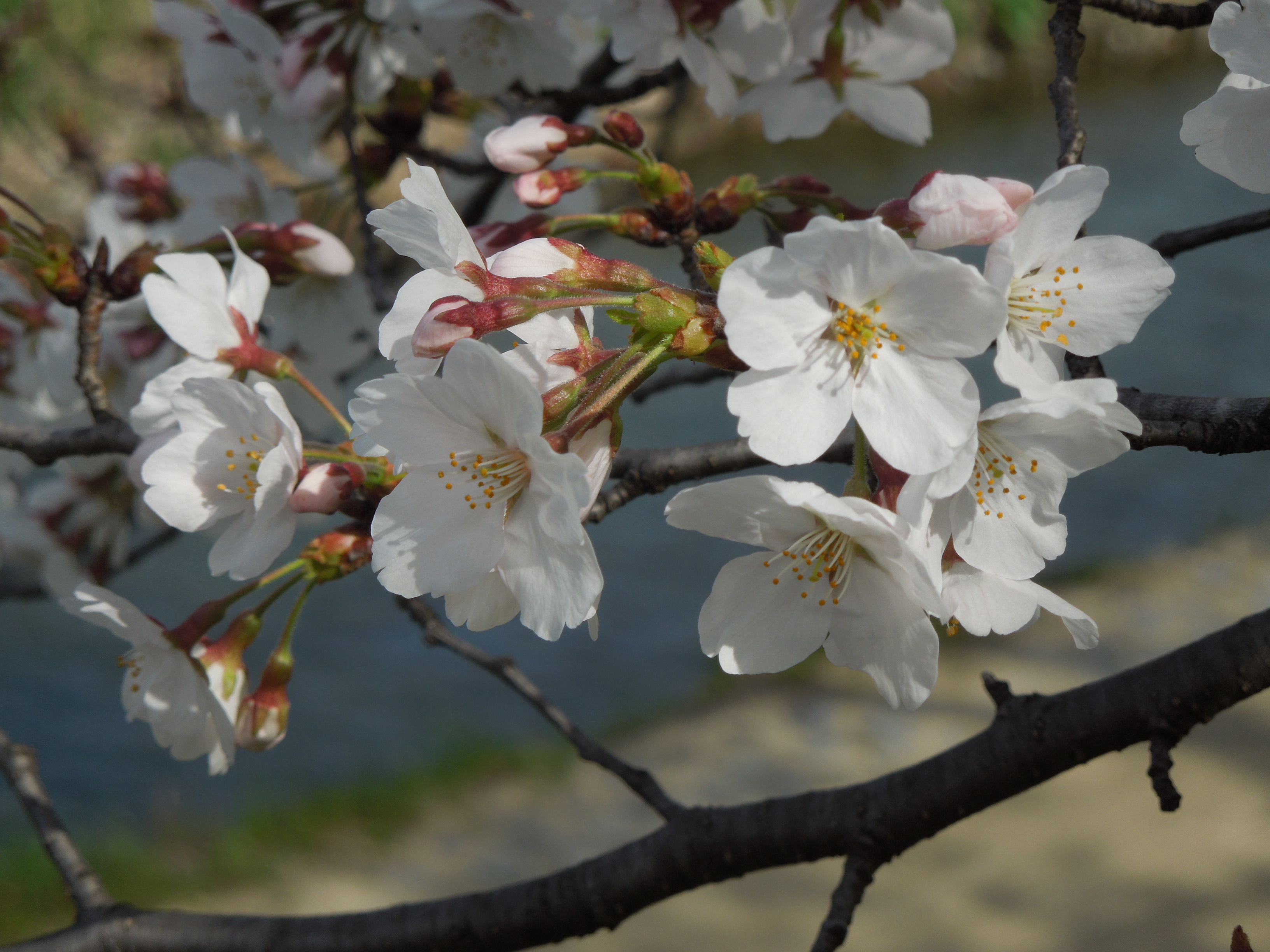
No one was a greater lover of cherry blossom than Saigyo, in whom animism mixed with pursuit of Buddha nature
Saigyo (1118-90) is one of my favourite Japanese poets. Brought up in the warrior class, he had a promising career in front of him but dropped out at 22 to become a Buddhist monk and wandering poet. Basho was a great admirer, and in both cases the wandering served to spur creativity, not only through the freshness of surroundings but through the motion itself, as I’ve noted in a piece on Walking and Writing.
In his pioneering work, Saigyo sought inspiration in the spirit of place, both through the historical associations and though the sense of presence. A true animist, he was above all sensitive to the transient beauty of the moon and cherry blossom. The moon was a symbol of Buddhism (the full moon suggesting enlightenment), whereas cherry blossom epitomised the fragile impermanence of life. His most famous poem combines both features, honouring the historical Buddha who is said to have died under a full moon:
I would like to die
at full moon
surrounded
by cherry blossom.
As a young man Saigyo lived in Kyoto on the Eastern Hills, but after tiring of the political in-fighting he took to a peripatetic life. He spent time at Mt Koya, headquarters of the Shingon sect, and often returned there. Twenty-eight years after his tonsure, he revisited the capital prior to setting off for Shikoku and the 88-temple pilgrimage. Yet despite being a sincere Buddhist who regarded waka poems as a form of mantra, Saigyo retained the strongest of feelings towards the kami and his writings show how very deep ran the syncretic strain within him:
‘Just as had always been so, I continued to go to the Kamo Shrine even after becoming a monk. Now at an advancing age, I was about to pilgrimage to Shikoku, thinking that I may never return. So I made a night visit to the shrine on the tenth day of the tenth month of 1168. I wanted to present a votive request, but since I was wearing the clothes of a Buddhist monk and could not go inside the shrine, I requested someone to present it on my behalf. Through the trees the light of the moon was filtering softly, so that the atmosphere of the place was even more sacred than usual, and I was deeply moved. I wrote this:
Awe is what fills me
as my tears fall onto the sacred branch
I here present:
my feelings are of someone
wondering if he’ll ever return.
(tr. William R. Lafleur in Awesome Nightfall: The Life, Times and Poetry of Saigyo)
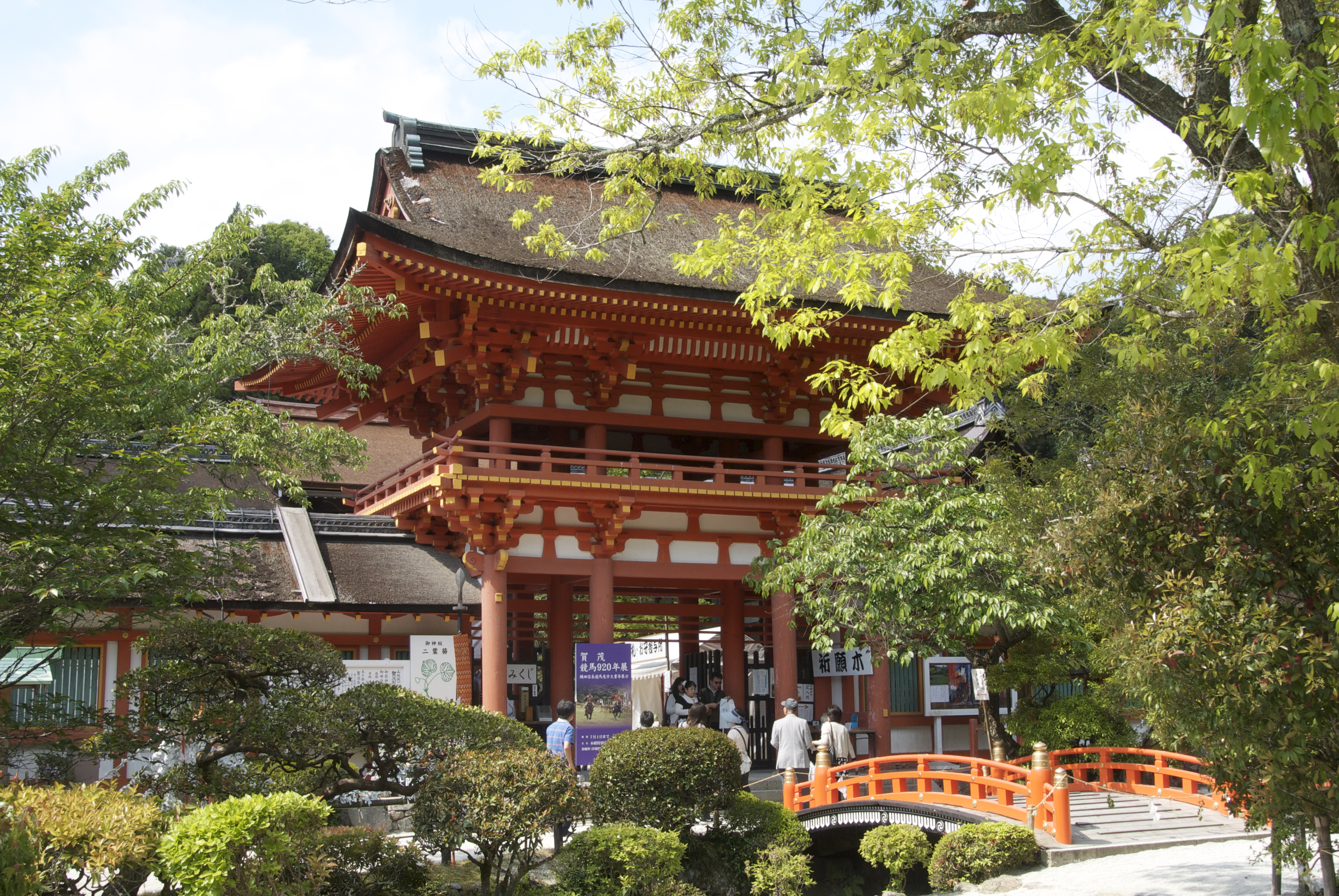
Kamigamo Jinja as it looks today
Later in life Saigyo mysteriously changed his place of abode from Mt Koya to near Ise, where he was based for 11 years. Writing of his decision, Saigyo referred to the central teaching of the day, honji–suijaku (element–trace), in which Shinto kami are seen as localised manifestations of universal buddhas and boddhisattvas. From this viewpoint, worship of Amaterasu was a means of paying respect to Dainichi Nyorai, the central buddha of esoteric Buddhism. ‘I grew tired of living on Mt Koya,’ writes Saigyo,
… and went to a mountain temple at a place called Futami in the vicinity of Ise. The sacred mountain of the great Shinto shrine there is referred to as the mountain traversed by sacred beings. Reflecting on the fact that the great Amaterasu, who is worshiped at the imperial shrine in Ise, is a manifest expression of Dainichi Buddha, I composed the following:
Following the paths
the gods passed over, I seek
their innermost place;
up and up to the highest of all;
peak where wind soughs through pines
One of the most inspiring Saigyo poems was written about Ise Jingu, surprisingly, since there was some antagonism at the shrine towards Buddhism and priests dressed in religious garb were forbidden entry. This apparently had no effect on Saigyo, who was moved by the vitality of the woods surrounding the shrine, and the poem he wrote as a result has been much quoted:
Just what it is
That resides here
I know not
Yet my eyes
Fill with tears
It’s the most complete expression of animism, which discloses a true sensitivity of soul. It speaks to the sense of awe at the mystery of existence. The Japanese are not given to metaphysics or intellectual abstraction, it is often said, and the poem here speaks to the emotional force of direct experience. There is no desire to name, no attempt to rationalise.
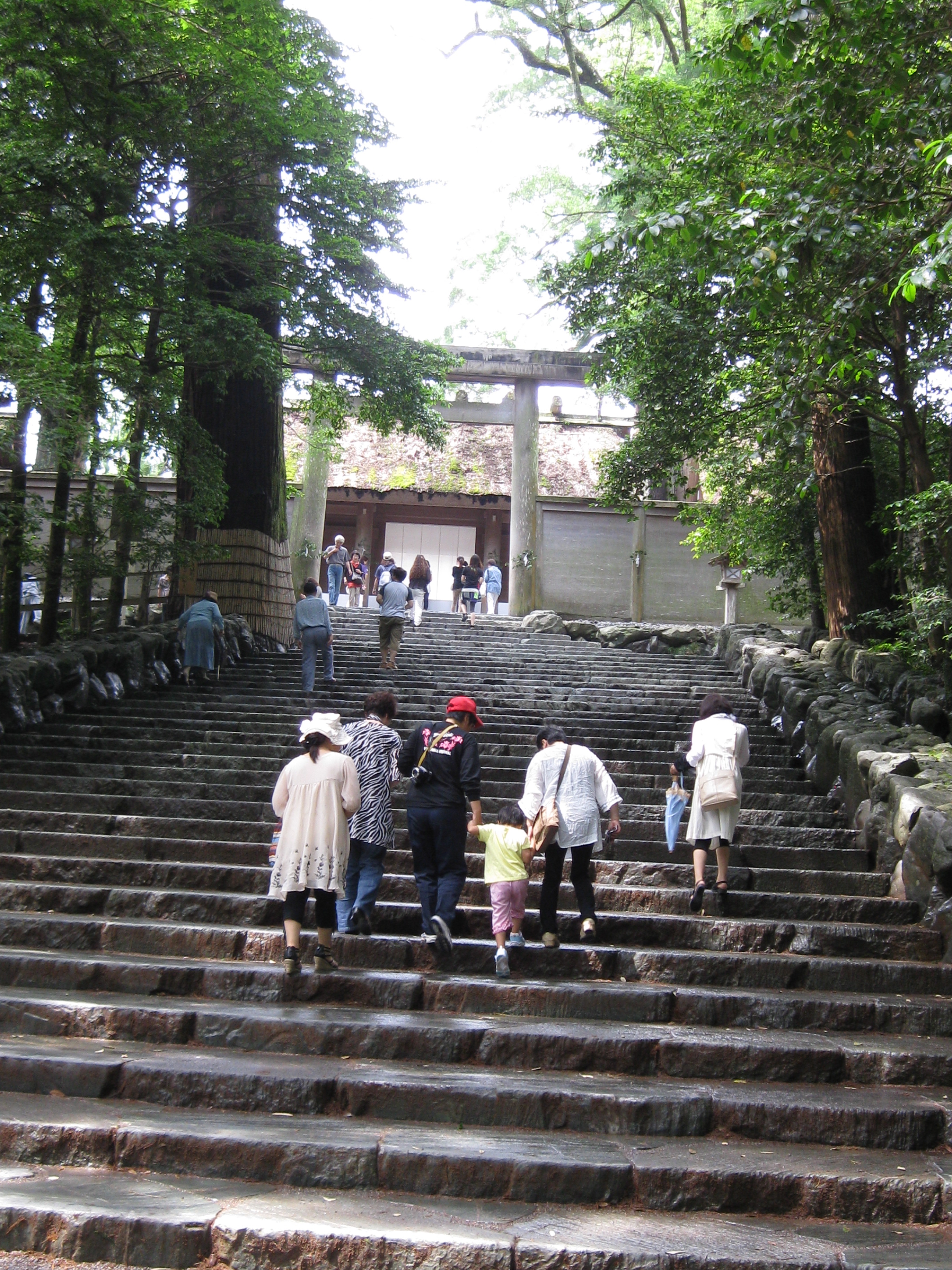
Ise Jingu, where the Buddhist monk Saigyo worshipped
It seems one reason Saigyo may have moved to Ise was his close relationship with members of the Arakida family, hereditary priests of the Inner Shrine (Naiku) from as early as the eighth century. Nonetheless the family seem to have had a strong interest in Buddhism, and Saiygo’s friend Arakida Mitsuyoshi, whom he coached in poetry, was later tonsured as a Buddhist priest.
Like others of his time, Saigyo was convinced of the interdependence of native kami and transcendent Buddhas, noting that ‘Having gone to Ise, I worshipped at the great shrine’…
Adoration for
the sacred sakaki tree
– pendant branches
with both gods and buddhas
depending on each other.
The identification of kami and buddhas in the honji-suijaku concept underwrote Saigyo’s love of cherry blossom too. Since the kami are present within natural phenomena that impress us with their beauty and numinous presence, then to be drawn to them is to be drawn to the buddha-spirit within. Love of cherry blossom was therefore to move towards the enlightened state, which was the goal for all Buddhists.
It’s a reminder that the other great writer of the times, Kamo no Chomei (1153-1216), was a Shinto priest at Shimogamo Shrine before dropping out to become a Buddhist recluse on the southern fringe of Kyoto, where he lived in ‘a ten-foot square hut’. The author of Hojoki (1212) was much preoccupied with impermanence and sought refuge in the transient beauty of nature, equating the cycle of the seasons with the great wheel of existence. For Shinto and Buddhism alike, the circular mirror was a potent symbol, and the notion of a ideological divide would have seemed absurd to these figures of the past. How could you break two modes of thinking that were so perfectly fused?
The history of post-Meiji Japan suggests they had a good point.
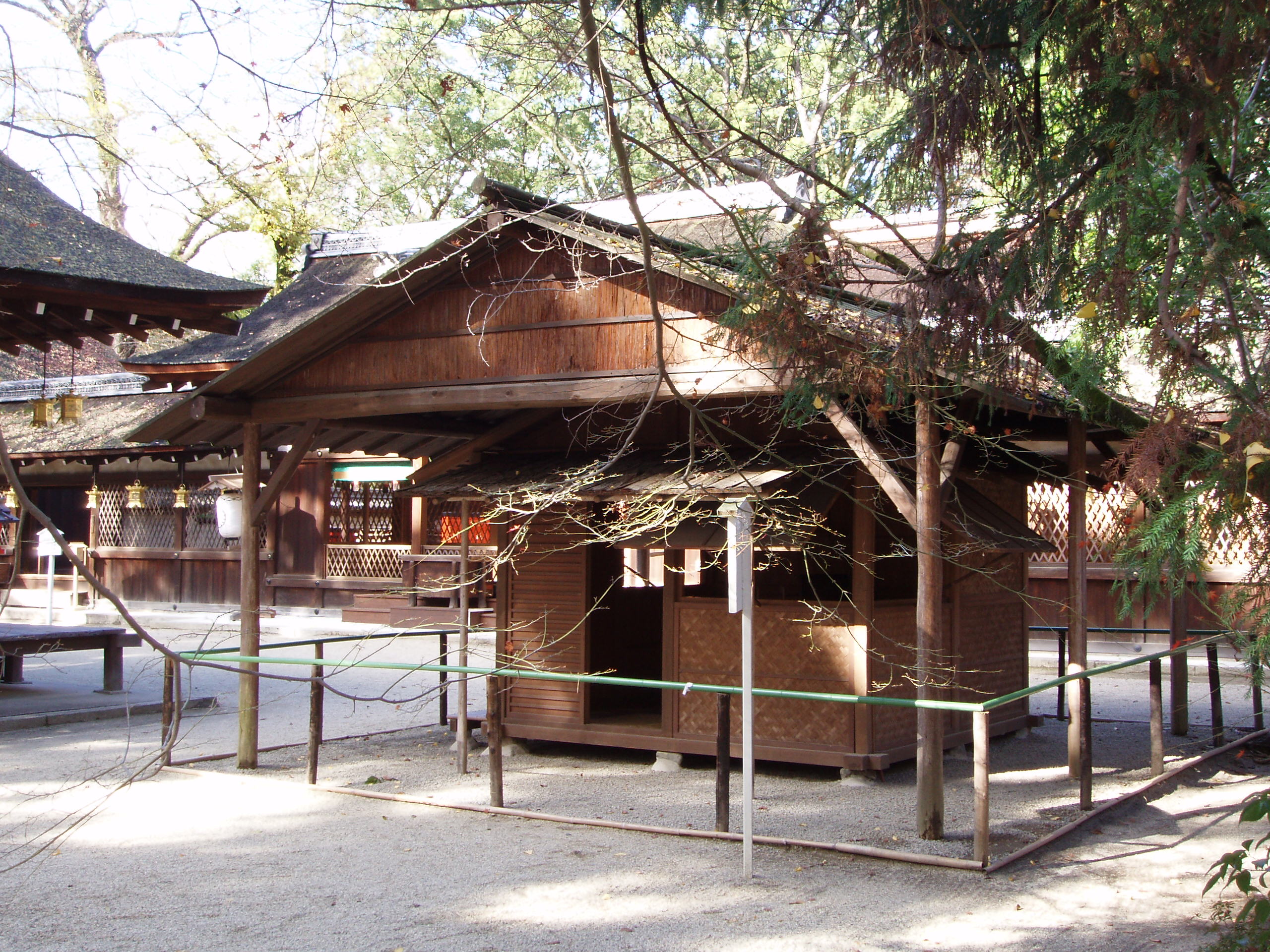
Model of the ten-foot square hut in which the syncretic Kamo no Chomei lived. Once a Shinto priest at Shimogamo Jinja, he dropped out to become a Buddhist recluse living close to nature on a hill outside Kyoto.
A great post John. I could imagine myself watching the full moon surrounded by cherry blossom when reading it. The poetry really captures the moment and Saigyo’s life story, and the syncretism it represents, is fascinating.
Thank you, Jann… Though 900 years have passed since Saigyo’s time, there are moments when I can recognise the same syncretic blend in Japanese religious sentiment. Here in Kyoto,for instance, the appreciation of nature at Kurama Temple and Kibune Shrine are very much part and parcel of the same reverence for the environment.
Thank you for sharing this. I would love to read more writings of the ancient Japanese philosophers. I will also try to learn more about where I live. There is so much I don’t know (it is astonishing for me when I realise that!).
Ah, it’s said that only the person who realises the vastness of his ignorance is truly on the path to knowledge…
The animism that I too embrace, perfectly described and illustrated. Thank you.
And thank you for taking the trouble to write in…
John, thank you for this fine article. Now I know why Basho admired Saigyo so much.
Yes indeed, I think we can rely on Basho having had true discernment in his appreciation of a fellow traveller…
Thanks for posting outstanding information. Your web-site is really cool.
I’m impressed by the details that you simply have on this site.
It shows how nicely you perceive this subject. Bookmarked this web page, will come back for extra
posts. You, my good friend, ROCK!