Author: John D. (Page 186 of 202)

Izumo no Okuni: kagura to kabuki

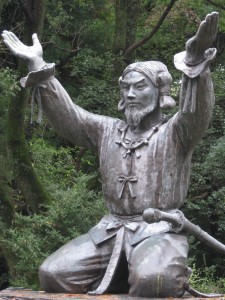
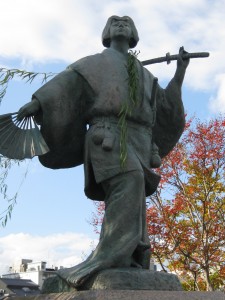
Okuni's statue in Kyoto showing her impersonating a samurai

Izumo no okuni was the daughter of a blacksmith who started out as a miko (shrine maiden) at Izumo Shrine. She was known for her beauty and her skill at performing sacred dance (kagura). She was therefore chosen to be sent to Kyoto to raise money for the shrine, as was the custom of the age.  Priests and other shrine personnel had to act as fund-raisers.

The freedom she found in the capital must have gone to Okuni’s head, for she soon turned from sacred dance to the profane. She started performing on the dry river bank of the Kamogawa, and her sensual style of dance attracted large crowds.  She added humorous skits satirising the manner of lovers, and she even impersonated samurai and prostitutes.  Though she sent money back to Izumo, the shrine authorities were concerned by her reputation and summoned her home.  She refused.

By the time that Tokugawa Ieyasu was declared shogun in 1603, Okuni had gathered together a troupe whose performances were called ‘kabuki’ or crazy.  The song and dance routines were done in colourful costumes, so as to please the eye as well as the ear.  Interestingly, in complete distinction to today’s kabuki, Okuni’s troupe were all female.

(Because of concern about women using the stage to advertise themselves, the shogun banned women from kabuki in 1629.  Thereafter, as on the Elizabethan stage, young boys played the part of women, though this was too was soon banned because of immorality.  You just can’t win with lust!)

Okuni had a patron, Ujisato Sanzauro, who helped give kabuki a more dramatic style.  As a result the troupe’s performances became famous – and copied – thoughout the land.  Interestingly, this was around the same time that Shakespeare transformed the English stage.

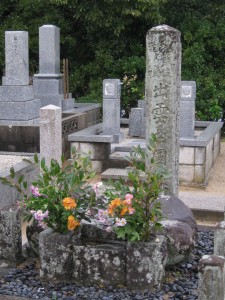
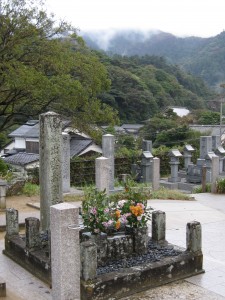
Okuni's grave at Izumo, near the shrine where she once served as a miko

What happened to Okuni in later years is uncertain, and her date of death is unknown.  There’s a grave for her in Izumo, so presumably, like Shakespeare, she retired back to her hometown when her career was over.  Once a simple shrine maiden, she left her mark on the culture of the nation.  From dancing for the gods (kagura), she had gone on to dance her way into history.

Viva Okuni ! We in Kyoto remember you with fondness…

Hearn 3): The Mirror

In his early days in Matsue, Hearn was fascinated by most everything he saw.  Here, in Glimpses of Unfamiliar Japan (1894), he describes his first encounter with the mirror that stands at the heart of the Shinto shrine.  It captures the curiosity that drove him, the fascination with Shinto things, and the sense of mystery to which he was so attracted.  Something in the mirror spoke to him of the search for home within himself.

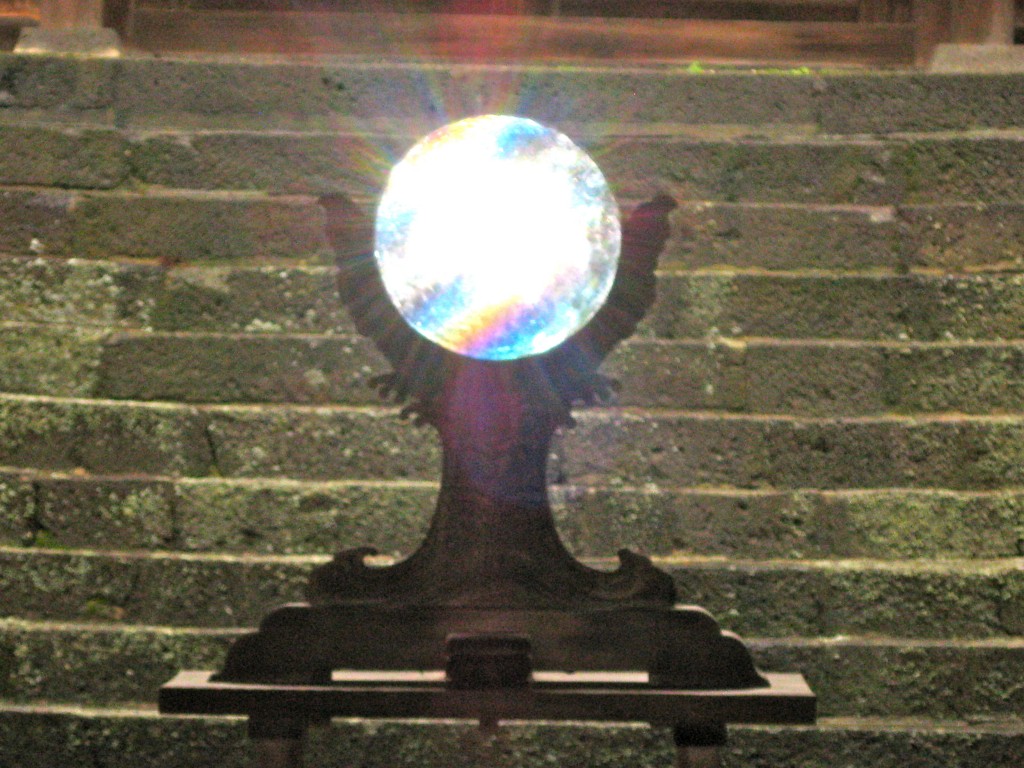
“Then I reach the altar, gropingly, unable yet to distinguish forms clearly. But the priest, sliding back screen after screen, pours in light upon the gilded brasses and the inscriptions; and I look for the image of the Deity or presiding Spirit between the altar- groups of convoluted candelabra. And I see―only a mirror, a round, pale disk of polished metal, and my own face therein, and behind this mockery of me a phantom of the far sea.

Only a mirror! Symbolising what? Illusion? or that the Universe exists for us solely as the reflection of our own souls? or the old Chinese teaching that we must seek the Buddha only in our own hearts? Perhaps some day I shall be able to find out all these things.”

[Glimpses on Unfamiliar Japan can be read online here. For more on Lafcadio Hearn, see here.]


Hearn 2): at Matsue

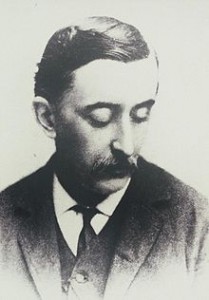
Lafcadio Hearn (1850-1904) in a typical pose to avoid his blank eye being seen

Honeymoon period
On my recent visit to Izumo, where the kami of Japan are presently gathered, I took the opportunity to make a literary pilgrimage to the home of Lafcadio Hearn. Though not well-known abroad, he is treasured in Japan for his sympathetic accounts of the country not long after its opening to the West.  A curious figure, he was the son of a British officer and a Greek woman, raised in Ireland, attended boarding school in England, then went to the US where he carved out a colourful career in journalism before heading for Japan just before his fortieth birthday.

Hearn arrived in 1890 and spent fifteen months in Matsue, ‘province of the gods’. in a classic case of what anthropologists call the honeymoon period, he was enchanted by everything he saw.  A hundred years later when I myself arrived in Kanazawa, further north along the Japan Sea, I was similarly entranced by a Wonderland where all was bizarre yet charming.  Like a second childhood, one has to learn from scratch to understand customs that are alien and a language that is indecipherable.

“Elfish everything seems,” wrote Hearn, “for everything as well as everybody is small, and queer, and mysterious: the little houses under their blue roofs, the little shop-fronts hung with blue, and the smiling little people in their blue costumes. The illusion is only broken by the occasional passing of a tall foreigner, and by divers shop-signs bearing announcements in absurd attempts at English. …  It then appears that everything  Japanese is delicate, exquisite, admirable—even a pair of common wooden chopsticks in a paper bag with a little drawing upon it… Curiosities and dainty objects bewilder you by their very multitude: on either side of you, wherever you turn your eyes, are countless wonderful things as yet incomprehensible.”

Collector of tales
Hearn’s house stands opposite the castle and gives a sense of the lifestyle he so enjoyed. The former house of a samurai, his home had a charming little garden with a pond mentioned in his writings.  Here the odd-looking Hearn found himself. He settled down in marriage, and when he naturalised he took his wife’s family name, calling himself Koizumi Yakumo (the second name, ‘eight-fold clouds’, is that of the local area, indicative of his attachment).
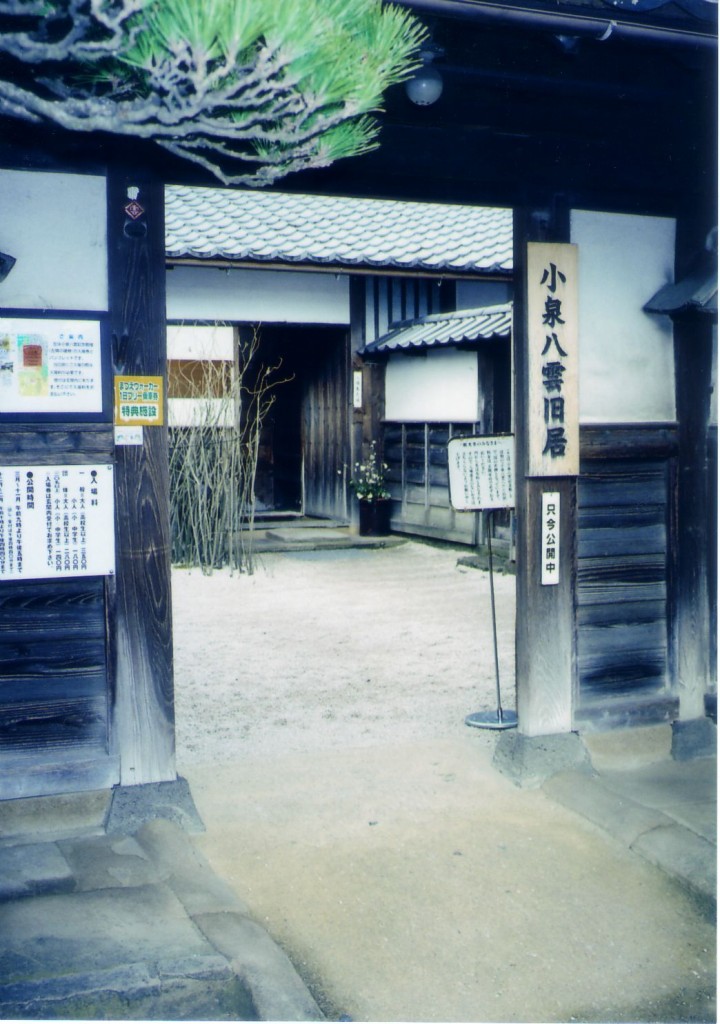
Hearn’s house in Matsue, Shimane prefecture

Hearn had been drawn to Japan by a book of Percival Lowell, The Soul of the Far East (1888).  Here in Matsue he was delighted by the spiritual devotion of the locals, learning eagerly of their religious beliefs.  It’s said his fascination was fostered by having been told of Irish legends as a child by his Connaught nanny.

I once went to a talk by Hearn’s great grandson, Koizumi Bon, who mentioned the similarities of Celtic and Japanese animism.  The circle of the Irish cross, for instance, is a remnant of ancient sun worship; animal familiars serve the gods; there is an Irish equivalent of Setsubun, when devils are driven out to ensure happiness in the coming year; and the Irish wishing tree is hung with cloths in similar manner to the way Japanese hang their fortune slips to trees.

In Glimpses of Unfamiliar Japan (1894) Hearn goes into some detail about local traditions, and the descriptions are fascinating because of their record of the past.  Some of the customs remain; others have vanished down the vortex of history.

**********************
“I see men and women descending the stone steps of the wharves on the opposite side of the Ohashigawa, all with little blue towels tucked into their girdles. They wash their faces and hands and rinse their mouths—the customary ablution preliminary to Shinto prayer. Then they turn their faces to the sunrise and clap their hands four times and pray.

From the long high white bridge come other clappings, like echoes, and others again from far light graceful craft, curved like new moons—extraordinary boats, in which I see bare-limbed fishermen standing with foreheads bowed to the golden East. Now the clappings multiply—multiply at last into an almost continuous volleying of sharp sounds. For all the population are saluting the rising sun, O-Hi-San, the Lady of Fire—Ama-terasu-oho-mi-Kami, the Lady of the Great Light.

‘Konnichi-Sama! Hail this day to thee, divinest Day-Maker! Thanks unutterable unto thee, for this thy sweet light, making beautiful the world!’ So, doubt-less, the thought, if not the utterance, of countless hearts. Some turn to the sun only, clapping their hands; yet many turn also to the West, to holy Kitzuki [Izumo Taisha], the immemorial shrine and not a few turn their faces successively to all the points of heaven, murmuring the names of a hundred gods; and others, again, after having saluted the Lady of Fire, look toward high Ichibata, toward the place of the great temple of Yakushi Nyorai, who giveth sight to the blind—not clapping their hands as in Shinto worship, but only rubbing the palms softly together after the Buddhist manner. But all— for in this most antique province of Japan all Buddhists are Shintoists likewise—utter the archaic words of Shinto prayer: ‘Harai tamai kiyome tamai to Kami imi tami.”

**********************
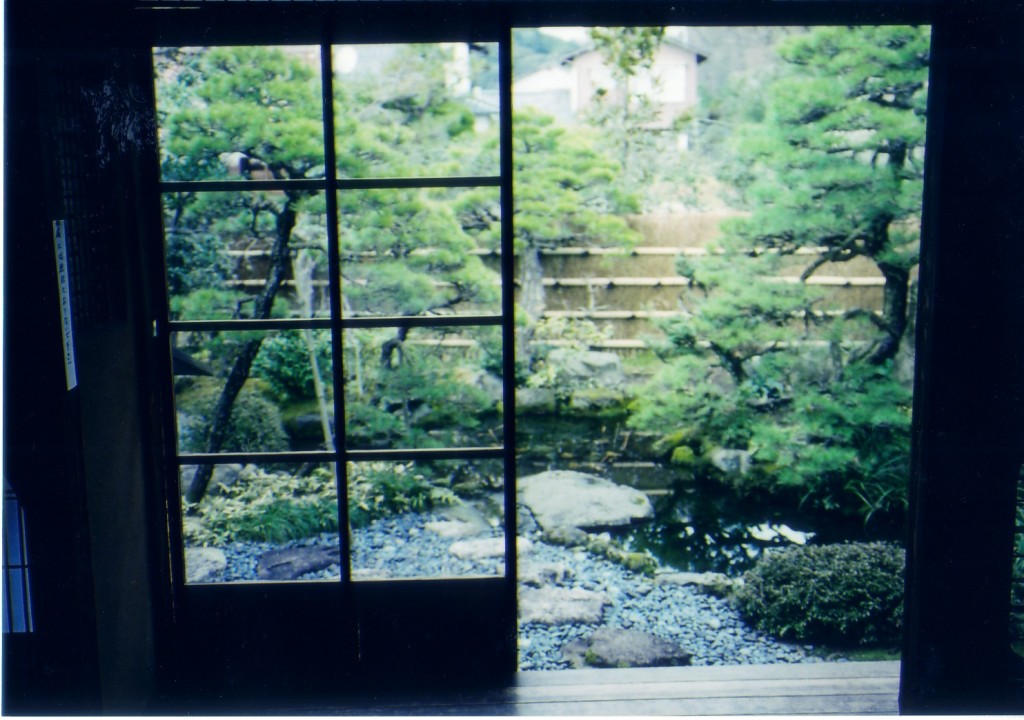
The garden in Hearn’s house in Matsue of which he wrote so graphically

Shinto as a key to understanding Japan
I’ve always felt ambivalent about Hearn, for he clearly idealised Japan as means of escaping from a West where he felt out of place.  By contrast his friend Basil Hall Chamberlain, author of Things Japanese (six editions 1890–1936) viewed Japan with scholarly detachment.  Unlike Hearn, he was fluent in Japanese and balanced his sympathetic accounts with some harsh comments.  Yet it is the romanticist’s vision which has won the wider readership, for the power of imagination invariably trumps dull reality.  ‘When legend becomes fact, print the legend,’ says a character in John Ford’s The Man Who Shot Liberty Vallance.  

Over time Hearn was to become well-versed in Shinto, and to see it as fundamental to an understanding of the culture as a whole.  Japan, An Attempt at interpretation (1904) remains a classic of its kind and even now, despite a century of dramatic changes, the insights are compelling.  Hearn manages to shed clarity on the vague and often contradictory mix of Japanese belief systems.  He only lived in Matsue a brief fifteen months, before going on to Kumamoto and Tokyo University.  It was Matsue though that shaped his attitude to Japan.  It was here in ‘the province of the gods’ that his love of Japan’s spiritual life was first fostered.

**********************

 “The real religion of Japan, the religion still professed in one form or other, by the entire nation, is that cult which has been the foundation of all civilized religion, and of all civilized society,—Ancestor-worship. In the course of thousands of years this original cult has undergone modifications, and has assumed various shapes; but everywhere in Japan its fundamental character remains unchanged. Without including the different Buddhist forms of ancestor-worship, we find three distinct rites of purely Japanese origin, subsequently modified to some degree by Chinese influence and ceremonial. These Japanese forms of the cult are all classed together under the name of “Shinto,” which signifies, “The Way of the Gods.” It is not an ancient term; and it was first adopted only to distinguish the native religion, or “Way” from the foreign religion of Buddhism called “Butsudo,” or “The Way of the Buddha.” The three forms of the Shinto worship of ancestors are the Domestic Cult, the Communal Cult, and the State Cult;—or, in other words, the worship of family ancestors, the worship of clan or tribal  ancestors, and the worship of imperial ancestors. The first is the religion of the home; the second is the religion of the local divinity, or tutelar god; the third is the national religion.”

**********************
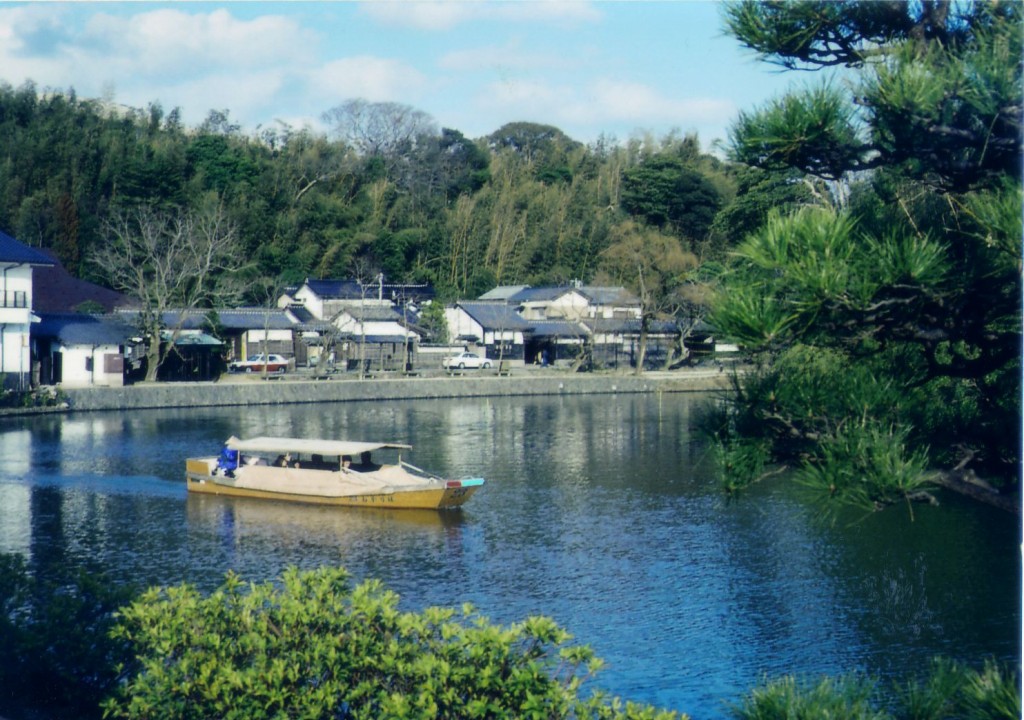
View towards Hearn’s house in Matsue, where he first learned about Japan’s ancestor worship

Glimpses on Unfamiliar Japan can be read online here. Japan: an Attempt at Interpretation can be found here.

The Wonder of Alan Watts

Alan Watts professed not to be a guru.  Well, guess what, Alan…  you are a guru to me!  Actually, you’re more like a kami, for you still talk to me once a week from beyond the grave, courtesy of ipod…

Today Alan was talking of the Relevance of Oriental Philosophy, and some of what he had to say struck me as relevant to the prospects of Shinto as a green religion. Here’s my transcript of a small portion of his talk …

*******************************************************************************************************

‘Man is a little germ that lives on an insignificant planet that revolves around a little sphere that exists on the outer edges of one of the smaller galaxies.

God, what a putdown that is.  But on the other hand I am absolutely amazed to be in such a very odd situation… and the more I look at things I cannot get rid of the feeling that existence is quite weird.

As Aristotle said, wonder is the beginning of philosophy, because it strikes you that existence is very, very strange.  Even more when you realise that in a world with no eyes, the sun would not be light.  And in a world where there are no soft skins, rocks would not be hard.  Nor in a world where there are no muscles, rocks would not be heavy.  Existence is relationships, and you are smack in the middle of it.

So there is obviously a place in life for a sense of awe and astonishment at existence.  And that is also a basis of respect for existence.  We don’t have much of it in this culture, even though we call it materialistic.  A materialist is a person who loves material.  But in the culture we call materialistic today, we are of course bent on the total destruction of material and its conversion into junk and poisonous gas. This is not a materialistic culture because it has no respect for material.

Respect is based on wonder, on feeling the marvel of a pebble in your fingers.’

*****************************************************************************************************

Awe – respect – harmony.  Is this not the model we have to get back to, and is it not a model that Shinto can help us develop?

Last week Aike Rots gave a talk about the green connection of Shinto at Kyoto University, pointing out that it is often linked with a nationalistic view of Japanese having a special feeling for nature. Environmentalism in the West is linked with the left; in Japan that is not the case. Rather than saving the whales, it’s Japan’s ‘special’ traditions that people here want to save.

Like Alan Watts, Green Shinto takes a firmly universalist stance and believes that regardless of nationality we are all in the same cosmic boat.  Awe is universal.  Wonder is universal.  Nature is universal.  Let’s make Shinto universal too.

************************************************************************************************

You can listen to the weekly Alan Watts ipod here.  There are also numerous Alan Watts’ videos on youtube: this seven-minute one is rather good, about the limitations of the human mind, but nearly all of those listed on youtube are worth the time IMHO.

Izumo Taisha Part 3: Kamiari sai

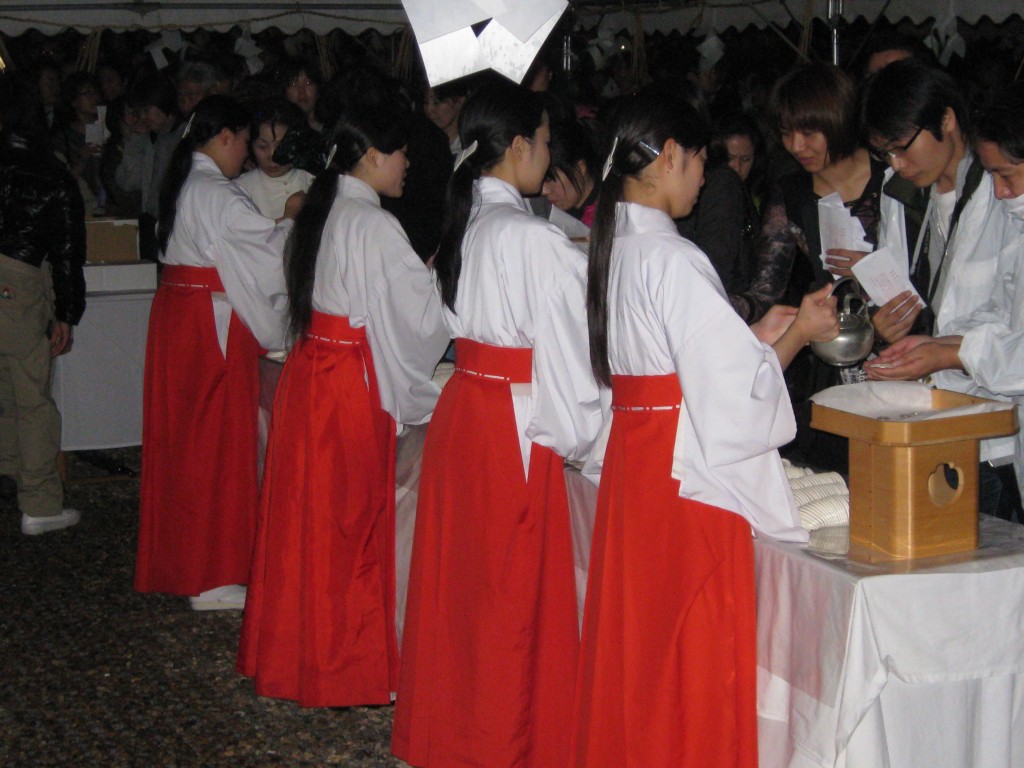
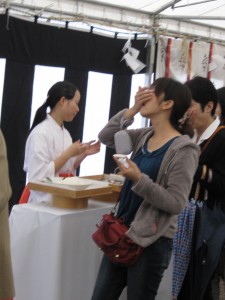
Miko (shrine maidens) administering omiki (sacred saké) to the throng


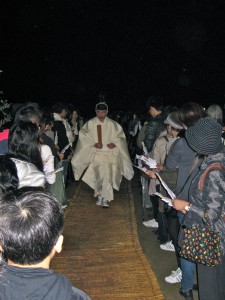
Priest leading the procession at the Welcome Ceremony

Kami visitors
The best time to visit Izumo is when all the kami of Japan go.  That’s in the tenth month of the old lunar calendar (the dates vary in the modern calendar but are around this time of year).  You can expect it to be crowded, with the eight myriad kami joined by several thousand Japanese. Such is the size of Izumo, though, there’s plenty of room – except for the immediate access roads which get pretty jammed.

The kami stay at Izumo shrine for a week, after which they circulate around eight other shrines in the area before taking their leave.  This year I attended the first two days of the event, and I’ve described the Welcome Ceremony on the beach here.  Outdoors and in the dark, it has a sense of theatre as the kami emerge from the sea and into the waiting branches (himorogi).

Honoring the snake
The day after the Welcome Ceremony I turned up at the shrine and found a line of people queueing before a small tent, where they were paying respects to Ryuja-san, the serpent-spirit who guides the kami as they arrive by sea.  What looked like a model snake sat in a mikoshi, and people filed past and prayed. Some were quite fervent.

Scoffing the rice grains, with saké cup-saucer in hand

Coming from a Christian background, where the snake has been demonised, it’s striking to see a serpent the focus of so much devotion. We tend to think of it as a vile, poisonous creature.  Here, however, because of its skin-shedding ability, it’s seen rather as a symbol of regeneration.

At the exit to the tent miko were serving saké and a few grains of rice. Watching people eat and drink, I couldn’t help thinking that here was the Shinto equivalent of Holy Communion.  Rice wine instead of red; rice grain instead of wheat.  Ingesting spirit and the body of the earth. Participating in the divine.

Networking
The kami had already got up by the time we arrived, and according to the priest I asked they had gone down to hold a conference at somewhere called Kaminomiya (or Karinomiya).  It was about fifteen minutes walk away, near the beach on which the Welcome Ceremony was held.

The road leads past the grave of Izumo no Okuni, famous to us who live in Kyoto as the founder of kabuki.  She is thought to have been a shrine dancer at Izumo, who went to Kyoto to seek her luck as a performer.  She invented a whole new crazy style of dance-drama.  She made a name for herself then, like Shakespeare, returned to her home town to die.

Okuni's grave, founder of kabuki, with the characteristic hills and mists of her Izumo childhood behind

There’a statue of Okuni in Kyoto that I pass every day on my way to work.  It stands by the Kamogawa river, where she held performances around 1600 on the dry river bed, and shows her dressed as a samurai and aping the mannerism of a man.  From sacred dance to crazy spirit, she lies now where every year she gets a chance to see all the kami of Japan pass by. Here’s to you, Okuni !

Conference hall

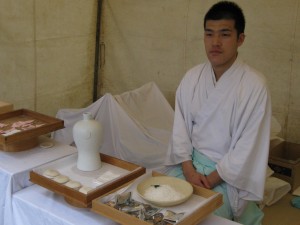
You’d imagine a conference hall for eight myriad kami – the assembled deities of the nation – to be an immensely grand affair.  Far from it.  It turned out, in fact, to be an unprepossessing shrine of seemingly little distinction.  A solitary priest sat at the entrance, dispensing the same saké and rice grains combination as at the Ryuja-san tent.

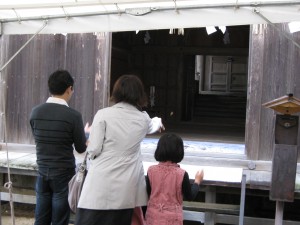
Prayers of respect were done in front of the worship hall, whose doors stood open.  There was nothing to see within but a few coins offered by visitors.  I thought perhaps the kami might be assembled there, invisible to the human eye, but the priest assured me they were behind closed doors inside the honden (inner sanctuary), where kami usually reside.

What were the kami discussing, I asked the priest.  ‘Mm,’ he said thoughtfully, then added something to the effect that it was not for us to know. I can guess, though, that high on the agenda this year was the little matter of Fukushima.

Priest with saké and rice grains to dispense to visitors

Offering coins at Kaminomiya where the kami of all Japan are gathered in discussion

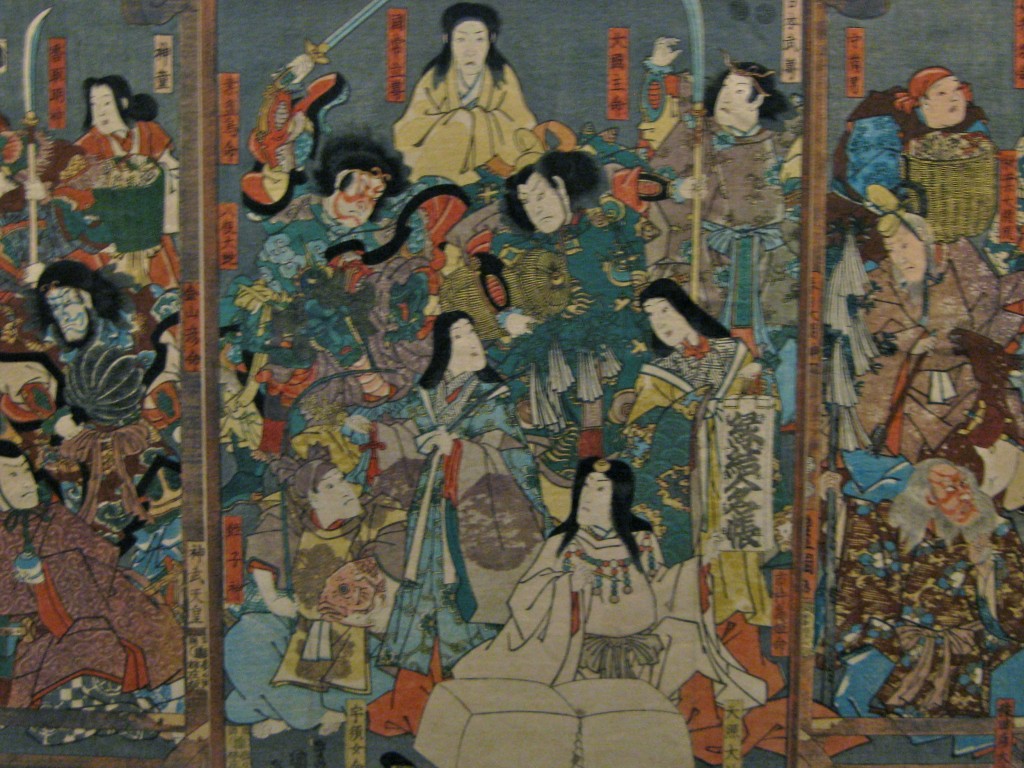
Edo-era depiction of the kami in conference

Izumo Taisha Part 2: Structure

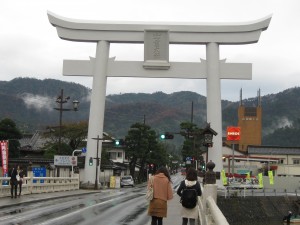
Approaching a realm of hills and mists; once a mighty 48 meter shrine might have been visible

When you approach Izumo Shrine these days, it’s along a busy road and past humdrum buildings.  Once, however, the approach must have been breathtaking. Nestled against tree-covered slopes, there stood an enormous shrine whose dimensions dwarfed its surrounds.

Today the honden (inner sanctuary) is thought to be half the size of what it was in Heian times. Yet even now it remains formidable.  In fact, size is what Izumo is all about.  ‘It exudes masculine power, like the hunting lodge of some mountain giant,’ writes Jospeh Cali in the forthcoming Guide to Shinto Shrines.

Unfortunately the honden cannot be seen at the moment as it is being rebuilt (for roughly the 25th time since the seventh century).  It shows the emphasis Japanese put on continuity.  Renewal and continuity. The present head, amazingly, is the 84th generation of the same Senge family who have run the shrine since its foundation.  Hereditary succession says a lot about Japan’s conservatism and sense of an enduring self.

Like Ise, the honden here has a symbolic central pillar (shin no mihashira), reflecting the mythological pillar by which Japan’s creators Izanagi and Izanami descended from heaven.  As in shamanism, spirits use the pillar to move between worlds.  The cosmic connection is built into the fabric of the building.

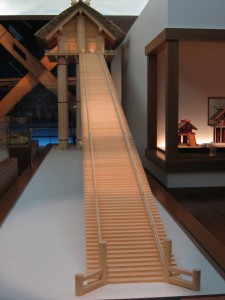
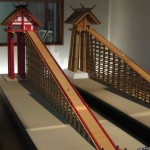
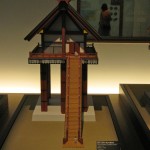
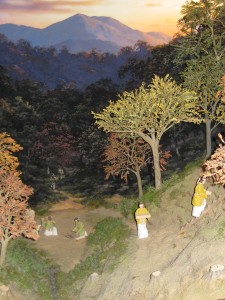
Model of how Izumo might once have looked

Former shrine
There exists a tenth-century book called Kuchizusami, written to educate noblemen’s sons, which contains a reference to Izumo being higher than the massive 45-meter Todaiji Hall of the Great Buddha at Nara.  Could it really be true?  For years modern scholars speculated about the likelihood of such a building. 

Clues to the possible construction came from a medieval draft held at Izumo, and experts came up with models of how the shrine might have looked   Then in 2000 came an exciting discovery in the precincts of the shrine.  Three huge cedar trunks were unearthed, which had been bound together to make one huge pillar.  It was a vast three meters in diameter.  The discovery caused huge excitement, because it showed that a huge shrine could well have existed in the past.  

The present consensus is that the find dates from the 1248 construction, which was the last time the tall main shrine of ancient times was renewed.  Thereafter circumstances led to the building of a lower shrine, with construction on a reduced scale during the medieval period and the fighting of the Warring States era.


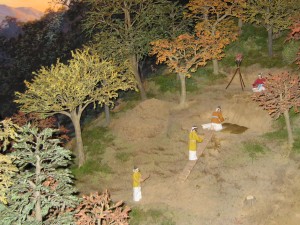
Models of how Izumo’s honden may have looked before the middle ages, when it was the tallest wooden building in Japan, and possibly the world.

Glimpses of former glory

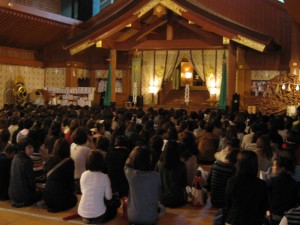
Inside the kaguraden, which copes easily with the masses of daytrippers

Reminders of Izumo’s former glory remain in the majesty of Izumo’s solid structures, such as the kaguraden. Unlike other shrines, this is not an open-sided stage, but a large building of such dimensions that whole busloads of tourists are swallowed whole.

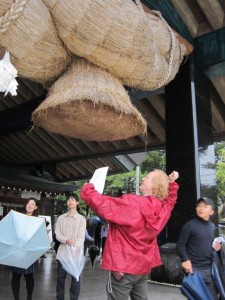
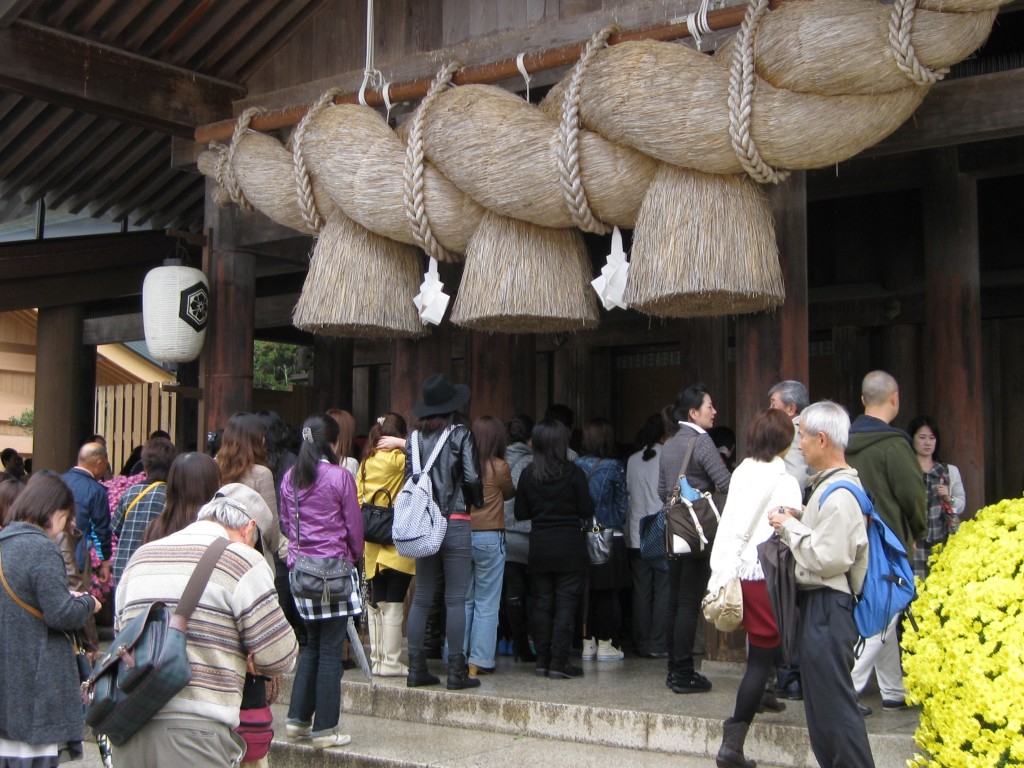
The kaguraden boasts the world’s largest shimenawa (rice rope).  It’s a massive affair that weighs five tons, so you want to be careful when standing below.  At many shrines around the country, you find Japanese wanting to leave something for good luck – putting a stone on top of a torii is popular at some places.  Here in Izumo there’s a tradition of throwing a coin up into the shimenawa.  If it sticks, the gods will be happy and fortune will smile on you.  I struck lucky with my first throw!

Izumo has pleasant and spacious grounds.  Next door is the fascinating Shimane Museum of Izumo History, with the models pictured above as well as videos and explanations of the archaeological record.  Fascinating stuff for those with a sense of curiosity about the past.  Here at Izumo, history is encoded in the very structure of the place.

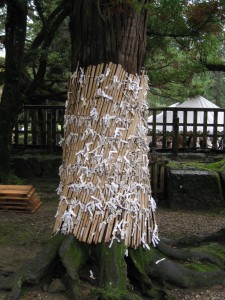
Izumo tree covered with fortune slips. This is the country's premier enmusubi shrine (good connections).

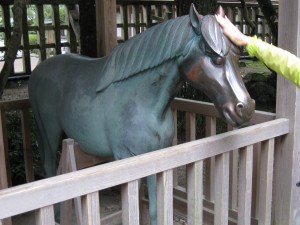
The shrine horse, messenger to the gods, getting a pat

Gaijin trying to get a coin to stick in the shimenawa

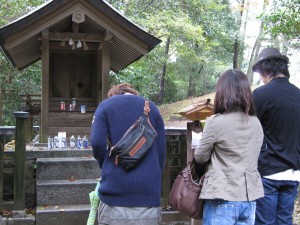
Reverence at one of Izumo's many subshrines. Who says the Japanese are not religious?

***************************************************************************************************

For an account of Izumo’s foundation, see Part One.  For some stunning photos of Izumo Taisha, see ojisanjake’s blogspot.

Izumo Taisha Part 1: Foundation

Foundation
Izumo Taisha is more than a shrine.  It’s a legend, a symbol, a reminder of a once glorious past.  It’s the country’s foremost shrine for enmusubi (love connections).  It’s got the biggest honden (inner sanctuary) in Japan, and the biggest shimenawa (rice rope) in the world.  Experts think at one time it may have had the tallest building in the world too. According to some, it’s the oldest of all Shinto shrines, dating back to before the imperial ancestors ‘descended from heaven’.  It remains, even now, second only to Ise in the popular imagination.

in reality no one is sure when exactly the shrine was founded.  There was a religious site here around 2000 years ago, for magatama sacred beads and halberd offerings were found nearby.  Speculation has suggested a date in the seventh century for the establishment of the shrine.  No doubt, like elsewhere, worship in the early centuries took place outdoors and was focussed on the hilltop or sacred rock.

Burial of ritual swords to the mountain kami opposite

Reconstruction of the ritual at Kojindani, where 358 swords were offered to the kami

In the Shimane Museum of Ancient Izumo, next to the shrine, is an exhibit showing the burial of 358 bronze swords at the Kojindani site.

The swords were found in 1984 and are thought to have been offerings to the mountain god opposite.  Alongside the swords were bronze bells and spearheads.

The exhibit gives an idea of how worship must have been 2000 years ago: open-air, and up on the hillside. It’s notable here that Shinto scholar Ponsonby-Fane claimed the Izumo Taisha site was originally settled by immigrants who practised ancestor worship on the hill behind the present shrine. It was only with advances in civilisation that there came a move towards the building of shrines at the foot of the hills.

Okuninushi, kami of Izumo Taisha

Statue of Okuninushi in front of the shrine

The main deity of the shrine is Okuninushi, a mythological descendant of Susanoo.  He ruled over the land of Izumo at a time when the rival Yamato kingdom was pressing its claims to national supremacy.  He’s remembered not only as an earthly ruler, but as ‘the god of marriage’.  There are a number of famous stories associated with him: one is the ceding of Izumo to Yamato.

According to Nihon shoki, Yamato cast an envious eye on Izumo and sent emissaries, who either defected or were defeated.  Finally they mounted a show-down, before which an aging Okuninushi submitted, in consultation with his sons.  According to the terms of the treaty, the country was to be divided, with Yamato taking charge of the worldly realm and Izumo the spiritual.

It’s thought the treaty may have taken place at the beginning of the fifth century.  In Izumo there were square burial mounds in the fourth century.  Keyhole mounds, as used in Yamato, started to appear in the mid-fifth century. By the 540s Izumo representatives were at the Yamato court.

As part of the treaty with Izumo, the Yamato authorities agreed to build a magnificent palace for Okuninushi.  (He was also later honoured as a kami called Onomuchi at the Yamato shrine of Omiwa.)  Most likely, Okuninushi’s palace was turned into a shrine to his memory some time after his death.  It’s worth noting here that the same word (miya) is used for palace and shrine – in a culture of ancestor worship, dead rulers became kami.

The rabbit and the princess

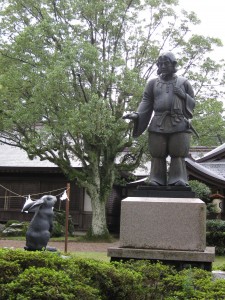
Okuninushi and the rabbit he rescued

There are two other famous legends about Okuninushi.  One has to do with the white rabbit of Inaba. It used to live on the island of Oki and tricked some sharks into letting it jump over their backs to the mainland.  The angry sharks took revenge by skinning the rabbit.

it so happened that Okuninushi and his band of brothers happened to be passing through Inaba at the time, when they came upon the rabbit. The brothers had fun by telling the rabbit to go wash in the salty sea.  Okuninushi oin the other hand took pity on it and suggested fresh water and a covering of soft cattail.  This proved effective and the rabbit was cured.

In gratitude the rabbit became an ally of Okuninushi, aiding and protecting him in his future travails.  It serves now as his familiar.

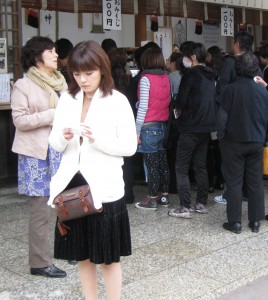
Young woman eagerly checking her fortune slip while others queue

Another story tells of Okuninushi escaping persecution by running to the underworld, where he met and fell in love with Susanoo no mikoto’s daughter, a princess called Suseri-hime. Susanoo put him to the test with a roomful of snakes, which he survived thanks to a blue scarf Suseri had given him.  Further tests followed, which again he survived thanks to other scarves supplied by Suseri-hime.  When Susanoo showed no intention of letting up, the lovers escaped back to Izumo where they built a palace, married and lived happily ever after.

The happy marriage with Suseri-hime led to the tradition of ‘enmusubi‘ (good connections) for which the shrine is famous. It means there are always young girls around, eagerly reading fortune slips and purchasing love amulets. Of all the wedding halls in Japan, that of Izumo is said to be the most highly prized.

(Incidentally, an archaeologist at my university suggested the association of Okuninushi and enmusubi arose from his role as host to all the other kami of Japan.  During the many meetings they hold, Okuninushi takes the prime role in networking and making important connections between them.)

There’s one further aspect to Okuninushi, for he became conflated with one of the seven lucky gods called Daikoku.  Why?  Simply because the reading of the Chinese characters is the same in both cases. Daikoku is a pot-bellied deity who carries a sack on his back, promising a financial windfall for those who beseech him. Go to Izumo Taisha then, and fortune may well lie in store for you – in more than one sense!

Lining up beneath the trademark Izumo shimenawa, symbolic of the 'knot' that Okuninushi ties between people

************************************************************************************************************************************************

For some stunning photos of Izumo Taisha, see ojisanjake’s blogspot.
Information for this article drew on Joseph Cali’s forthcoming Guide to Shinto Shrines

« Older posts Newer posts »

© 2026 Green Shinto

Theme by Anders NorénUp ↑