Author: John D. (Page 178 of 202)

Rethinking life, rethinking Shinto

Satish Kumar, eco-activist and editor of Resurgence

This evening I went to a talk by Satish Kumar, whose magazine Resurgence I used to subscribe to in the 1970s…  ah, those heady days of youthful idealism!  Unlike others, Satish still keeps the faith and continues to proclaim a message of eco-spirituality to all who will listen.

Born in India, he joined the peace movement and walked over 8000 miles for two and a half years as part of an anti-nuclear campaign.  He has been a Jain monk as well as a founder and teacher at Schumacher College in Devon dedicated to holistic science and ecology.

Change yourself, change the world
In Japan Satish has quite a following, and over 300 people were packed into the hall to watch a film and listen to him talk.  He spoke of the need to rethink the way we are living in order to have a more balanced, wholesome and fulfilling lifestyle in harmony with nature.

‘Become the change that you want to happen,’ was his central message, and one practical step he advised was to begin by looking at the meals you eat.  If the food there was healthy, local, free of cruelty and chemicals, then it was good for you and good for the planet.

During the question time one of the many Japanese who queued up to ask was a young man training to be a Shinto priest.  How could communities get control of their lives, he wondered?

By way of answer, Satish Kumar first of all spoke of Shinto as a ‘nature religion’ and its potential in meeting the needs of the age.  He then suggested that Switzerland provided a model democracy in the sense that power was located close to the grassroots while the central authority was relatively weak.  Could anyone name the Swiss president?  The answer, unsurprisingly, was no, and this was because in Satish’s opinion the president was relatively unimportant.  Swiss cantons were more or less self-governing.

Harnessing the power of youth
In response to another question about Japanese youth, Satish responded by saying that as a nation people here generally had less ego than other countries, which was good.  Yet while the humility was admirable, the tendency to passivity was a danger and young Japanese needed to be more active in fostering change.  For example, the Japanese flag carried an image of the sun, and sun power, not nuclear power, should be the demand of its people.  This brought a round of applause.

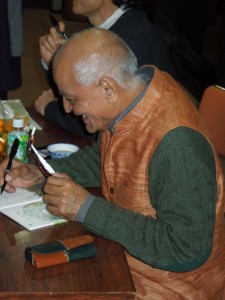
Afterwards I got to chat with the budding priest, who is about to obtain his licence from Kogakkan University before heading off to work at a shrine in Kumano. His interest in alternative lifestyles and environmental matters was clearly taking him in a direction different to the conventional Shinto priest, and we agreed that there may be a generational shift taking place.  He hopes to visit Schumacher College in Devon, which may well put him in the vanguard of the green movement in Japan.

It was an inspiring evening.  Those waves of energy from the 1970s seemed to be lapping at the shores of contemporary Japan, and I came away from the meeting with a sense of renewed hope for the future.  Soil – soul – society was Satish’s motto for change.  Could Shinto not add to it another ‘s’ ?
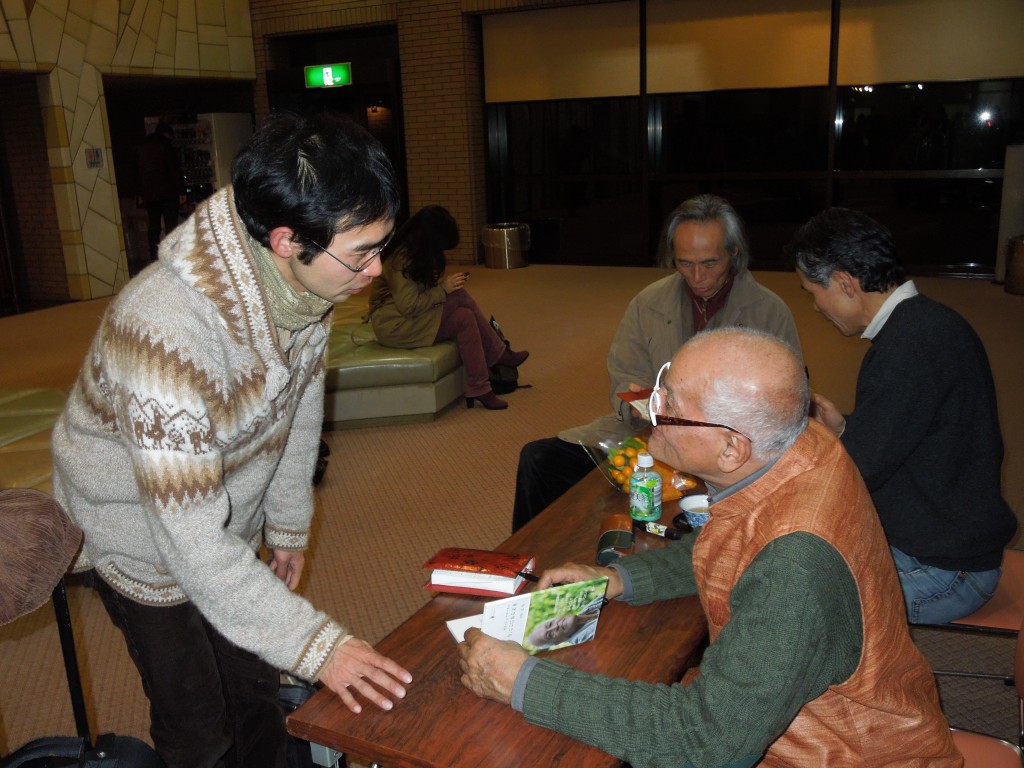
A future priest takes advice from an eco-veteran


For more about Satish Kumar and Resurgence, please see http://www.resurgence.org/satish-kumar/
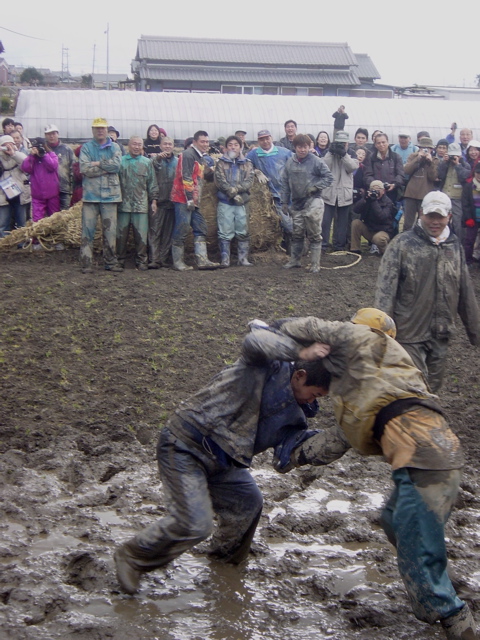
Fertility Festival (Tsunakake sai)

With spring comes a rash of fertility festivals, designed to further the success of the year’s crops.  These have ancient origins and go back to a time when the very existence of villagers depended on the success of the harvest.  In a country of unpredictable weather and constant disasters, beseeching the help of the kami was a matter of vital importance.

With the Meiji Restoration of 1868, many of the old fertility practices were banned or frowned upon.  Still today there are Japanese who shun or are ashamed of them, particularly among the urban sophisticated who look down on such ‘primitive’ lewd customs of the past.  Those in the countryside though have no such inhibitions and are more in touch with the raw essence of life.  It is here that one can find age-old rites still being carried out in the manner of their ancestors.

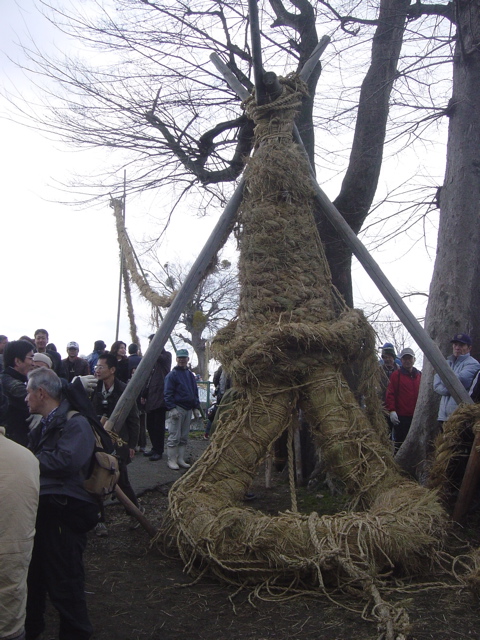
One such festival happens every year on Feb. 11 in the Yamato basin near Omiwa Jingu, when two neighbouring shrines hold a joint festival.  The male kami of one shrine is symbolically coupled with the female kami of the other by the use of phallic and vaginal shaped rice ropes.

Before the coupling, the kami are entertained, as you can see on the right, by sumo wrestling in the as yet unplanted rice paddies.  It’s a muddy affair!

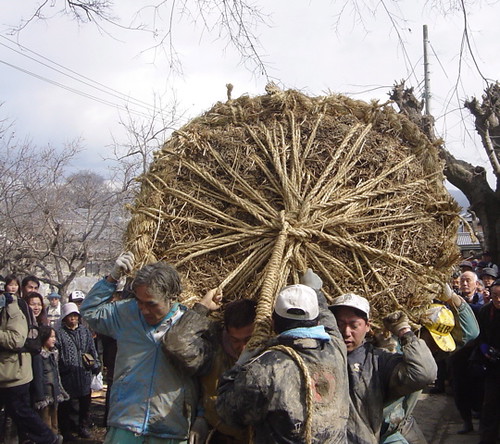
Following this the female symbol is dragged from the neighboring field, borne on the backs of several stalwart men.  It has a long tail and the weight makes it difficult to manoeuvre, but eventually it is brought to where the male lies waiting.  In the picture below you can see it being raised up into the air between the branches of adjoining trees.


The next stage of the operation involves hauling across the giant phallus, which as you can see from the strained faces of the villagers in the picture below requires a great deal of effort.


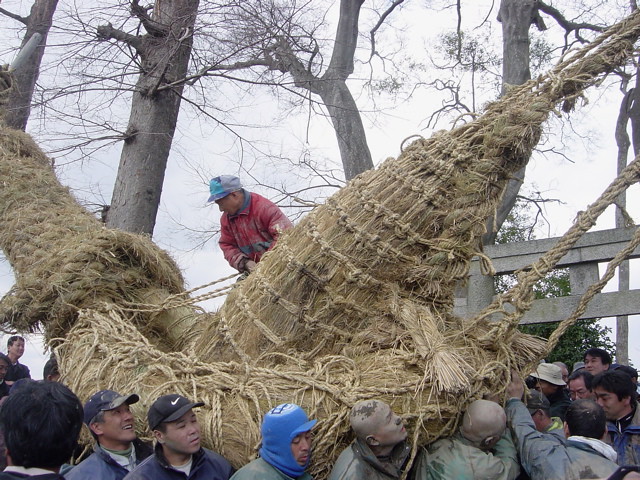
Following the arrival of the giant phallus comes the climax of the proceedings, when it is inserted into the female (see below).  Once it is in position, it has to be secured by winding the rice rope attached to it around and around the two objects, which is why one of the smaller villagers in the picture below has to climb on top.  The whole operation takes quite some time and no little skill, with lots of shouting, instructions and good humour.


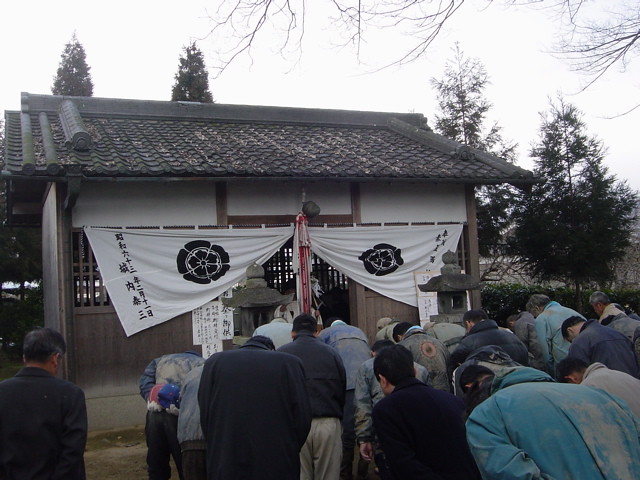
The closing rite of the festival takes place at the village shrine in honour of the presiding kami, Susanoo no mikoto.  Given his wild nature and outrageous behaviour in the mythology, he makes a suitable patron for the Pan-like shenanigans done in his name.  Hopefully he will see fit to provide a good harvest for this year also!

Fertility festival: service afterwards

Tohoku memorial service

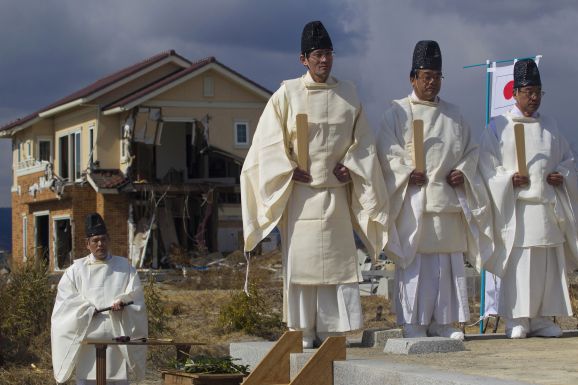
Today’s Japan Today carries a lead picture of a memorial service held in the nuclear exclusion zone in Tohoku.  (photo courtesy of AP)


Shinto priests hold a memorial ceremony in the abandoned town of Namie inside the 20-km nuclear exclusion zone around the Fukushima Daiichi nuclear power plant, on Sunday. A group of former residents returned to the area for the day to hold the ceremony at the site of the ancient Kusano shrine that was destroyed by the March 11, 2011 tsunami.

When did Shinto begin?

The origin of Shinto is a hot topic, because it determines how one views the religion.  Is it a uniquely Japanese affair which has continued since ancient times, or is it an invented tradition which has been constructed to serve the ends of the ruling class?

When did Shinto begin?  Here are seven possible answers.  Take your pick…

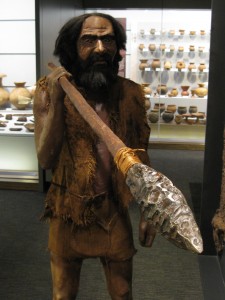
Jomon man (Kokugakuin University Museum)

1) Jomon Period.  (c.10,000 BC – 300 BC)

Some commentators see links between the spirituality of ancient Jomon people and Shinto animism. Clay figurines of pregnant women may have been used in fertility rites. An archaeologist at my university, who specialises in Jomon religion, believes there was a form of ancestor worship (based on their family burials).

This viewpoint is particular popular with traditionalists, who see Shinto as an indigenous faith which has existed in Japan since time immemorial.  ‘Shinto is the traditional faith of Japan, with a history extending from remote antiquity to the present,’ writes Umeda Yoshimi, director general of the International Shinto Foundation.  State Shinto maintained mythical Emperor Jinmu founded Japan in this age in 660 B.C.

2) Yayoi Period. (c.300 BC – 250 AD)

This may be the standard view, since it’s said that Shinto is based around wet-rice cultivation which was introduced to Japan in this age.  Rice, rice-rope and rice wine remain essential components of ceremonies, and many of the most important rites and festivals celebrate the planting or harvesting of rice.  The notion of kami moving down from the mountains in spring to return in autumn is also associated with this period.

The influx of influences from the continent, together with differences in body type, has led to debate about the extent to which the newcomers affected native ways and the genetic stock.

3) Fourth or fifth century.

Archaeological evidence at sites like Omiwa, Izumo and Okinoshima suggest that offerings and rituals date back to around this time.  It was most likely a time of clan kami, rock worship and temporary shrines in clearings.  The shamenness Himiko lived in the mid-third century, and not long afterwards the Omiwa court flourished with worship at its sacred mountain.  It was the nucleus of the emerging Yamato kingdom, whose religious practice was to shape what is now known as Shinto.

4) Sixth century

The arrival of Buddhism in 537 brought awareness for the first time of a native tradition.  Up to this time there had been a range of diverse practices, including shamanism, fertility rites, kami worship, nature deities, exorcism etc. There was no sense of commonality.  However, the arrival of foreign deities threatened traditional practices and native deities, which were championed by the Mononobe and Nakatomi clans.  The powerful Soga clan on the other hand proclaimed Buddhism, and the two sides clashed at the battle of Shigisen in 587.  The victory of the Soga led in 604 to Prince Shotoku’s 17 Article Constitution, which cemented the country as Buddhist though the emphasis on harmony made it plain that kami too should be respected.

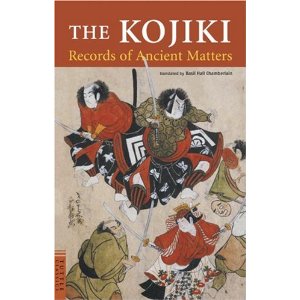
Kojiki's publication in 712 wove a coherent narrative of divine origins out of divergent myths

5) With the Kojiki (712) and Nihon shoki (720).

The first recorded use of the word ‘Shinto’ comes in the Nihon shoki, where it is used to differentiate the native traditions from Buddhism.  It followed a coup in 672 by Emperor Tenmu, who usurped his nephew and then sought to legitimise his power by investing the ruler with spiritual authority.  Mythologisers were ordered to compile histories which would show the emperor’s divine lineage, together with that of the clan leaders who supported him. It led too to an official hierarchy of shrines organised under imperial patronage.  It was around this time that comes the first usage of the title ‘tenno’ (emperor).  The centralisation suggests the beginning of an organised religion, though it’s argued that this only affected the small court circle and did not affect the population at large.

6) Medieval times.

In recent years the notion has been gaining ground that a self-conscious ideology called Shinto only emerged in medieval times.  The view has been championed by John Breen and Mark Teeuwen in their book A New History of Shinto, in which Yoshida Kanetomo (1435-1511) is credited with being the first to articulate a theory that could be in any meaningful sense be called Shinto.  It was in this age too that other theoretical forms of Shinto emerged, such as Watarai Shinto.  The argument here is that previous to this there was no consciousness of identifying with something called Shinto.

7) Meiji times.

The scholar Kuroda Toshio argued forcefully that Shinto as we know it today was a Meiji-era invention, and that previous to that no independent religion but rather a Japanese form of Taoism (in ancient times) and a form of esoteric Buddhism (after the Heian age).  Such was the case during the Edo period, when most kami worship was carried out by Buddhist priests.  With the Imperial Restoration of 1868 politicians decided the country needed a state religion in the manner of Western countries, which were bolstered ideologically by Christianity.  The government decided therefore to separate Shinto from Buddhism, despite more than a thousand years of integration.  Shrine-temple complexes were divided, Buddhist items removed from shrines, and priests forced to choose to be either Shinto or Buddhist.  Syncretic practices like shugendo (mountain asceticism) were banned altogether. The emperor was championed as supreme spiritual authority, and the imperial link with Ise was cemented by Emperor Meiji making the first visit since the time of Empress Jito in 692.

Sourcebook in Shinto (Book Review)

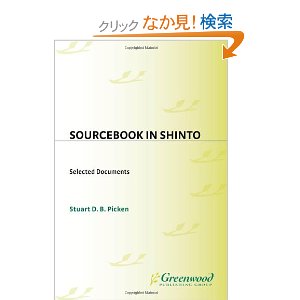
Sourcebook in Shinto: Selected Documents by Stuart Picken  (Resources in Asian Philosophy and Religion) Westport, CT: Praeger, 2004    Hardback 399 pages.  $165.00.

Ian Reader, author and academic, said of Stuart Picken’s Essentials of Shinto that it was the worst book on religion he had ever come across.  There were times in reading through Picken’s Sourcebook in Shinto when I knew exactly what he meant, for this most valuable resource of primary documents is accompanied by a commentary that exasperates as much as it illuminates.  It’s a great shame, for Picken has rendered English speakers a tremendous service by delivering such a vital collection of writings through the ages.

The first quirk of the book is the bizarre ordering of the material, to which there appears little rhyme or reason.  The chapter on State Shinto, for instance, comes before that on Nativism which led up to it.  This goes along with some surprising selection decisions.  Despite the comprehensiveness, there’s no section on Yasukuni which has been a key issue for Shinto in the postwar period.  Picken argues that it has been covered elsewhere, though his one-sided partiality elsewhere suggests rather he is loathe to include something so controversial.

Annoyingly the primary texts are not allowed to speak for themselves, but are constantly cast in the light of the editor’s prejudices and preferences.  Some are otiose, such as when he claims one of his own books as a landmark in foreign writings about Shinto, while denigrating the work of a rival as that of an amateur.  And the book is marked throughout by a view of Shinto that is best described as traditional – a uniquely Japanese religion that has existed since time immemorial.  In their recent book on Shinto, Breen and Teeuwen identify the beginning of the religion with the fifteenth-century Yoshida Shinto; for Picken, by contrast, it was ‘rehabilitating the indigenous cult and restoring the prominence it had once enjoyed in ancient times.’  Contemporary scholarship would find that problematic, to say the least.

But it is the political slant of Picken’s commentary that proves the most irksome, for he acts as apologist for Japan with the kind of arguments that typify right-wing nationalism.  There is not a single mention of Japan’s victims in WW2 yet he dwells on the dignified role of the nation as victims of the atom bomb.  He excuses the emperor as powerless to affect the war (which is a falsehood), and he makes an astonishing attack on Helen Hardacre by claiming that her well-received book ‘leans towards a conspiracy theory whereby somehow or other, a scenario may exist in the minds of some Japanese to establish State Shinto’.  Later however Picken scores a spectacular own goal by himself writing of ‘the tendency in certain government circles to appear to favour the restoration of State Shinto’.

Worst of all, Picken goes so far as to defend Japan’s reluctance to apologise for war crimes in WW2 by claiming ‘Wrongs cannot be righted by apologies or by endless harping back to past sufferings’.  Only the most callous of people could argue that way, and it’s a most extraordinarily un-Christian attitude for someone who is a Scottish pastor.

In the end Picken’s commentary proves an unfortunate distraction from the wealth of valuable material.  Much of it is unavailable elsewhere in English, and for those interested an outline of the contents follows below.  It’s certainly worth having these writings to hand, though the expense will probably rule it out for most.  (You can find it as a google book here.)  Those looking for primary documents might consider the more affordable Sources in Japanese Tradition, whose scholarly commentary is a model of objectivity and restraint.  It has a generous Shinto selection too, and for those interested in a more manageable alternative to Picken’s substantial collection a review can be found here.

Contents

1 Mythology and Classic Literature
2 Early Historical and Liturgical Documents  P. 49
3 State Shinto and the Post-1945 Situation P. 87
4 The Imperial Household and Shinto P. 123
5 Sect Shinto and the New Religions P. 143
6 Shinto Thought to the Meiji Restoration  P. 163
7 Early Modern Western Views of Shinto P. 227
8 Early Modern Japanese Views of Shinto p.247
9 Contemporary Western Discussions of Shinto  P. 269
10 Contemporary Japanese Expositions of Shinto P. 315
List of Imperial Incumbents P. 349
The Misog Ritual P. 355
The Association of District First Shrines Ichinomiya Kai P. 365
Selected Bibliography P. 379
Index P. 395


The circular mirror: Shinto symbol

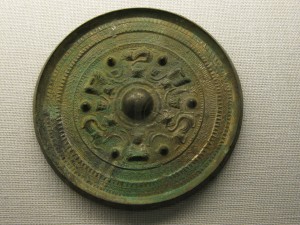
Back of an ancient bronze mirror, in the past a precious item and symbol of authority

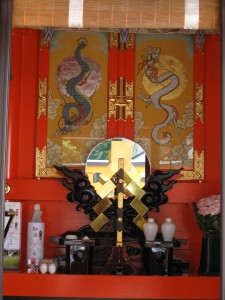
The circular mirror of Shinto is a potent symbol.  One often sees it when visiting shrines, where it stands on the altar as representative of the kami.  It can play a more vital role too, for it sometimes functions as the ‘spirit-body’ (goshintai) of the kami.  The idea is that the spirit enters into the object to take physical form.  The mirror thus acts as an interface between the physical and spiritual realms of existence.  What could be more appropriate for the meeting between them than the illusionary nature of a reflecting mirror?

Japanese mythology claims that the original ‘spirit-body’ was that of Amaterasu, the Sun Goddess, who gave a circular mirror to her grandson, Ninigi, when he descended to earth.  It had been used previously in an elaborate ruse to lure her out of a cave in which she was hiding.  Her absence had plunged the world into darkness, and to tempt her out she was told that there was another goddess as beautiful as herself.  The mirror was held up so that when she peeked out she was greeted by her own radiance, and the momentary hesitation allowed a rope to be tied across the cave entrance so as to prevent her from re-entering.  Sunlight was restored to the world.

Later when Amaterasu decreed that a mission be sent down to earth from the High Plains of Heaven, her grandson Ninigi-no-mikoto was chosen to lead it.  Before he departed, she presented him with the very same mirror which had played such an important part in the rock-cave incident.  ‘Take this and revere it as if it were myself,’ she told him.  Within the reflecting surface something of her essence had become ingrained.

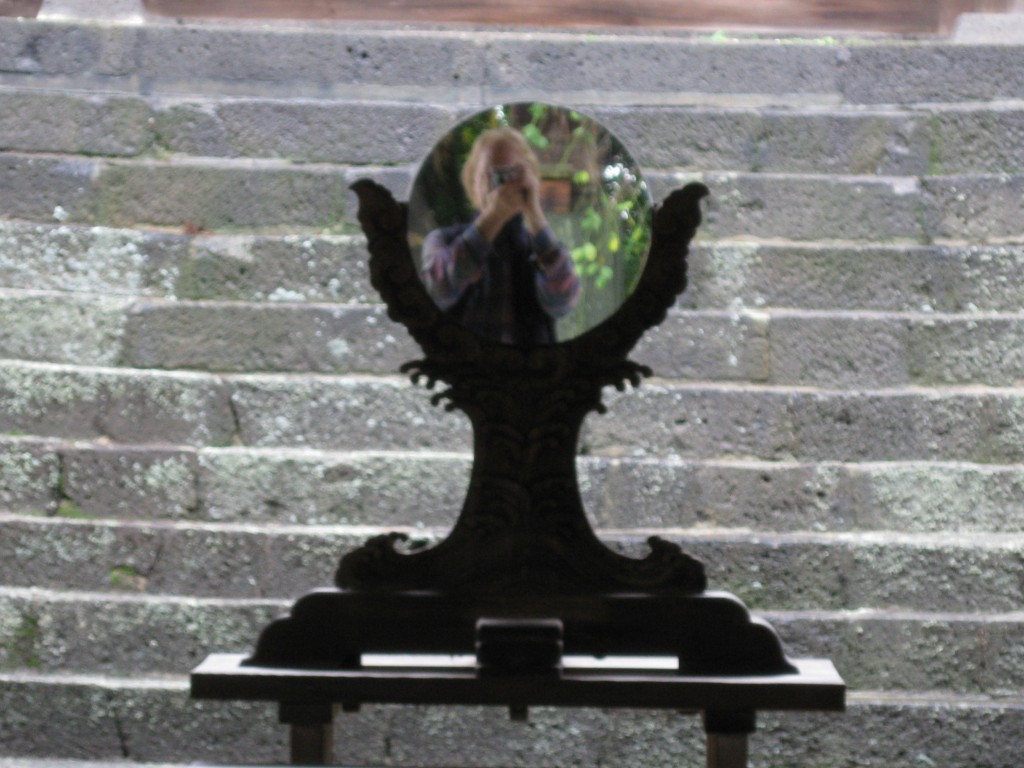
Mirror at Kuzuryu Shingu, near Hakone

According to the mythology, Ninigi passed the mirror down to his heirs, who formed the imperial line which continues to this day (the present emperor is the 125th).  For a long time the mirror was kept in the palace of the king of Yamato, the dominant state in ancient Japan, but in the early centuries of the Common Era it was deposited at Ise Jingu.  Since that time it has been kept secluded from human eye, acting as the unseen focus of worship for the millions of pilgrims and worshippers who file before it each year.  As the ancestral shrine of the imperial family, Ise is considered Japan’s premier shrine, housing the country’s holiest of holies.

The idea of a circular mirror serving as spirit of a sun goddess might well strike some as odd.  But it’s worth noting that the ancient Chinese believed the human soul to be a shining disc, a connotation that carried over to the circular mirror.  For ancient humans it  was seen as a means of spirit possession, just as some tribes in modern times were afraid of being photographed lest the camera steal their soul.  Reflection and reality were colluded, as indeed they tend to be in the mind of the observer even now.

In modern shrines the mirror that sits on the altar represents the spirit of the enshrined kami.  Purity, gratitude, awe are the feelings that it is intended to invoke.  Yet in some shrines the mirror is fixed at such an angle that when worshippers pray, they find they are looking at their own reflection. How suggestive!  People are praying to themselves!  But it’s not a case of worshipping your own ego so much as worshipping the divine within yourself.  As the children of the kami, humans too are part of the divine order and live in a sacred world.  It’s this life-affirming assertion which is part of the appeal of Shinto.

The altar mirror reflects another world

Robots – a Shinto connection?

Our friend, Christal Whelan, has written an interesting article for Daily Yomiuri about the Japanese fondness for robots. The positive attitude of Japanese towards robots contrasts with the suspicion towards them in Western culture, where they are often depicted as a threat to humanity (think 2001).  Japanese manga by contrast are more likely to view them as cute and helpful.  Why the difference?  Whelan hits on an interesting idea below with the traditional notion of a spirit inhabiting objects.  It’s why there are so many pacification rituals (kuyo) for things like used needles, dolls and even old shoes.

Here’s an extract from Whelan’s article, which can be read in its entirety here.

******************

The willingness–or even desire–in Japan to coexist with mechanical beings is not solely explained by Shinto animism, often cited as the nation’s cultural basis. Nor can the impact of postwar robot icon Astro Boy account for the aspirations of humans who would readily live in symbiance with machines.

The concept of modern robots in Japan was triggered in 1924 by Czech playwright Karel Capek’s hit drama R.U.R. (Rossum’s Universal Robots), which was staged in Tokyo two years after its Prague debut. Capek used the Czech term robota, meaning serf labor, to refer to the synthetic, mass-produced factory workers in his play.

Capable of feeling emotion, these robots soon revolted against their human inventors, and eventually killed them.

However, classic Frankenstein plots so pervasive in Western narratives lack resonance in Japan, a country where the bond between an artisan and his tools has deeper, enduring roots. Tools are revered in Japan not because they are “alive,” but because they are an extension of the craftsman’s body. Through daily use, a worker infuses his tools with his soul so that they acquire a kind of life of their own.

This idea is common currency in Polynesia, where it is referred to as mana. Since a person and his tools make human livelihood possible, the product of this relationship is one of profound gratitude, a central value prevalent in Japanese culture that fosters a subjunctive mood. The tools are “as if” they are alive, but not mistaken for living things.

**************

(For an example of the Japanese propensity for robots, see the article about the role of robot seals in Japan Today about healing tsunami victims.)

High-tech fluffy seals that respond to human touch are the latest weapon in the battle against depression for survivors of Japan’s tsunami disaster.

« Older posts Newer posts »

© 2026 Green Shinto

Theme by Anders NorénUp ↑