Author: John D. (Page 154 of 202)

New year in Kyoto

New Year is such a great time to be in Japan.  Apart from all the shrine visits for Hatsumode, there are a number of ‘first events’ to celebrate the beginning of a new year.  Here is a small selection of what’s going on in Kyoto, courtesy of the Kyoto Visitor’s Guide.

Jan. 2-4
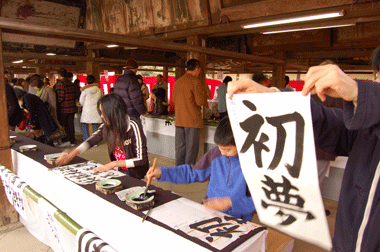
New Year Calligraphy at Kitano Tenman-gu Shrine

The deity of Kitano Tenmangu Shrine is Sugawara no Michinaga, an important court officer as well as a gifted poet and calligrapher in the Heian period; From 13:00 on the 3rd, kyogen comic theatre will be performed; People also come here during this period to write the first calligraphy of the year (50 yen /paper; 10:00-16:00); Access: Kyoto City Bus #50, get off at Kitano Tenmangu-mae; Tel: 075-461-0005; kitanotenmangu.or.jp/


Jan. 3
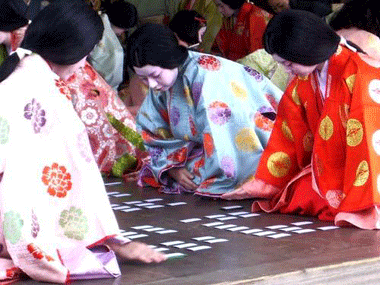
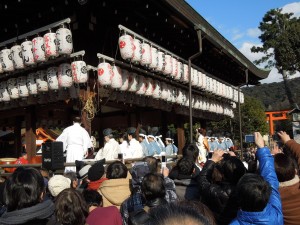
Karuta Hajime at Yasaka Shrine

At 13:00, fourteen women dressed in Heian period court costumes play karuta (a traditional Japanese card game introduced by the Portuguese in the 16th century); Access: Kyoto City Bus #206, get off at Gion; Tel: 075-561-6155; web.kyoto-inet.or.jp/org/yasaka/


Jan. 4
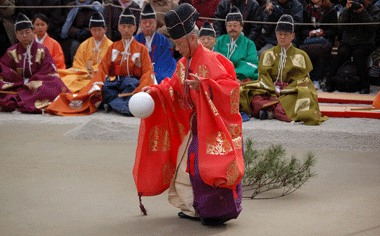
Kemari Hajime at Shimogamo Shrine

Kemari, a kind of football game dating from the Heian period is played here by men in court costumes starting at 13:30; Access: Kyoto City Bus #205, get off at Shimogamo-jinja-mae; Tel: 075-781-0010; www.shimogamo-jinja.or.jp/


Jan. 7
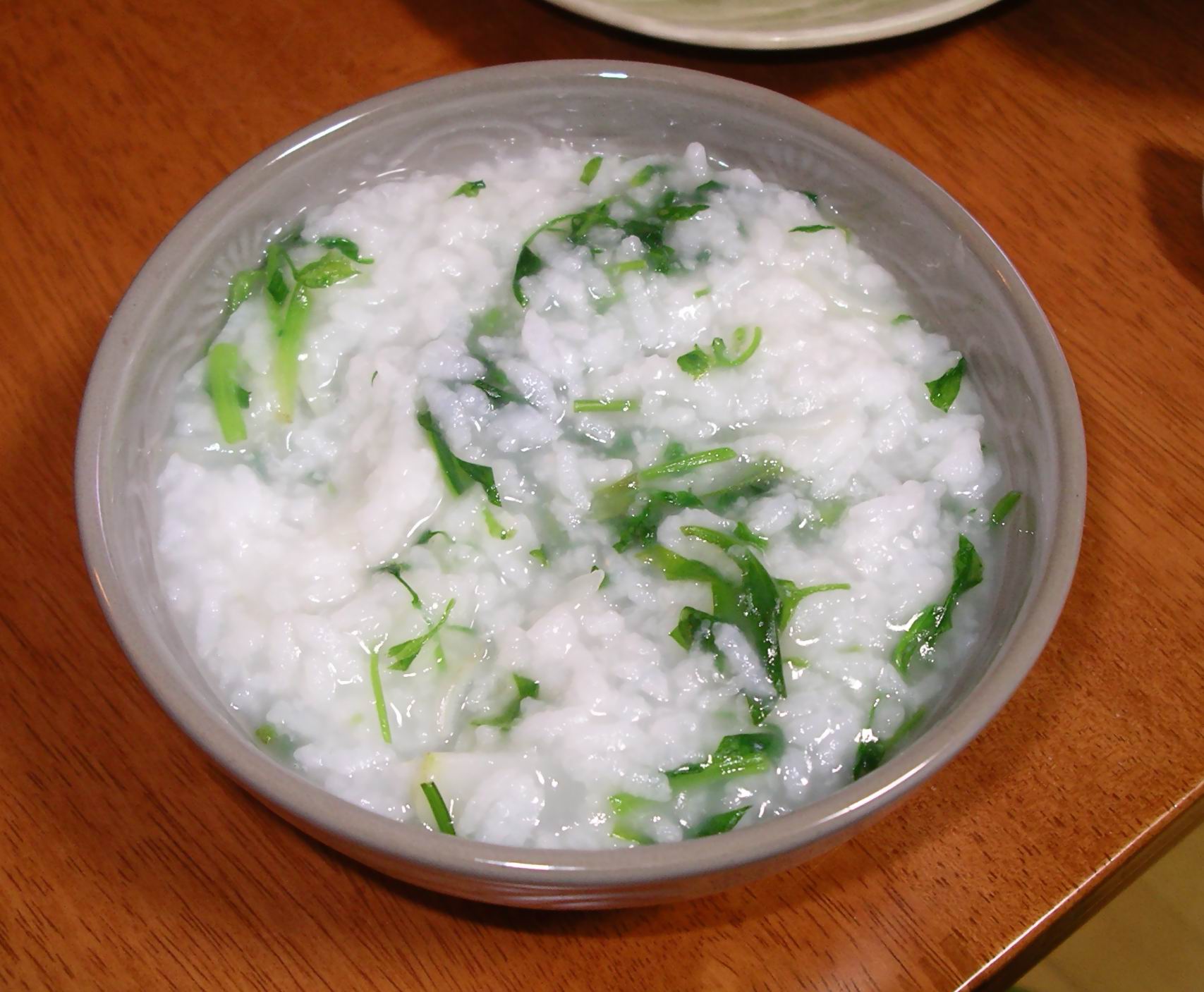
Nanakusa Ritual at Gokonomiya

On this day, from 9:00, people come to the shrine to offer seven kinds of edible grasses (nanakusa) to the deity; After the ritual, rice porridge made with the seven grasses will be offered to visitors; Nanakusa-gayu rice porridge: 300 yen; Access: Kintetsu Momoyama Goryo-mae Stn.; Tel: 075-611-0559.

Seven Japanese Spring herbs are;
① seri (セリ), ② nazuna (ナズナ), ③ gokyou (ゴギョウ), ④ hakobera (ハコベラ), ⑤ hotokenoza (ホトケノザ), ⑥ suzuna (スズナ), and ⑦ suzushiro (スズシロ).

Year of the Snake (pt 1)

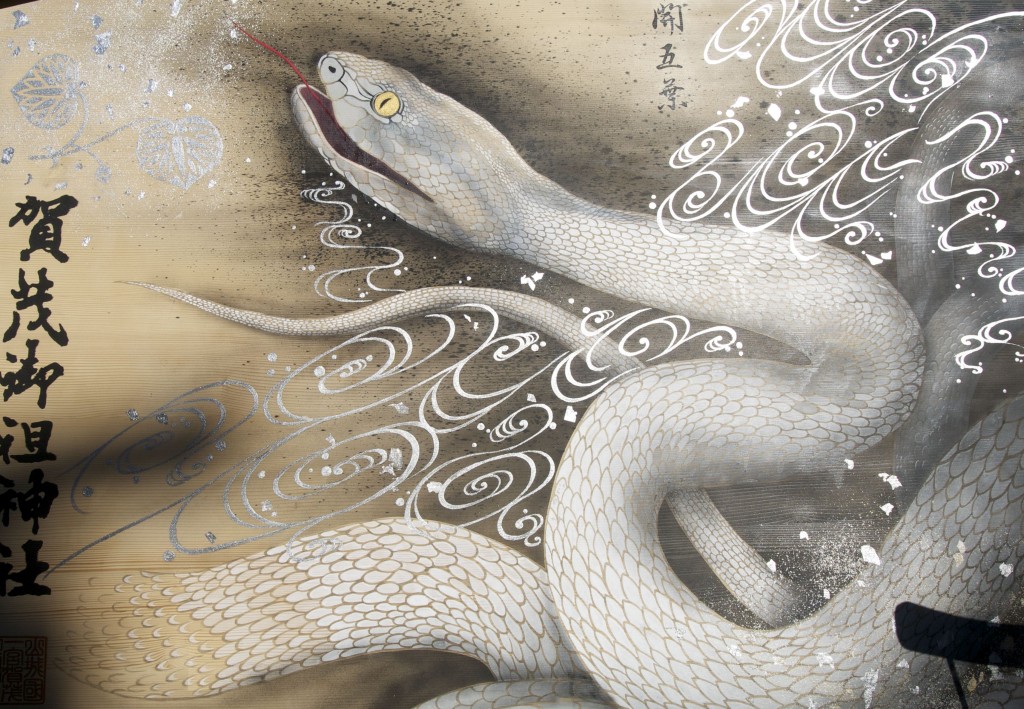
Snakes are central to many mythologies because of their ability to slough off their skin and regenerate.  Some also have the power of life and death.  In addition, the lidless eyes and unpredictable movements give them a sense of mystery.  In contrast to Christianity, which deliberately demonised the pagan symbol, the snake was seen positively in ancient times as a creature of earth wisdom.

In some cultures snakes were fertility symbols, in others they symbolised the umbilical cord, joining humans to Mother Earth.  But the most potent association was with immortality, because of the shedding of their skins. They were also seen to make a circle by biting their tails and to coil in spirals, both forms being highly significant in spiritual terms as symbols of eternity.

The caduceus motif of two snakes wrapped around a staff is thought to represent the dynamic energies of the life-force, as exemplified through the snake’s regenerative power.  As such it also became associated with sexual energy, with a male and female snake wrapped around a shamanistic Tree of Life.  In their union comes harmony and health, which may explain why the caduceus morphed into the present-day medical symbol.

The Japanese take their symbolism from the Chinese zodiac, in which the snake denotes intelligence, happiness and good fortune.  It is associated with the life-affirming dragon; indeed, many experts suppose that it is the prototype for the mythical creation.  In some places the snake also symbolizes wealth, and people carry snake skin in their wallet in the belief that it brings luck.

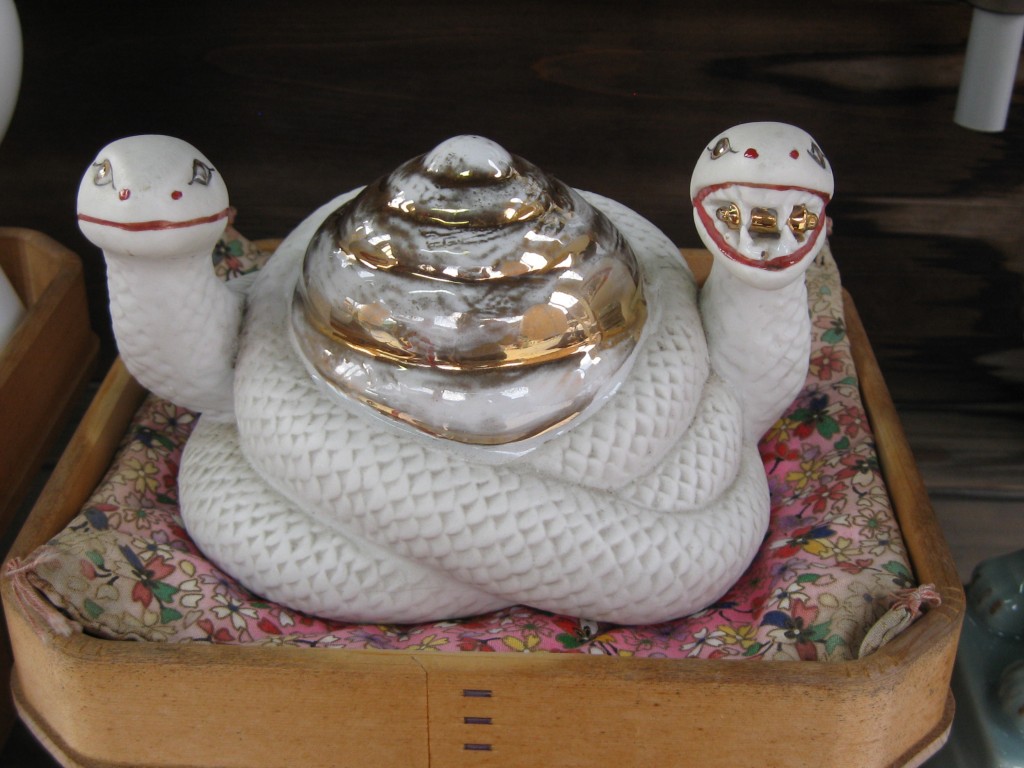
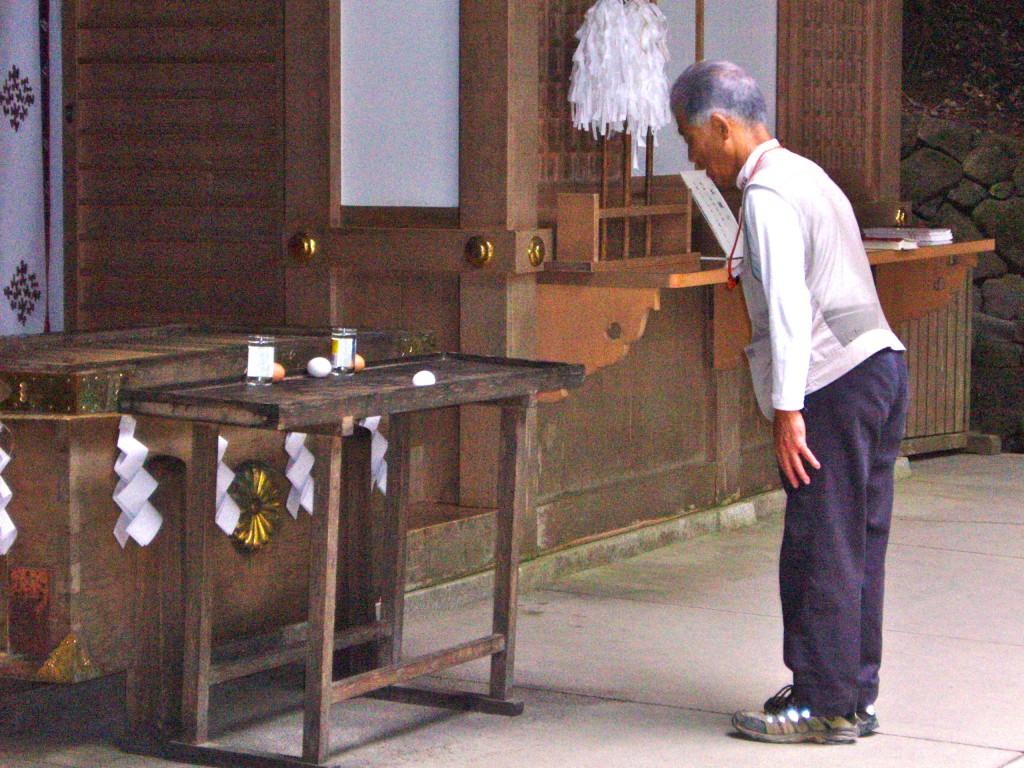
White snakes are particularly auspicious, presumably because of the rarity and association with purity.  They are the familiar of Benten aka Benzaiten, so perhaps this is a year to patronise the muse of the arts.  Or perhaps it’s a suitable year to make a pilgrimage to Omiwa Jinja, where the deity manifested in snake form and eggs are left out as offerings.

Wherever the year may take you, Green Shinto would like to wish you all a very happy – and prosperous – year of the snake!!

Paired white snakes on a container at Jisshu Shrine, Kyoto

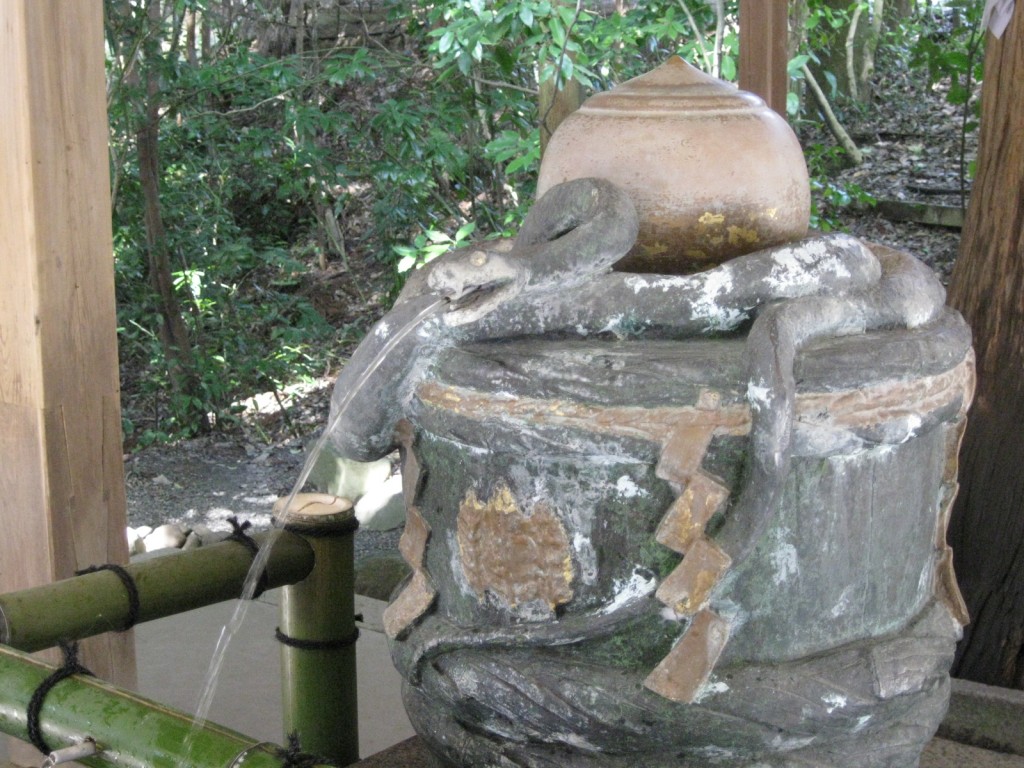
Snake water basin at Omiwa Jinja

Worship at Omiwa, with eggs put out for the snake deity

Death of the old (sacred tree)

Here is a sad update on the poisoning of sacred trees, which featured in an earlier entry.  The poisoners have not yet been caught, but the number of their crimes has grown considerably.  In the passage below, there is a description of the ritual held for the trees before they were cut down…

****************************************************************************************************

Serial tree killer on the loose in 5 prefectures
Japan Today  DEC. 31, 2012

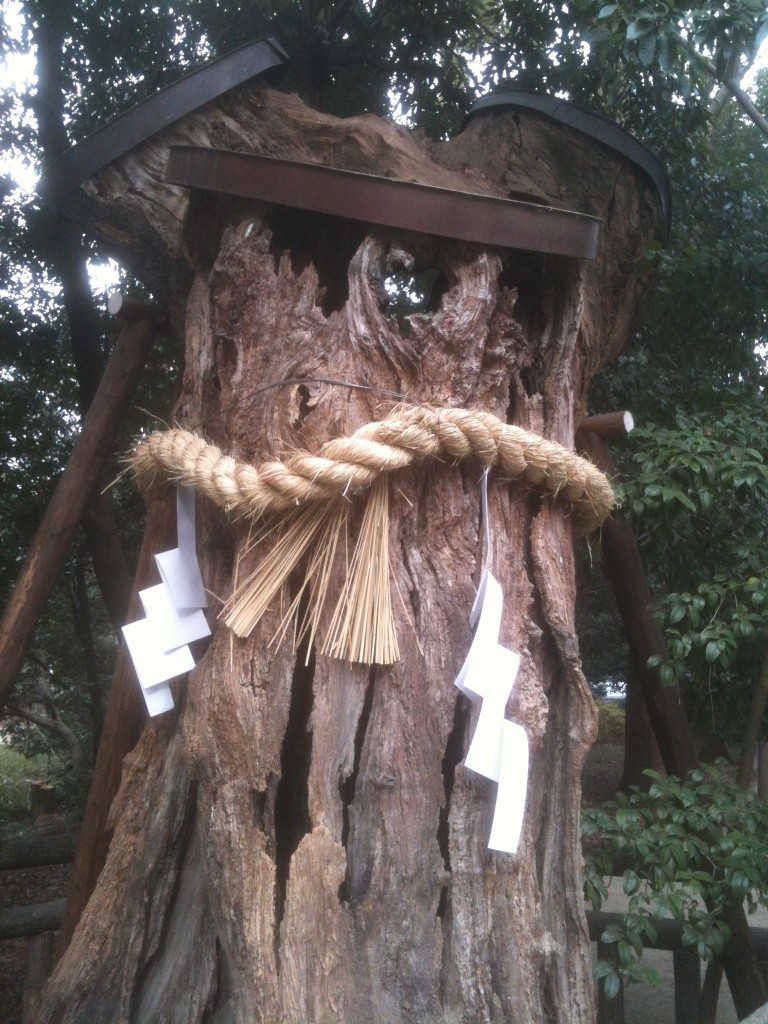
Sacred trees are usually massive in size and centuries old with some reportedly over 1,000 years old. You can usually tell them from the “shimenawa” wrapped around their trunks. A shimenawa is an extremely thick rope which encloses something holy and wards off evil from outside.

These age-old trees are beautiful specimens of nature’s strength and longevity and add an extra level of serenity to their shrines. However, in the past month, someone or some group has been killing off these sacred trees of shrines in five separate prefectures in Japan.

The So-Kawachi Daimei Shrine in Ehime Prefecture sits in the tiny remote village of Namegawa nestled in the mountainous outskirts of Toon city. It is home to a pair of sacred hinoki (Japanese cypress) trees each over 500 years old.

In September, strange holes were found around the base of their trunks and substantial withering was taking place throughout the trees. A subsequent police investigation found traces of chemical used an “arboricide” or tree poison.

After long consideration, the shrine determined on Dec 26 that the considerably weakened trees posed a risk of collapse and needed to be cut down.

The day before, the head priest and townspeople held a ritual to pray for the safe removal of the trees. The priest gave a Shinto prayer known as a norito to thank the trees for their protection of the shrine from the elements for so many years.

“For many years, these trees and I have watched over this shrine. With the trees gone, there is only emptiness,” said the head priest in a eulogy fused with frustration over someone deliberately killing these landmarks of his shrine.

He then faced the trees one last time and gave an offering of rice and salt so that their souls may be calmed. The following day, after half a millennium, the two trees came down.

As a result of this incident, the Forestry Agency conducted an emergency survey for sacred trees that died by human hands. What they found was a string of sacred tree poisonings across several prefectures west of Aichi.

Kochi Prefecture was hit the hardest with seven sacred trees killed off at shrines located in sparsely populated areas. Tokushima saw three trees die and Wakayama and Aichi prefectures each had one death. Including the twin trees in Ehime Prefecture, the toll comes to 14.

In each case, holes were drilled into the trunks at a depth of about 4 cm and a tree killing chemical was injected. The chemical could then travel up the trees’ xylem which act like veins and delivers the poison throughout the plant.

Authorities speculate that the trees were poisoned and killed in an effort to get their “sacred” lumber that would fetch an extremely high price as a building material.

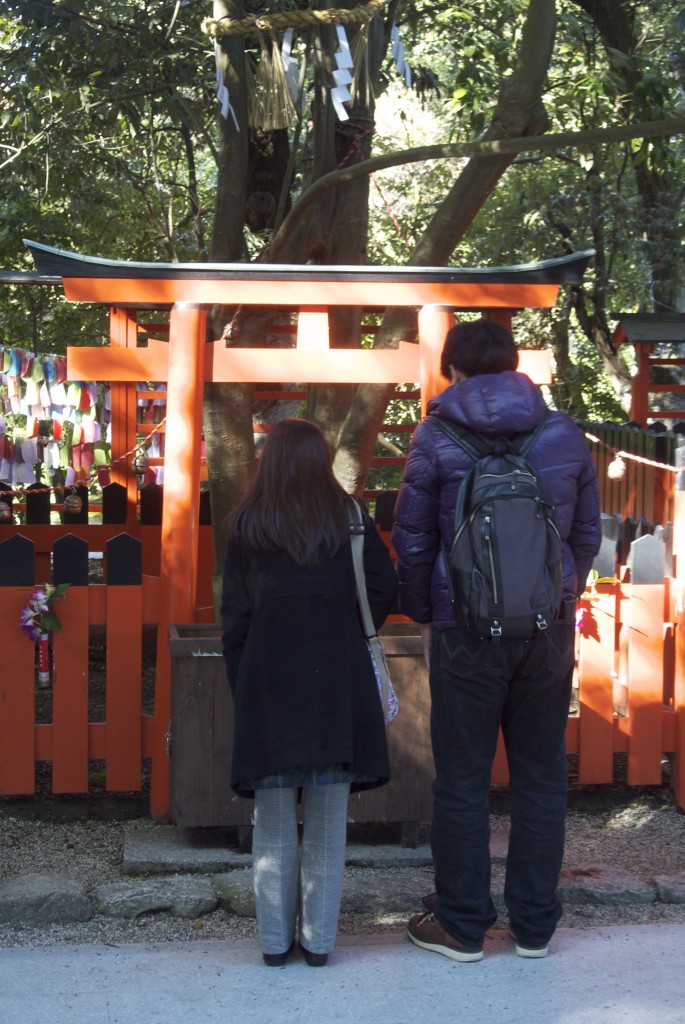
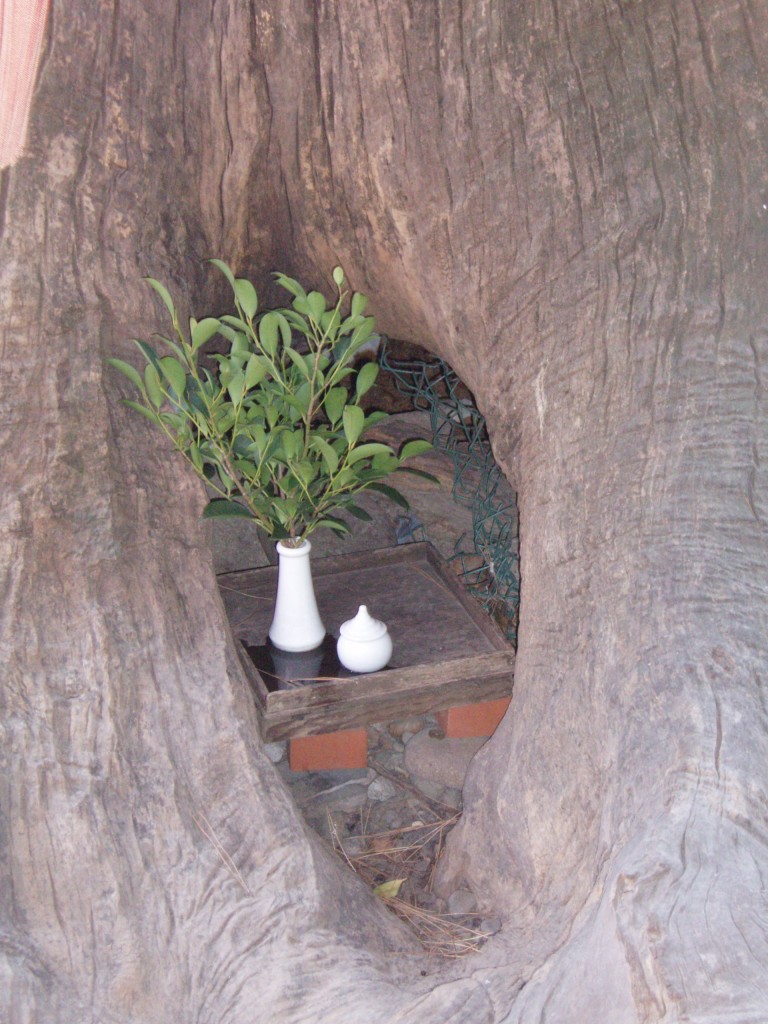
Cherishing the sacred heart of the tree

Death and rebirth

Ringing out the old

The true soul of Japan is neither Shinto nor Buddhist.  It’s Shinto-Buddhist.  Until the artificial split of early Meiji times, the country had more than 1000 years of happy syncretism.  Born Shinto, die Buddhist is still the Japanese way.

Shinto is this-worldly, concerned with rites of passage and social well-being.  Buddhism is other-worldly, concerned with individual salvation.  At New Year the two religions come together like yin and yang, either side of midnight.  Buddhism sees out the death of the old; Shinto celebrates the birth of the new.  Joya-no-kane (tolling of the bell) gives way to Hatsumode (first visit of the year).

To get the full feel of a New Year, one needs to be syncretic too.  In the dying minutes of the year, it is good to go and hear the bell being rung at a Buddhist temple.  By tradition it is rung 108 times once for every attachment that plagues the human condition.  Then after midnight one can head for a shrine to pick up arrow and amulets for protection through the coming year.

With over 3000 temples and shrines in Kyoto, we’re happily spoilt for choice.  A popular but crowded combination is Chion-in and Yasaka Jinja, where one files up the hill to watch the young priests at the temple acrobatically swing on ropes to ring the bell, before heading down to the shrine to get bamboo lit with sacred fire to take home and purify the house.

Yasaka Shrine

Personally I prefer the open space of Kurodani, where the bell booms soulfully over the nearby hillside.  Open fires give off a warm glow, which you can add to with heated sake before lining up to ring the bell.  Afterwards a twenty-minute walk leads through dark and dozing streets to the wooded surrounds of Shimogamo Jinja.  From solemnity one passes into a world of jollity.

Suddenly there are laughing voices, bright kimono, and gaudy lights.  Aspiring yakuza sell candy floss and goldfish.  Here is rebirth and the promise of new beginnings, as ‘Akemashite gozaimasu’ rings out on every side.  A throng of people toss coins over the heads of those in front into the offertory boxes, so that with the blessing of the kami this too will be a happy New Year.

Happy New Year to all the readers of Green Shinto, and many thanks for helping us get up to nearly 1000 hits a day.  Rainen mo yoroshiku!

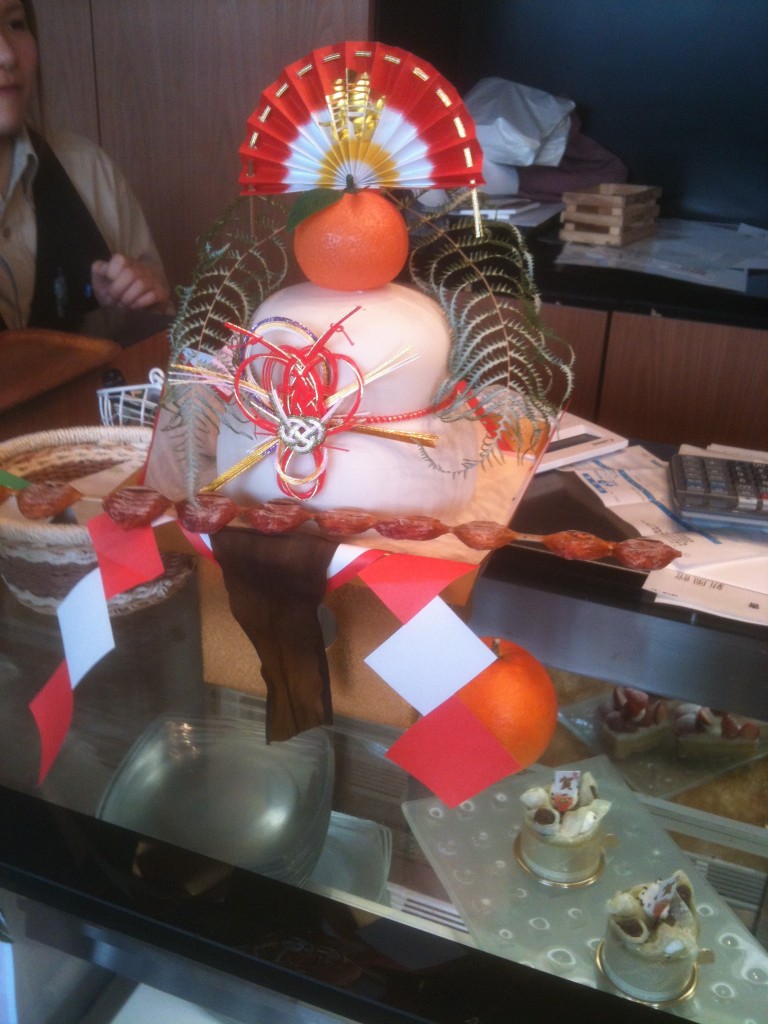
Traditional New Year decorations

Lucky Seven (Tokyo)

Friday, Dec. 28, 2012  Japan Times  By TOMOKO OTAKE

Instead of visiting one shrine, visit seven

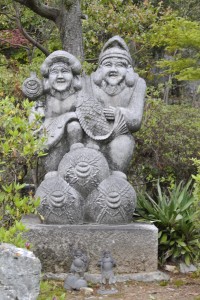
Daikoku and Ebisu

A fun thing I like to do at New Year’s is to go on a walking tour of seven shrines and temples in Tokyo. The hike is called the shichifukujin meguri (pilgrimage to Seven Lucky Gods), and there are a number of such pilgrimage options available across the nation. Each of the participating premises is assigned one of seven gods with different characters and attributes, such as Ebisu (a god of fishermen and merchants) and Bishamon (a god of warriors), all derived from Japanese mythology and folklore.

While most people visit just one shrine or temple during the New Year, this way you can cover seven at once, each with the prospects of bringing you different kinds of good luck, from monetary fortune to good health. The one I frequent is the Ebara shichifukujin in Shinagawa Ward (www.sinakan.jp), comprising four temples and three shrines.

I typically start at Oi Gongen Shrine (by JR Oimachi Station) and buy a shikishi (a square piece of paper) there for ¥1,500, which has names of the seven shrines and temples you need to visit on it.

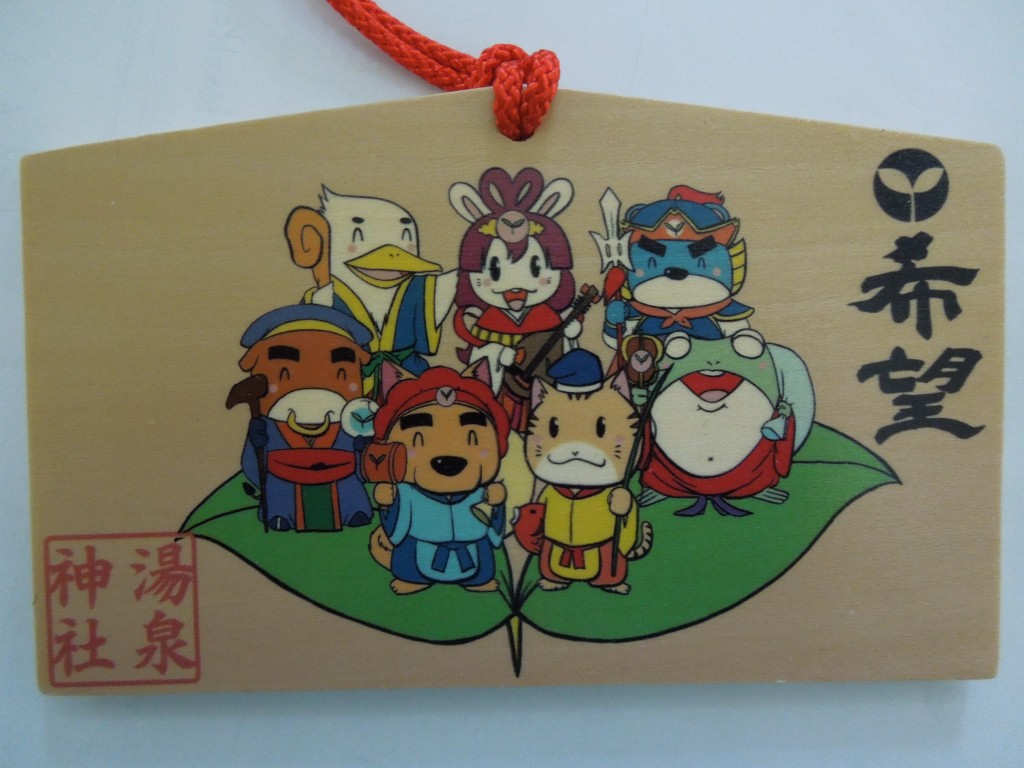
The entire route is about 6 km, or a 20-minute stroll from one stop to the next, during which you collect stamps from the shrines and temples on the paper. Some of the establishments also give you a small cup of amazake (sweet sake) or a tiny bag of sacred rice. When you cover them all, you show the card with seven stamps to officials of whichever shrine/temple you are at, and they will give you an ema (a wooden plaque). You can write your New Year’s wish on it and leave it at the shrines or temples. (Tomoko Otake)

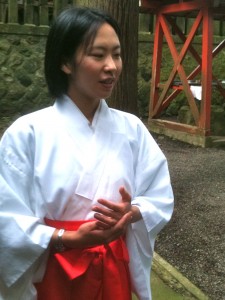
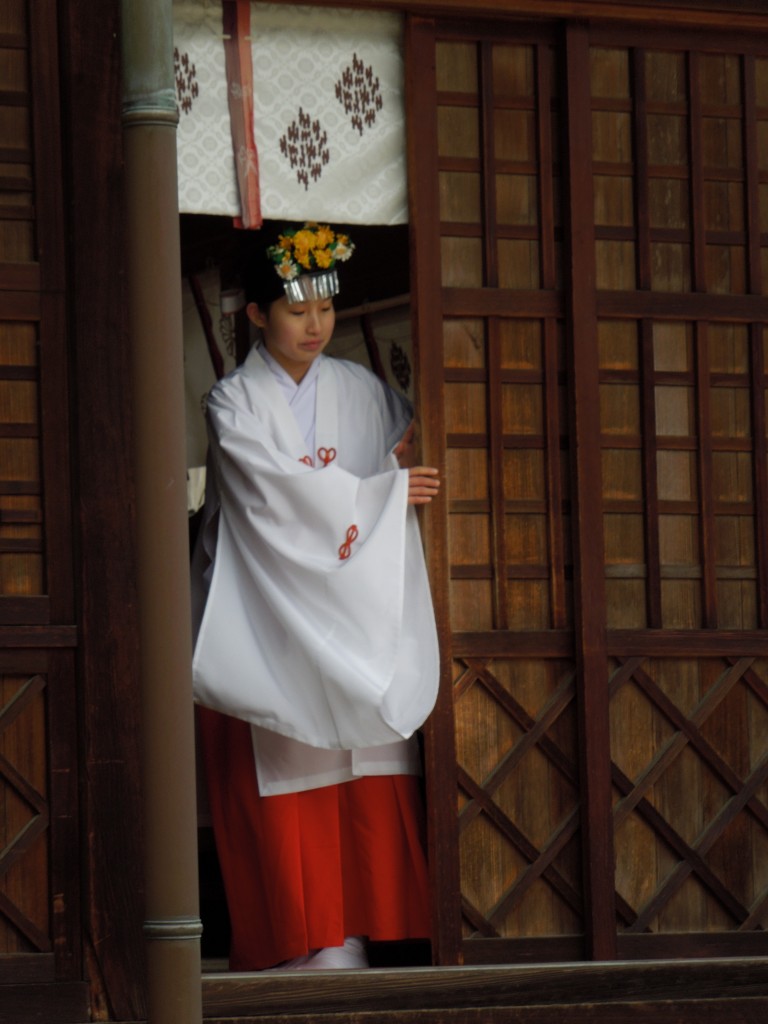
Miko fascination

That the roots of the modern miko (now a simple shrine attendant) lie in the shamaness of ancient times is well-known.  It’s generally accepted that her leading role was taken away by a Confucian emphasis on the primacy of male priests.  The famous episode in Kojiki (712), where Izanami is chastised for speaking first to Izanagi speaks of the transition in mythological terms.

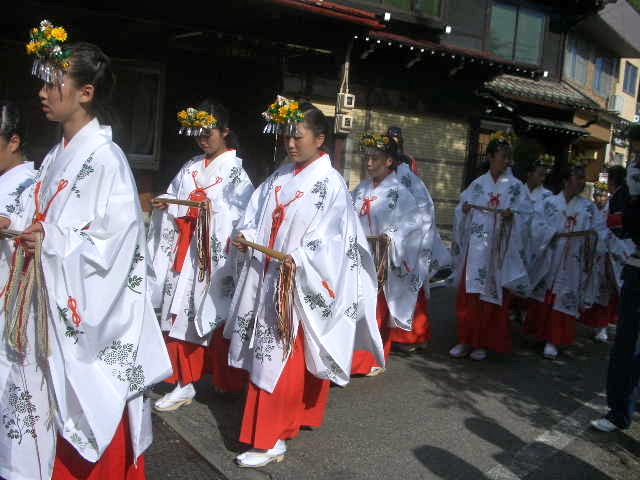
Yet despite the debasement in her role, the modern miko continues to attract attention, and she’s been taken up as a star of anime and manga.  There’s evidently something alluring about pure virginal girls dancing for the pleasure of the gods.  The stately performances speak of the elegance of Heian times and the values of an aristocratic society given to the cultivation of grace and aesthetics.

All the charms of a miko dance can be seen in this youtube video.  But I can’t help wondering about the shamanic rites that seem to underlie it.  For one thing, there’s the swirling motion, reminiscent of the sufi way to transcendentalism.  Then there are the delightful bells (suzu), which along with the more famous drumbeat can act as a means of trance induction.  Beneath the stately movements, does one not sense the frenzied moves of a shamaness struggling to be released?

As with the geisha, much of the fascination of the miko has to do with her costume.  One of my students, a perfectly ordinary girl, had a part-time job as a miko at a shrine, and I’m sure had I seen her there I would have found her transformed in some way.

The costume with its white and red speaks of the traditional symbols of happiness (hence the Kohaku – Redwhite – NHK programme on New Year’s Eve).  It’s said that white is the colour of purity, while red wards off demons and illness (which is why Jizo have red bibs).

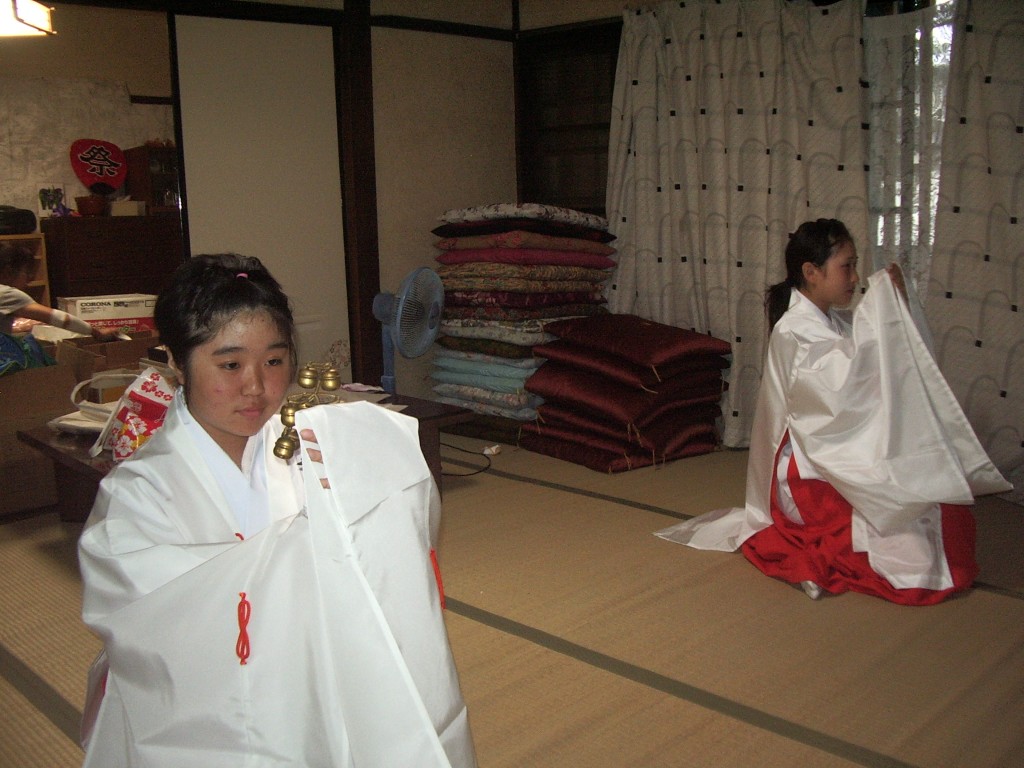
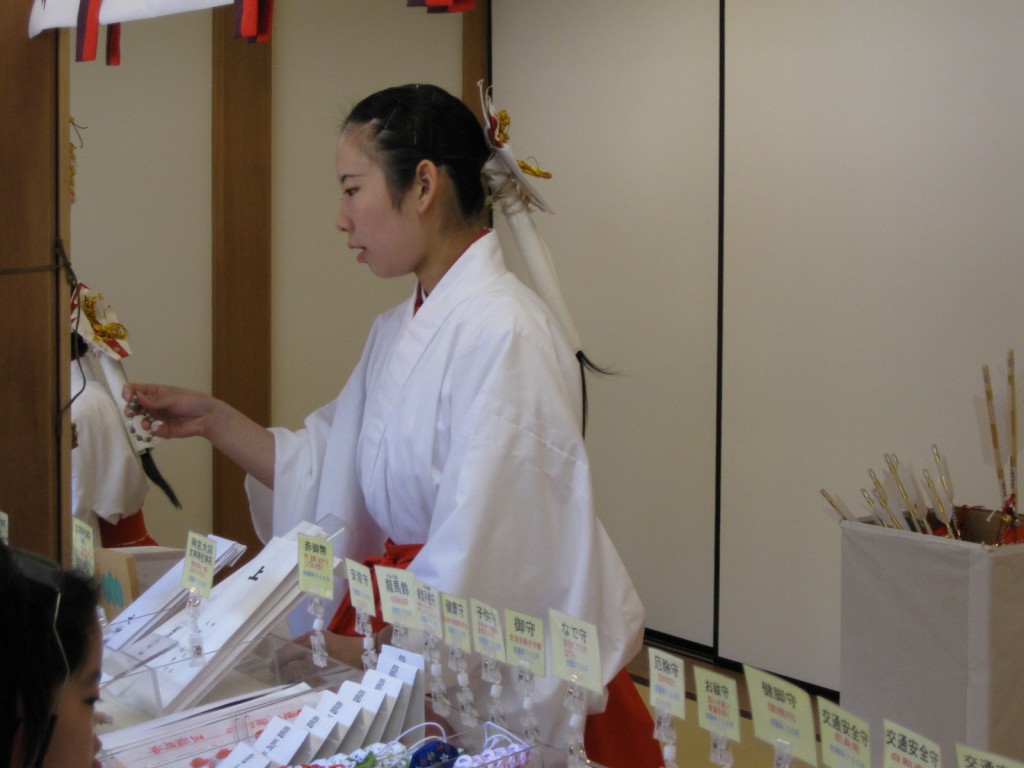
As we come up to the New Year, the miko of Japan are girding themselves up for what is going to be a very busy season.  Income from New Year sales and donations makes up a huge proportion of a shrine’s income, so you can be sure that a lot of practice to get things right will be going on during these last few days of 2012…..

Universalism

The Shimane website celebrating the 1300th anniversary of the Kojiki has a marvellous page explaining the commonalities of Japanese myth with stories found elsewhere in the world.  It’s a refreshingly global view of the mythology, which is often treated by Nativists and nationalists as if it were something special to Japan as a land of kami.  Here below is what they write, a piece which can be accessed on their website by clicking here.

************************************************************************
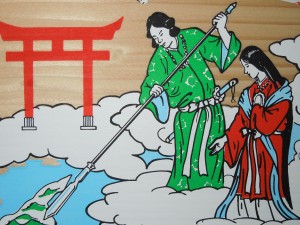
Izanagi and Izanami stirring the primal brew

Similarities to Other Mythology
Similar themes can be found throughout mythology and religion the world over. Many themes in Japanese mythology share striking similarities with other world mythology.

Let’s start with Izanami and Izanagi. The idea of the world being formless and chaotic is quite common, and Izanagi and Izanami’s creation of the world is similar to the story of Adam and Eve, in the sense that a male and female pair was necessary for creation, be it of the world itself or the people who would populate it.

After Izanami’s death, the reason she gives for not being able to go back with Izanagi is that she ate the food of the underworld. Persephone’s abduction by Hades in Greek mythology shares this idea that once food of the underworld is eaten, it affects the one who has eaten it. Because she had eaten three seeds of a pomegranate, Persephone has to spend three months out of every year in the underworld. During this time, Persephone’s mother Demeter, the goddess of the harvest , is sad and nothing will grow, which is how Greek mythology explained the existence of winter.
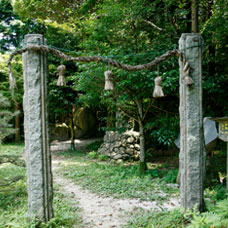
Supposed entrance to the underworld (in Shimane ken)

Izanagi’s quest to bring back Izanami from the underworld is very much like the story of Orpheus and Eurydice, although the endings differ greatly. Orpheus and Eurydice are greatly in love, but she is bitten by a viper and dies. Orpheus goes to Hades to bring her back, and through the power of his music, convinces Hades to let her go. Hades adds a condition, though; he must not look back until he has left the underworld. Just as he is about to return to the land of the living, Orpheus looks back, fearing that the gods have tricked him, and Eurydice, who had been following behind him, is lost to him forever. Both tales show examples of how men are not the most patient creatures in the world.

Worship of the sun is also a common thread, from the Greek Apollo to the Egyptian Ra. The idea that the sun and moon are siblings, as the female Amaterasu and male Tsukuyomi are, is also matched in Greek mythology in the brother-sister pair of Apollo and Artemis.

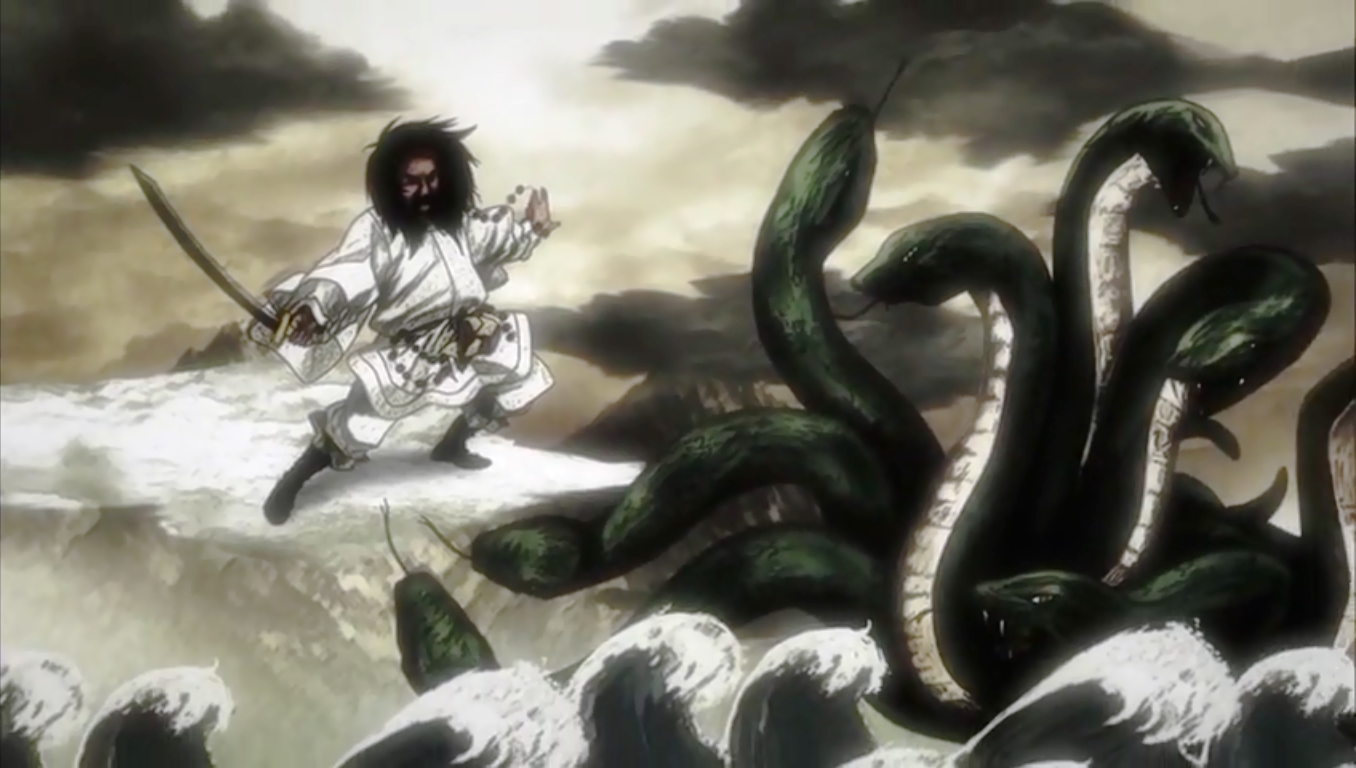
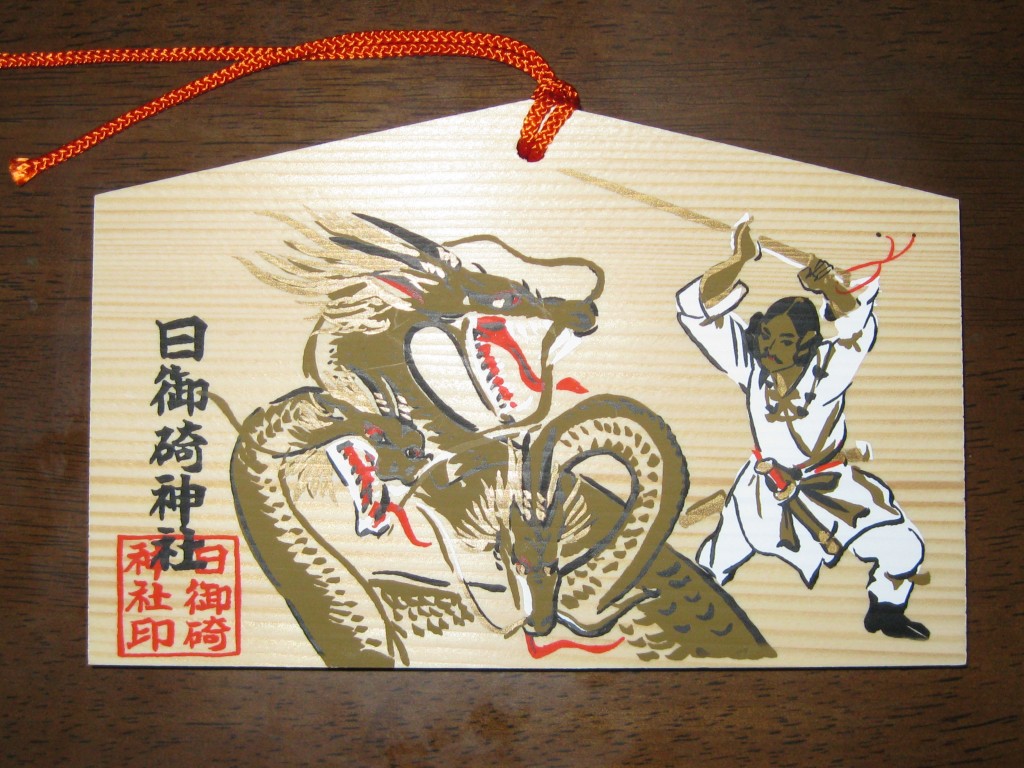
Susano-o’s slaying of the Yamata-no-Orochi can be seen as a different version of the dragon-slaying legends of medieval Europe, with Kushinada-hime as the fair maiden in distress and Susano-o as her knight in shining armor. It also matches up nicely with the Greek legend of Perseus and his slaying of a sea serpent to save Andromeda from being sacrificed to it. Perseus and Andromeda also get married after he rescues her. The Yamata-no-Orochi itself is similar to the hydra, in that they are both serpents with multiple heads.
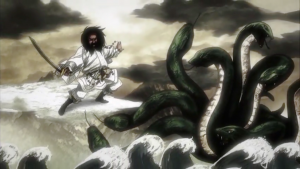
Susanoo and Yamata no orochi (courtesy Gustavo Araujo)

The testing of Okuninushi by Susano-o is similar in some ways to the trials of Hercules, in that the tests were considered to be impossible and most likely lead to the death of the one being tested. The amazing feats of strength shown by Yatsukamizuomizunu, although being on a much larger scale, also are comparable to some of the exploits of Hercules.

The Kojiki provides a record of imperial lineage that shows direct descent from the gods and establishes rightful authority to rule. This is similar to the “begats” in the Old Testament that trace King David’s lineage and show him to be the rightful ruler of Israel.

Mythology provides a window into the world view of a culture, and while each culture’s mythology has a unique sensibility to it, finding connections between world mythologies shows that maybe we’re not as different as we think.

« Older posts Newer posts »

© 2026 Green Shinto

Theme by Anders NorénUp ↑