Author: John D. (Page 157 of 202)

Fuji: Yes or no?

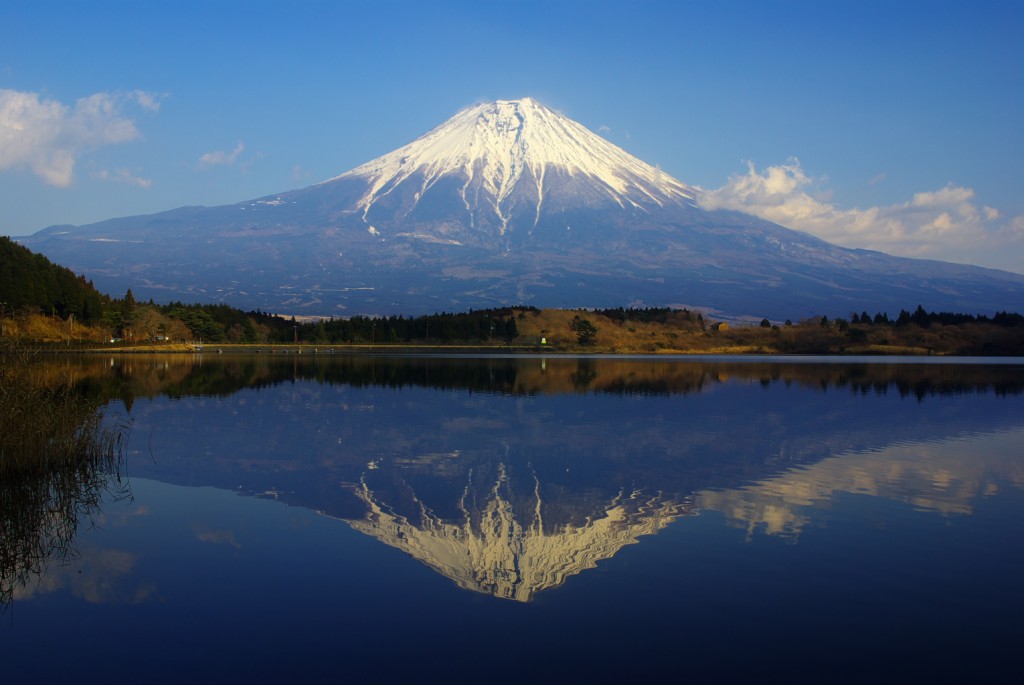
Fuji already prepared for winter, with its characteristic white cap (pic.courtesy of tanuki-fuji)


These are anxious months for Mt Fuji….   While some reports have played up the likelihood of the volcano exploding in the near future, some of the neighbouring settlements and organisations are more concerned about the announcement next June of whether its application for World Heritage status will be confirmed or not.

Fuji is a national symbol of Japan, and its religious significance is thought to extend back to pre-Yamato times when the Ainu lived in the region.  It might seem an obvious certainty as a World Heritage Site, to go along with the likes of Stonehenge and Machu Picchu, but a previous application was turned down.  One problem as the extract from the Yomiuri article below makes clear is the number of visitors, with cars and waste that has had a negative effect on the environment.

Set against the environmental damage is the cultural significance of the mountain, particularly in its guise as a Shinto kami and source of inspiration for the Fuji-ko sect.  In this respect, the shrine mentioned in the article is of particular interest.  In the coming months, as the timing of the application draws near, I hope to carry more on the subject.

***************************************

http://www.yomiuri.co.jp/dy/national/T120930002785.htm

Despite their international fame, Mt. Fuji and the ancient samurai capital of Kamakura, Kanagawa Prefecture, may not be added to the World Cultural Heritage list next year.

A decision on Mt. Fuji and Kamakura will be made at a meeting of UNESCO’s World Heritage Committee in June.

According to people concerned, however, listing the two sites may become more difficult because of stricter screening, as there are already 962 World Cultural Heritage sites.
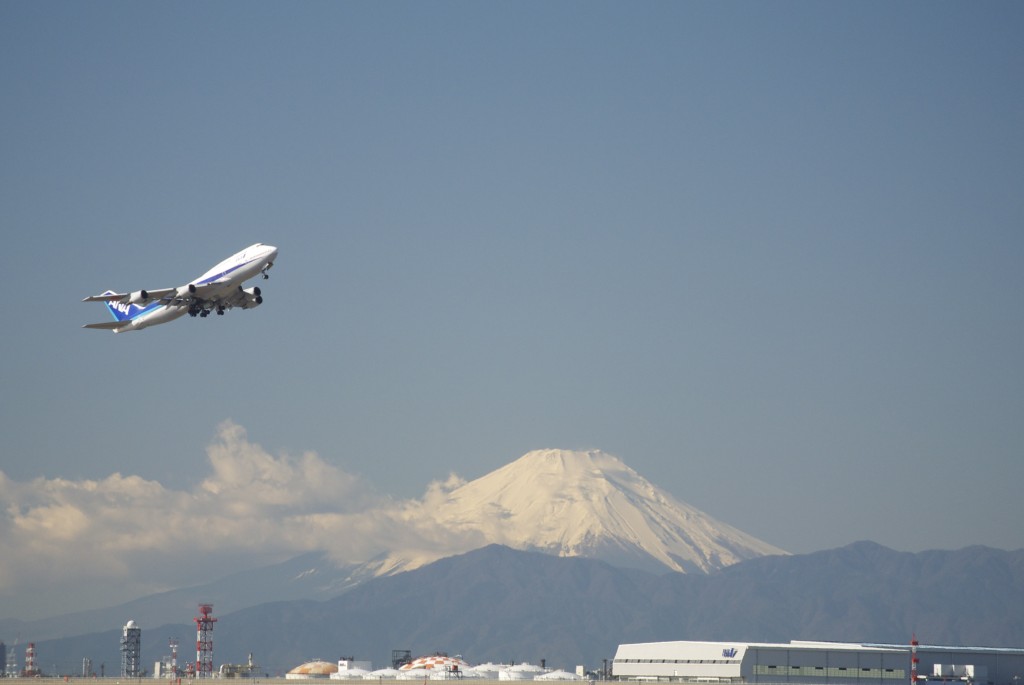
A plane takes off from Haneda airport, with Fuji in the background (photo taken this week from the Ogasawara ship in Tokyo Bay).

Mt. Fuji faces the additional problem of the huge number of climbers who trek up the mountain every year–320,000 have already climbed it this year. In a bid to have it listed, the Shizuoka prefectural government is set to toughen restrictions on the entry of cars on the mountain to curtail this massive assault on the nation’s highest peak.

Kamakura has to contend with the problem that Nara and Kyoto have already been listed. It has to prove to the committee it is somehow unique to these ancient capitals if it wants to join them on the World Cultural Heritage list.

===

UNESCO council’s inspections

In preparation for screening the application for Mt. Fuji’s listing, a Canadian architect from the International Council on Monuments and Sites (ICOMOS), an advisory body to UNESCO, carried out an eight-day inspection in early September at the foot of the mountain.

One site studied by the ICOMOS expert was Kitaguchi Hongu Fuji Sengen Jinja, a major shrine dedicated to the sacred mountain in Fuji-Yoshida, Yamanashi Prefecture.

Yamanashi prefectural government officials said they were keen on convincing the researcher that Japan’s centuries of worship of Mt. Fuji should be recognized as a “cultural heritage.”

For this purpose, the officials permitted the researcher to see such time-honored rites as “otakiage,” in which a group of mountain priests tell good and bad omens based on the falling patterns of ash from a bonfire.

The officials said they hoped this would help the researcher determine the “cultural value” of mountain worship. Japanese traditionally are believed to stand in awe of Mt. Fuji.

In Kamakura where ICOMOS research was conducted from Monday to Thursday, another researcher from the U.N. body, a Chinese architect, was given firsthand experience of “samurai culture being handed down to today” in such forms as sado, the art of tea ceremony, and Zen-related vegetarian cuisine.

Officials of the two candidate sites noted the researchers had difficulty grasping the culture and religious faith peculiar to Japan because they came from different cultural backgrounds.

The officials said they took into account the “lessons drawn from Hiraizumi,” which had to wait three years from the initial application before it joined the cultural heritage list.

The Cultural Affairs Agency promoted Hiraizumi, Iwate Prefecture, for cultural heritage listing in 2008. The effort failed mainly due to a lack of detailed explanations to ICOMOS researchers about the cultural value of the “Pure Land Buddhism” that inspired the creation of Hiraizumi’s legacy.

After that, agency officials excluded some historic sites originally included in the application for the UNESCO registration as they were considered hard to explain to foreigners.

The agency subsequently applied a second time by having the English version of application documents checked by an American researcher of Buddhism. Hiraizumi was added to the World Cultural Heritage list in 2011.
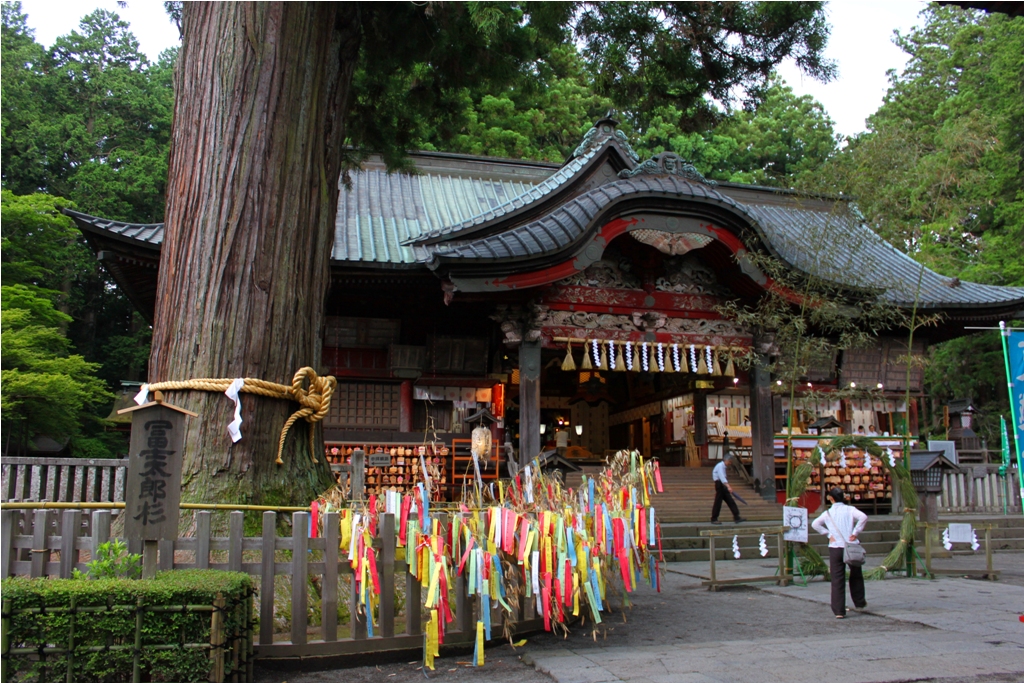
         One of the thousand Fuji Sengen shrines, dedicated to Konohanasakuya-hime, goddess of Fuji
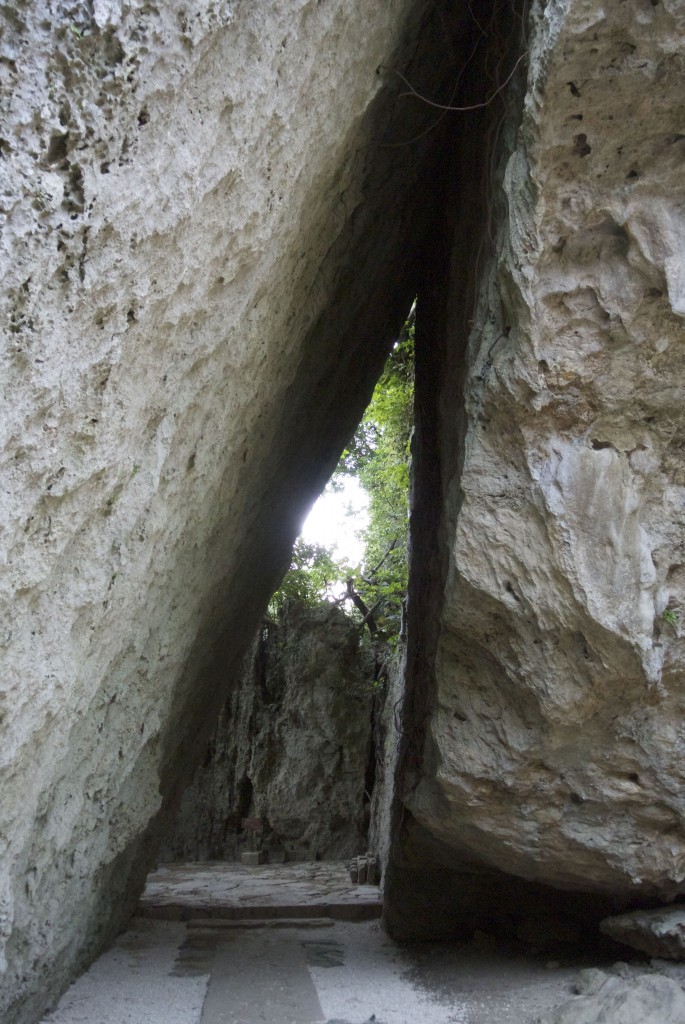
 

Okinawa 5: Seifa Utaki

Opening into a sacred world


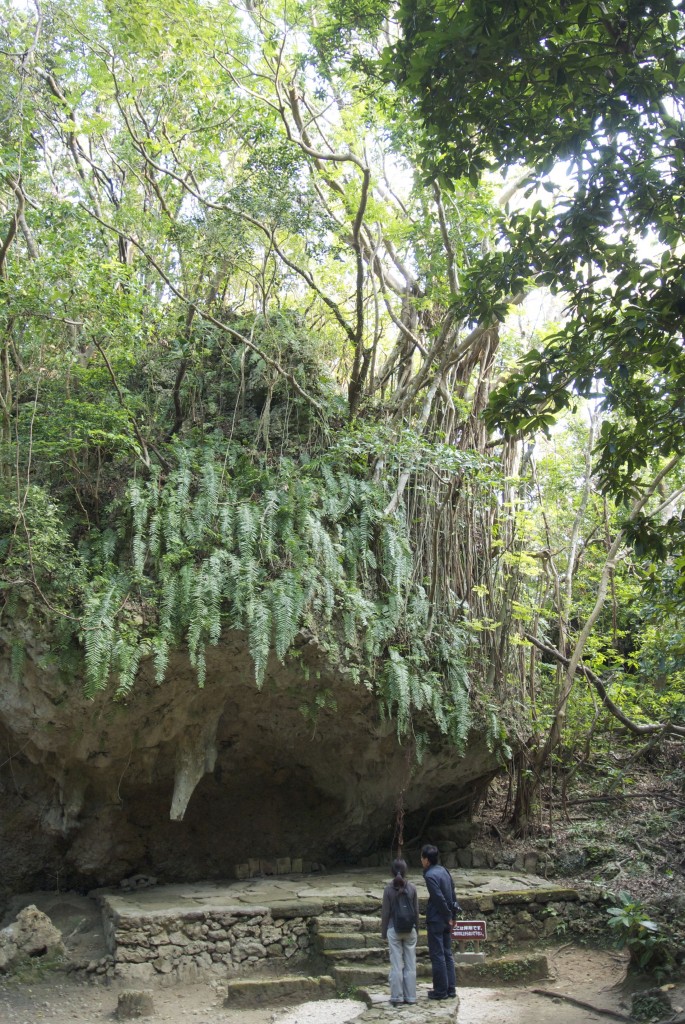
Seifa Utaki is the Ise of Okinawa.  It’s a sacred site associated with royal patronage that lay at the apex of the Ryukyu kingdom’s religious structure.  I think of all the spiritual places I’ve visited in Japan, this is the one that speaks to me most clearly of ‘a natural religion’.  It’s as if nature herself had carved a cathedral out of sacred rock and subtropical forest.

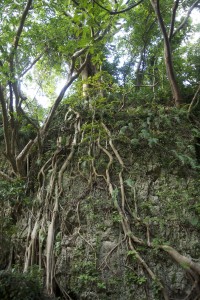
Nature itself adds decoration to the site’s surrounds

The site lies south-east from Naha, on the Chinen peninsula which is associated in mythology with the very origins of the country.  Legend tells of how the first of the islands to be created was that of Kudaka, which lies offshore from Seifa Utaki.  From there the gods proceeded to the main island itself.  No doubt there is some folk memory here of the arrival of ancestors from the southern seas, who settled first on the outlying island.  In such a way origins are made sacred.

In the past only priestesses could enter Seifa Utaki (the king and any workmen who entered had to tie their kimonos in female fashion).  At the head stood Kikoe-Okimi, a virgin relative of the king dedicated to the gods.  The system of Kikoe-Okimi was in effect from 1470-1869, during which time there was a total of fifteen in all.  They were responsible for divination and the great rites of the realm which ensured its stability and prosperity.  Like the Saio at Ise, the office is probably a legacy from the shamaness-queen who ruled the country in ancient times.

The Kikoe-Okimi lived not far from the royal palace, travelling along the coast to Seifa Utaki for important rituals.  Beneath her was a hierarchy of priestesses, starting with the noro who had control of up to five villages.  Other ranks included the yuta and kamichuu, responsible for such duties as divination.

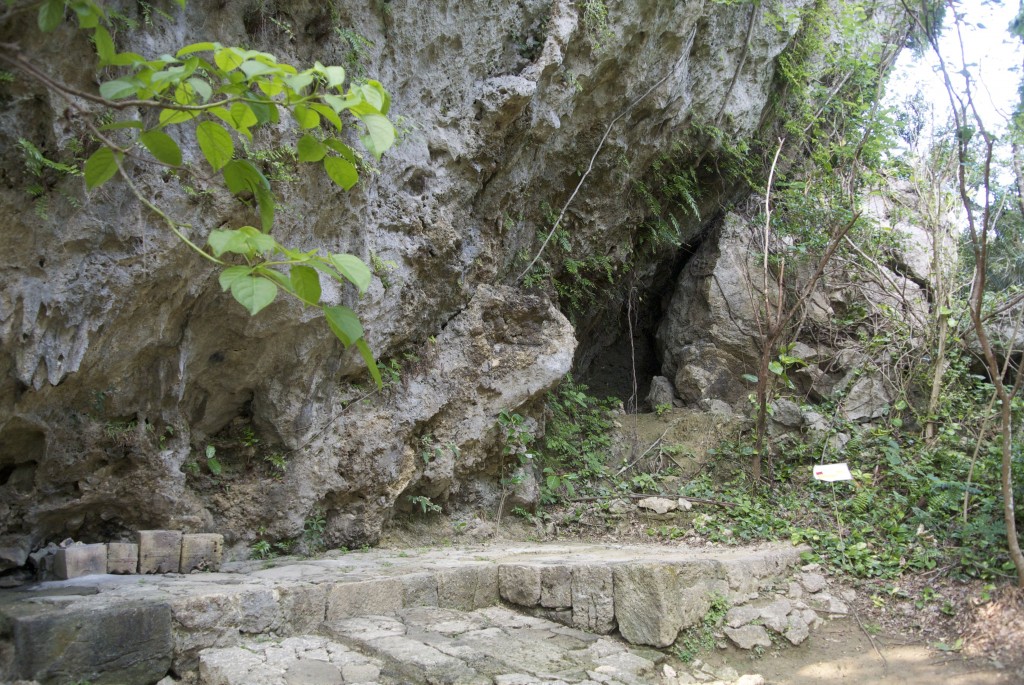
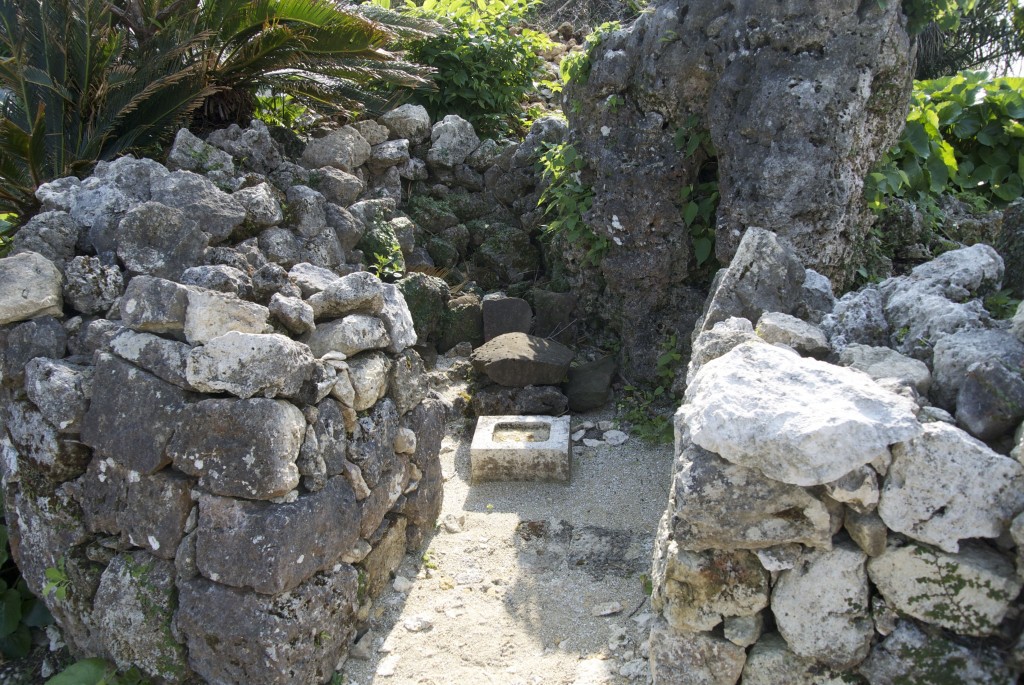
Near the entrance of Seifa Utaki is a spring, where priestesses would purify themselves before entering the sacred precincts.  The  altars and different areas are named after rooms in the king’s palace at Shuri-jo, showing the close links with royalty.  The most holy part of the complex is a triangular opening. leading to s small altar space from which there are views of Kudaka Island.  It is as if an orifice opens up into a rock womb, offering a secret view of life’s origins.  Here in this innermost recess, the priestesses fostered the renewal and rebirth of the nation.


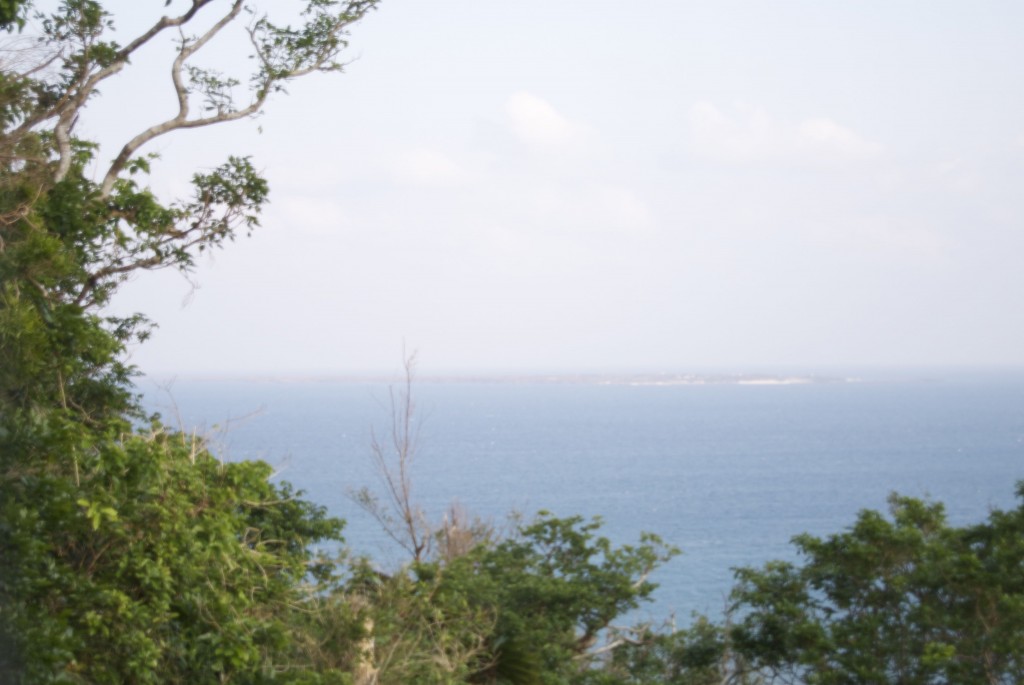
View towards distant Kudaka island, like a mirage on the horizon, mythic origin of Okinawa where the ancestors of ancient times first arrived


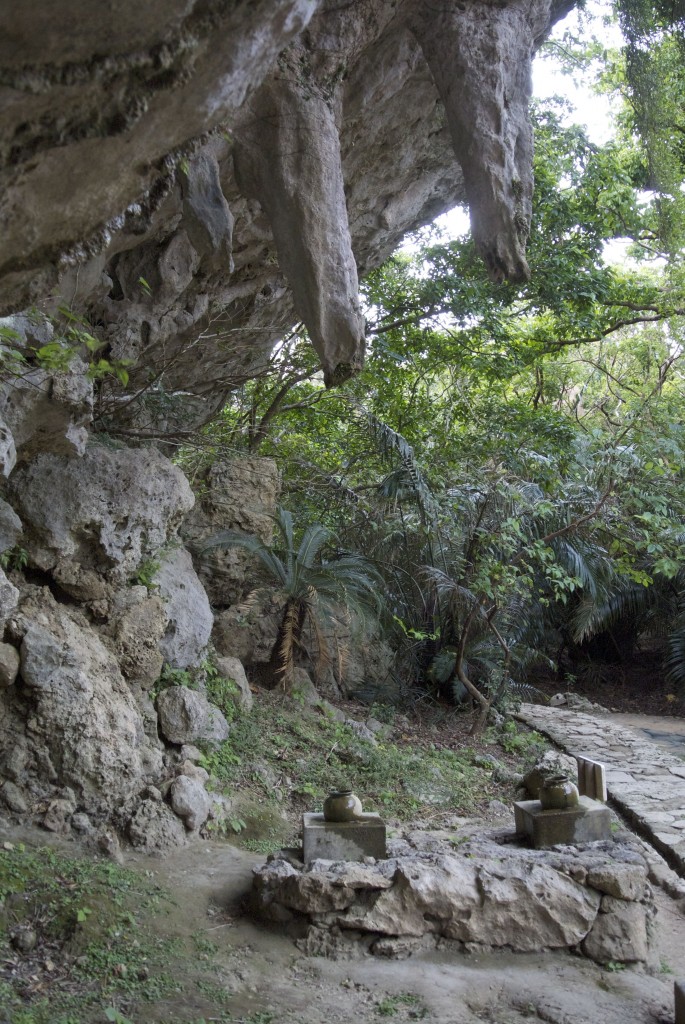
Unearthed items here include gold, celadon porcelain, coins and magatama jewellery, indicative of the precious offerings made.  Outside the triangular opening are two large stalactites, from which water drips almost imperceptibly into bowls placed below.  This liquid essence, wrung as it were from out of the very fabric of the rock, was considered holy water with magical qualities and used both for divination and in rituals to enhance spiritual power.

In Ryukyu times the site was a place of pilgrimage for king and commoner alike.  Still today worshippers come here to pray, and it is here too that the leaders of extended families pay respects on behalf of their kin.  Before the war the practice took place once a year, I was told, but now some only perform the ritual once every twelve years on completion of the cycle of the Chinese zodiac.

I was somewhat dismayed to find the atmosphere changed since when I last visited Seifa Utaki, with a welcome centre and guides in attendance.  Since it became a World Heritage Site in 2000, visitors have increased dramatically.  Now people walk around talking loudly on mobile phones, and parents yell out to errant children.

‘Seifa Utaki is a special sacred prayer site, not a tourist spot,’ said mayor Keishun Koya recently.  He has a good point.  One of the measures to protect its sanctity is to close it for six days a year according to the lunar calendar by which Ryukyu rites are fixed.  It will allow worshippers to pray in peace amidst the immemorial rocks.

What makes Seifa Utaki special is the sensitive interaction of natural features and spiritual expression.  Mystery, awe and wonder – these are precious feelings we’ve lost in the comforts of modern life.  They can still be found at Seifa Utaki however, if you take care to visit first thing in the morning or linger to the last in the evening dusk.  It’s at such times one can appreciate just why this was the Ryukyu’s ‘supreme sacred site’.  It’s special indeed.

Ufuguni, one of the altars which served for the preparation of food

Two stalactites that drip holy water into bowls placed below

The awesomeness of nature is ever present

Okinawa 4: Shrines

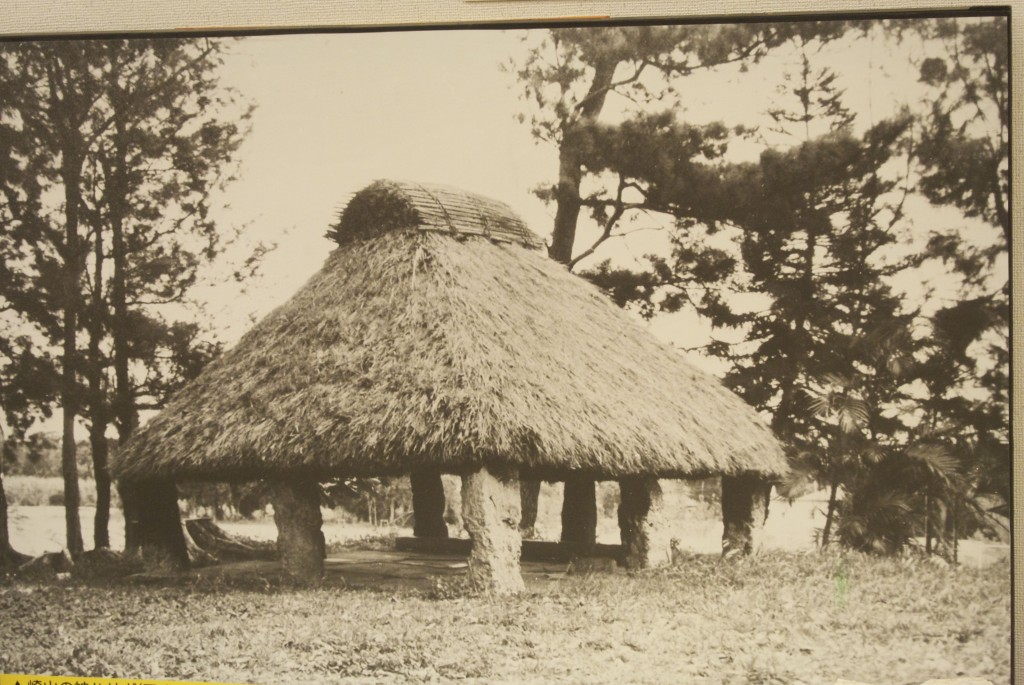
An Okinawan village shrine (photo in the Nakajin Castle Museum)


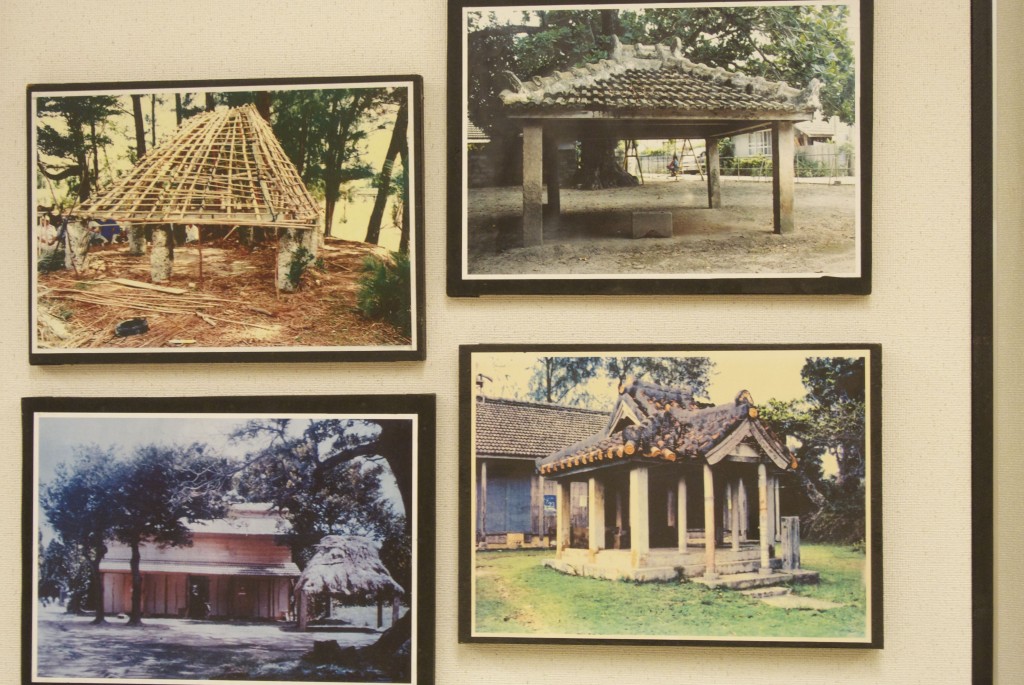
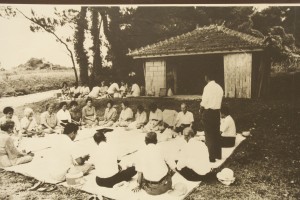
Different styles of village gathering places


At Nakijin Castle on the Okinawan main island, there is a museum with an exhibition of Ryukyu practices.  It includes pictures of kamiasagi, which are gathering places for religious ceremonies.  These are not to be confused with the more widely known utaki sacred sites.  So what’s the difference?

The utaki were special sites where the spirits dwelled or into which they descended. As such they were off-limits to ordinary folk: only the priestesses could go there for special rites.  These numinous sites were often copses or springs, far beyond the village boundaries.

The kamiasagi on the other hand were not hallowed ground as such, but places where gatherings could be held.  Since they were easily accessible by villagers, they acted as an intermediary point between the village and the sacred site.  Not every village had one, I was told, but most did.
In response to my question about how far Ryukyu religion was still being practised, the woman running the museum told me that ordinary people still continued former practices but that the noro (priestesses) were slowly dying out.  In her own village for instance, the noro was eighty years old and with no one likely to succeed her.

Once the noro had received an official stipend, but this had been stopped in Meiji times and now they had to make do as they could.   For the young it was not an attractive proposition, and the daughters of noro who used to take over the family tradition often choose to move away or take up other career paths.

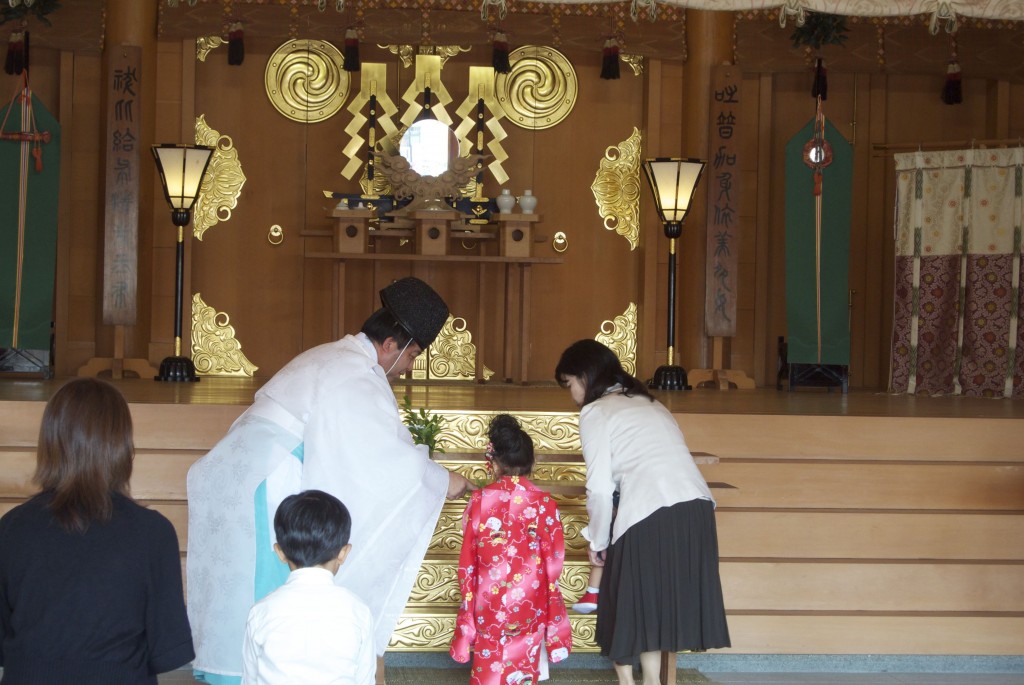
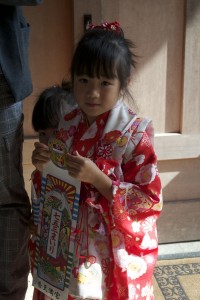
All dressed up at Futenma Shrine for the 7 – 5 – 3 ceremony

But even without the noro, Ryukyu practices live on.  I came across an interesting example at Futenma Shrine, where 7-5-3 celebrations were in full flow.  which was established as an outpost of Honshu’s sovereignty in Edo times, dedicated to the Kumano kami, and is considered one of the eight major shrines of the Ryukyus.

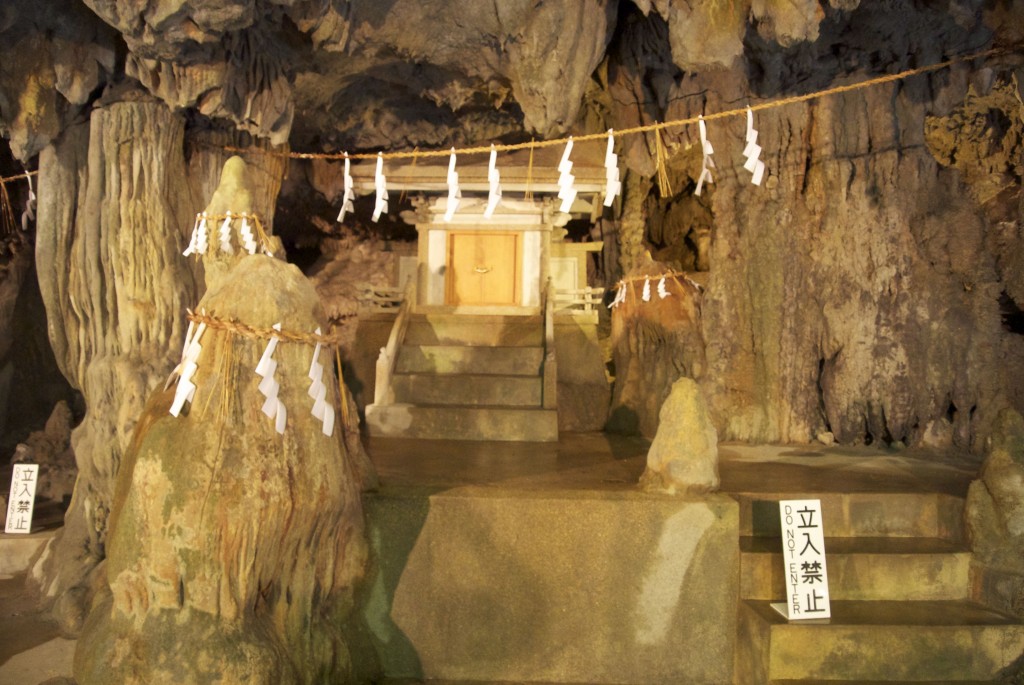
While most visitors carried out prayers in the conventional Shinto manner, two locals squatted before the shrine and directed their prayers in a different direction.  It turned out that they were worshipping more ancient gods than those of the Jinja, for the shrine is built above an extensive cave (280 meters long), which was sacred to locals before the coming of the Satsuma invaders.

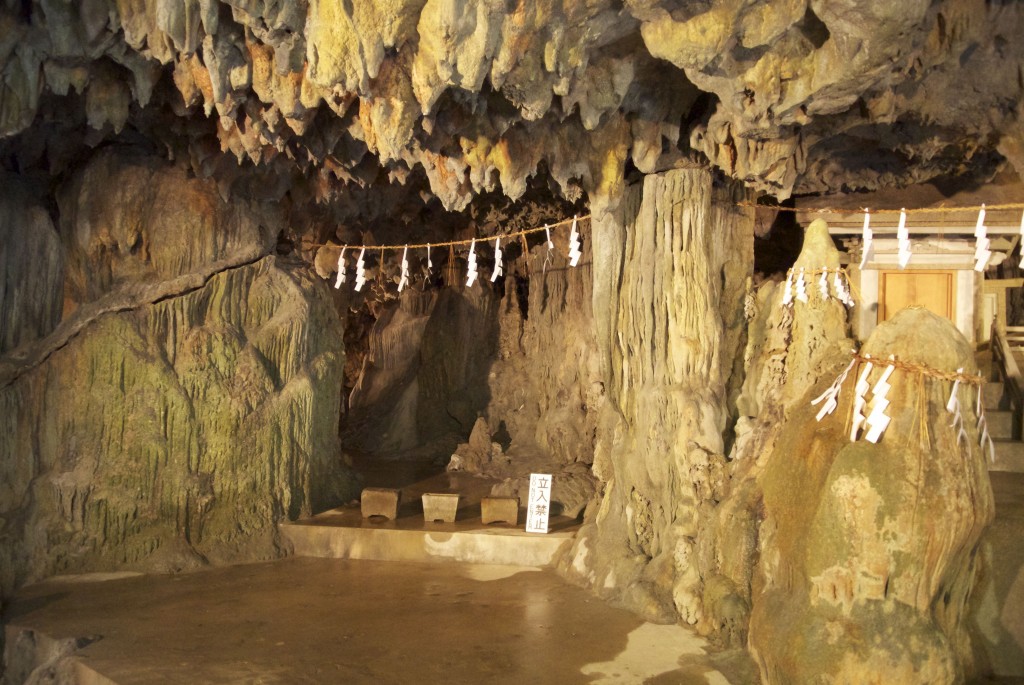
Eerie and atmospheric, the cave has a numinous quality that makes one wonder why it is kept locked up (you have to get permission from the shrine office to visit).  It’s used once a year for a ceremony at which some 800 people attend, and it honours two ancient kami, Megami and Sennen (The Old Mountain Man).

Megami was a beautiful but pious woman, who wished not to be seen.  However, the husband of her younger sister caught sight of her when he peeked into her house, as a result of which she rushed out and took refuge in the cave, never to be seen again.  (A very Taoist tale, methinks, with overtones of Amaterasu’s Rock Cave myth.)

The legend of Sennen, the Old Mountain Man, has to do with the incarnation of a spirit who visited a poor woman, whose life was one of sacrifice and deprivation.  As a test of her honesty, he gave her a wrapped item which he told her was valuable and asked her to keep it for him.  Despite his disappearance, the woman did all she could to find and return the item to him, as a reward for which he presented her with gold.  As a token of their gratitude, she and her husband built a shrine in the cave to the Sennen.

The cave, and the shrine above it, stand right next to the fenced gateway of the US military base at Futenma.  It’s an odd juxtaposition.  Here in a nutshell the history of the island is laid out, from the myths of Ryukyu times, to domination by Satsuma, to integration into Japan, and to American hegemony.

A shrine that speaks to another world turns out to have much to say about this world too.

The Futenma cave: a special space only opened on request  

Haunting and atmospheric: the Futenma cave is right next to the US military base


Meanwhile, above the cave the 7-5-3 ceremonies were being carried out in true Shinto style

Okinawa 3: Way of the Dead

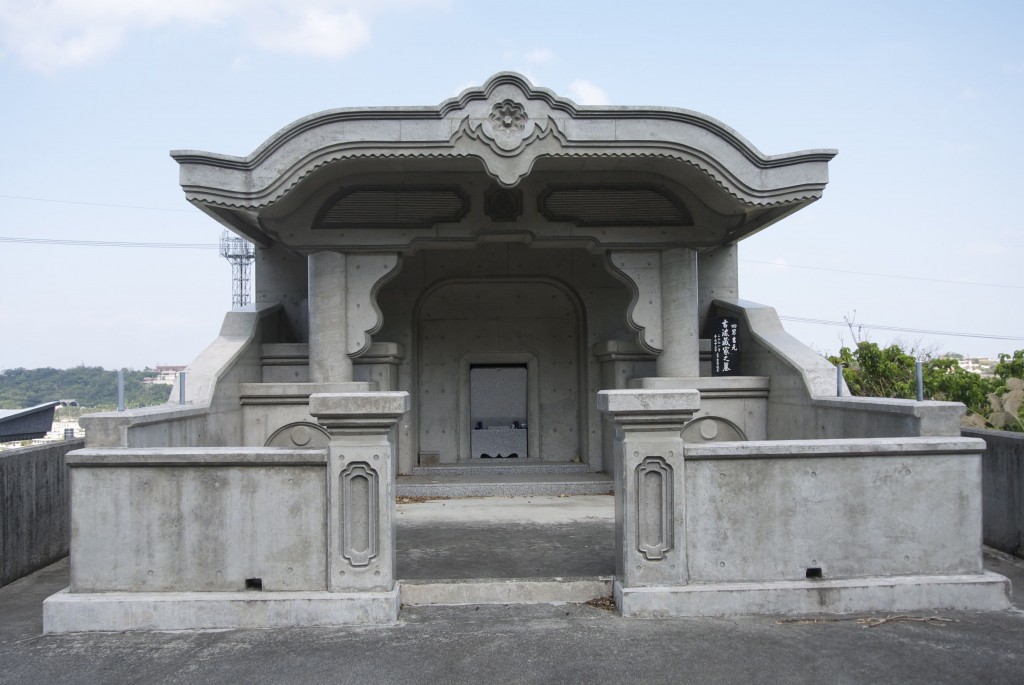
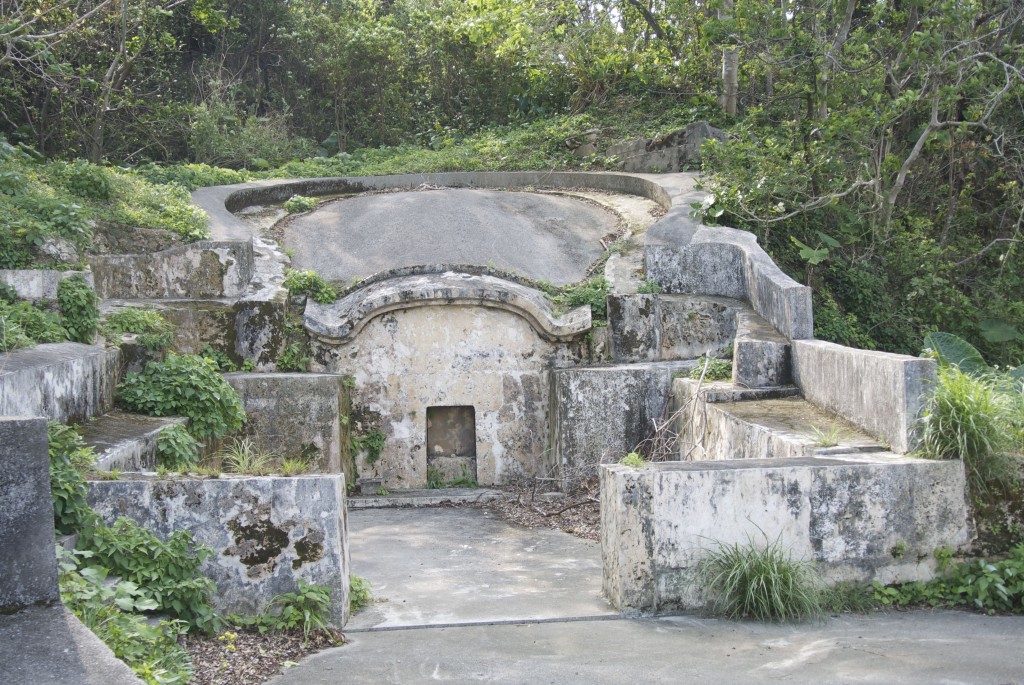
Okinawan family tomb


Driving around Okinawa, one can’t help noticing the many distinctively large tombs.  They resemble small houses, with a porch and courtyard.  Some are turtle shaped and nestle into the slope of the earth, as if wombs.  The dead who are buried here will be reborn in spirit form.

For Lafcadio Hearn, ancestor worship was not only the defining characteristic of religion throughout East Asia, but the origin of religion in all countries.  In early societies ghosts were regarded as the spirits of dead family members, who were honoured as immortal beings with the power to protect and punish.  In this way ghosts became gods.

In the case of Okinawa, treasuring the memory of past generations is given expression both within the house in the form of a family altar and outside in the form of family graves.  The altar, known as a buchudan, is ostensibly Buddhist but contains no buddhas.  Instead it houses memorials of the deceased.

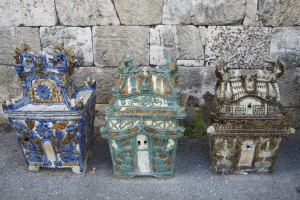
Funeral urns

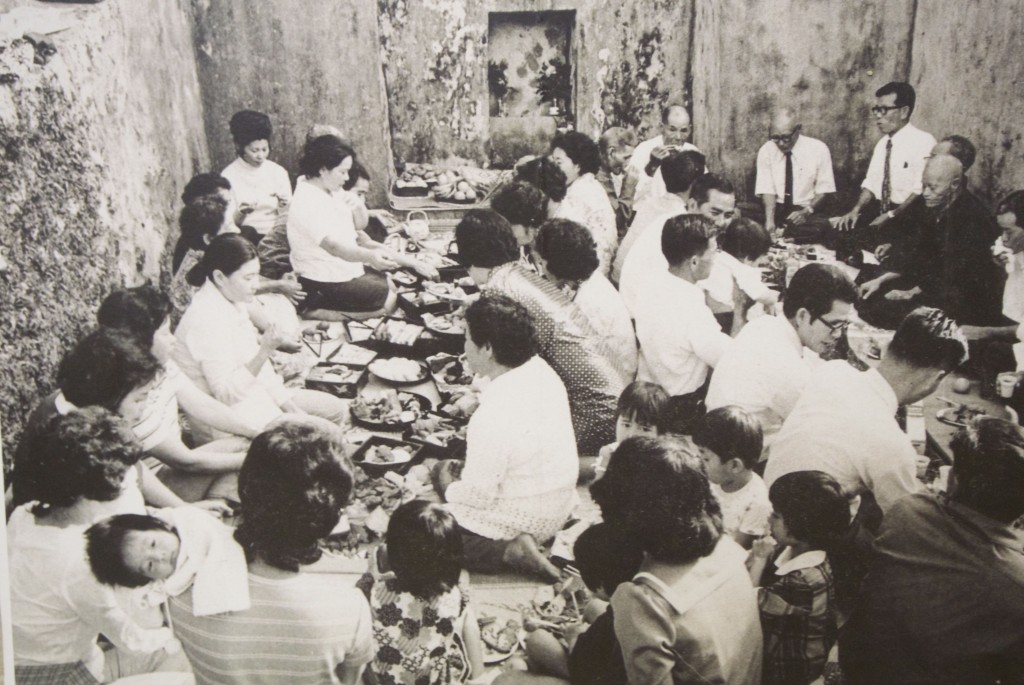
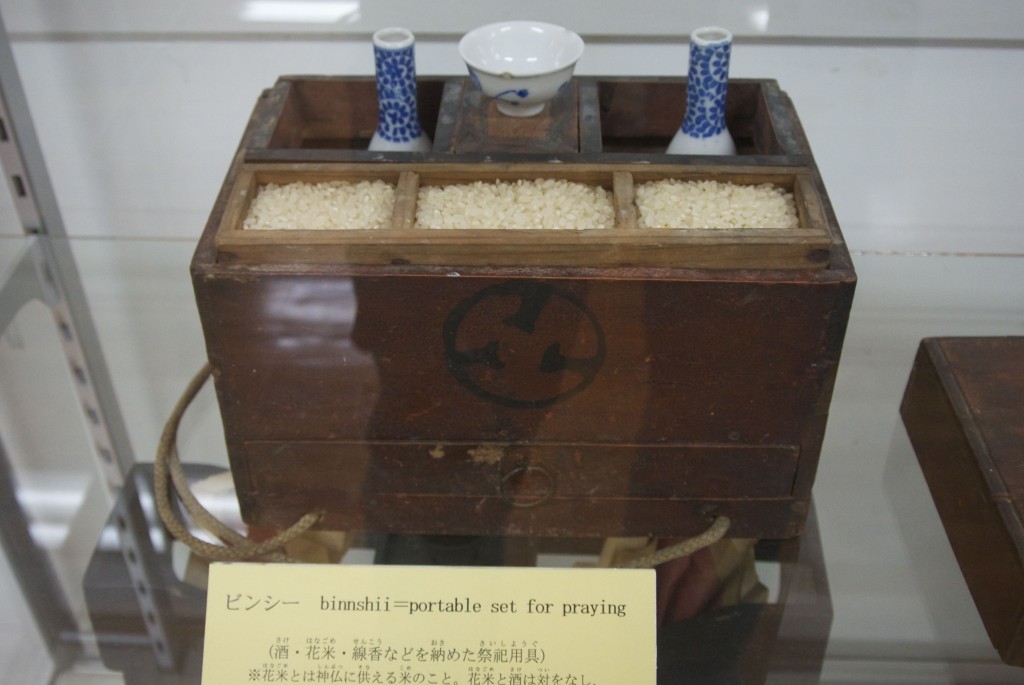
After death, the cremated remains of the deceased are placed in funeral urns and taken to the family tomb.  Twice a year prayers and offerings are made there by the extended family of descendants.  The gatherings can be sizable, involving anything up to thirty or more.  Offerings are made of rice, water and saké.  Expressions of gratitude are given, as well as solicitations for blessings.  Afterwards food and drink are shared between the living and the dead, much as in the manner of a wake.

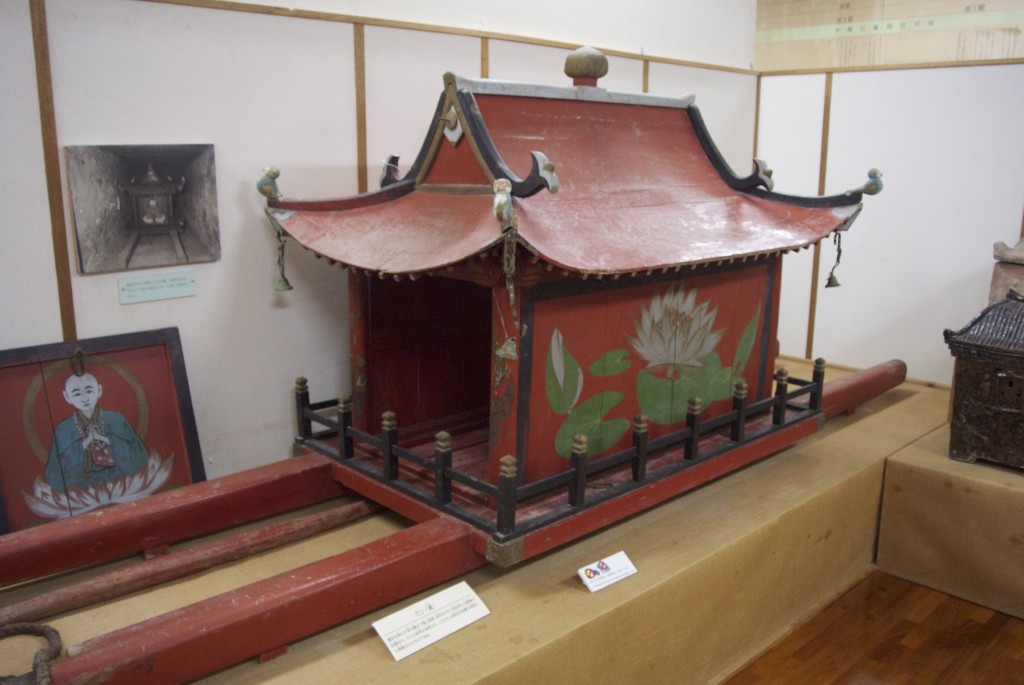
Though ancestor worship has been carried out in some form or other since ancient times, the large tombs used now were not introduced until the seventeenth century, influenced by the customs of south China.  The oldest tomb dates back to 1687, and in former times the deceased were carried to the grave in a form of palanquin called ‘gan’.  Once a mere mortal, the family member had passed over into the form of a higher being.

How many urns are kept within the family tomb, I couldn’t hep wondering?  When I asked a friendly waiter about it, he told me that in his family at least the tradition was to keep as many urns as possible within the tomb, and that when there was no more space the oldest would be smashed up and the contents mixed into the floor of the tomb.  Dust returns to dust, but within the safekeeping of the family.

Traditional tortoise-shaped tomb, built womb-like into the side of the hill

Gathering of an extended family at an ancestral tomb (picture in Nakajin Castle museum)

Portable offering set used at rituals before the ancestral tomb

Traditional palanquin used up to Meiji times for carrying the dead to the family tomb

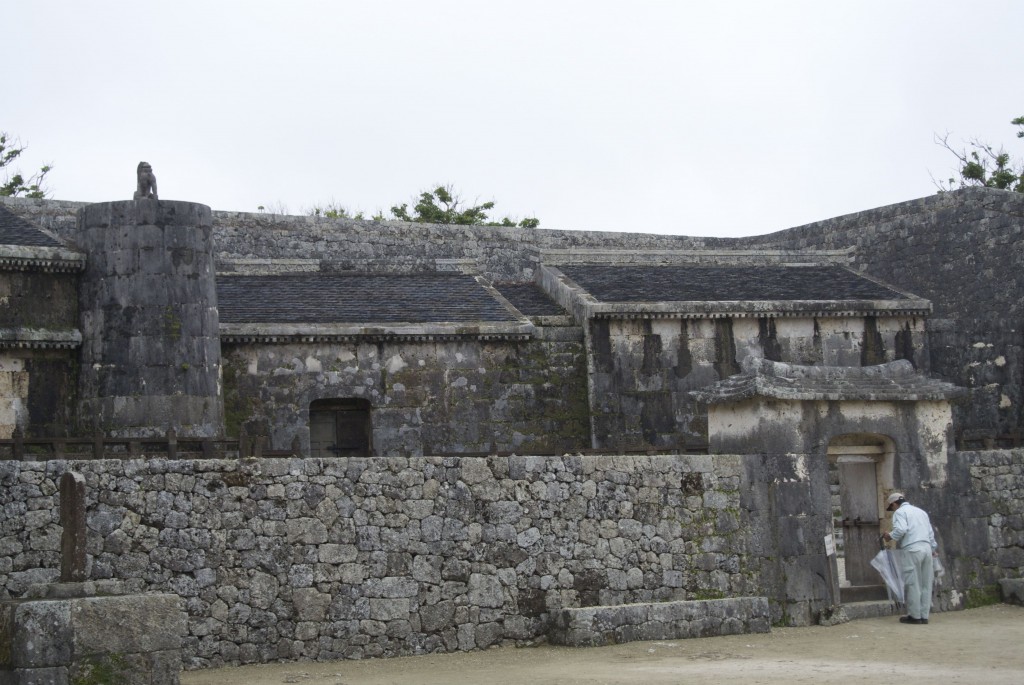
Paying respects at Tama-u-dun, a World Heritage site and mausoleum of the Ryukyu kings

Short quiz

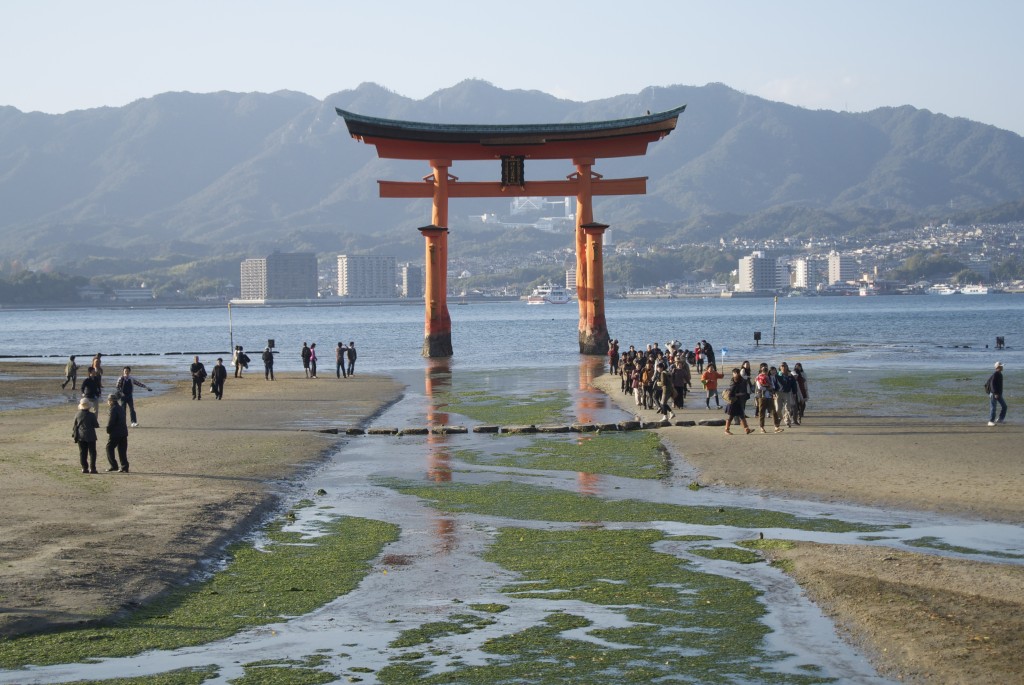
The most famous torii in Japan? Itsukushima Shrine at low tide...


There was another short quiz on an entertainment show ast night on television. It may be that competition with all the Christmas publicity is bringing up thoughts of Hatsumode…

There were only two questions on the show last night. The first concerned what bird was referred to in the meaning of torii, which literally means ‘bird roost’.

Answers ranged from pigeons (associated with Hachiman), to crows (they speak with the voice of the gods, as in the example of yatagarasu), to the phoenix (which sits atop Buddhist buildings like Byodo-in).

The real answer – namely chickens, or more properly cockerels ~ came as a surprise to panellists, who had clearly never read Kojiki! The sacredness of the cockerels was held to derive from their role in the Rock-Cave myth when Amaterasu’s retreat plunged the world into darkness. However, I’ve also read of another theory, namely that Korean villages used to keep chickens on a roost at the edge of villages, the shape of which was like an empty entrance gate or torii.

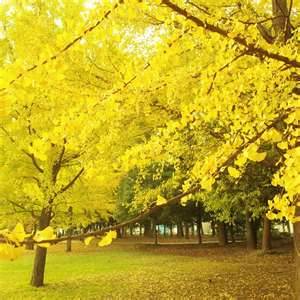
The second question was to do with the reason for the prevalence of ginkgo trees (ichou) at shrines. I must confess to not knowing this one. Answers ranged from the colour yellow being significant, to the nuts providing food.

The answer turned out to be that ginkgo trees are more resistant to burning than other trees, because they retain moisture. The risk of fire was ever present in Japan of the past, and measures to prevent or contain fire were a constant concern. Something to look out for when next visiting a shrine, perhaps…

Okinawa 2: Castle rites

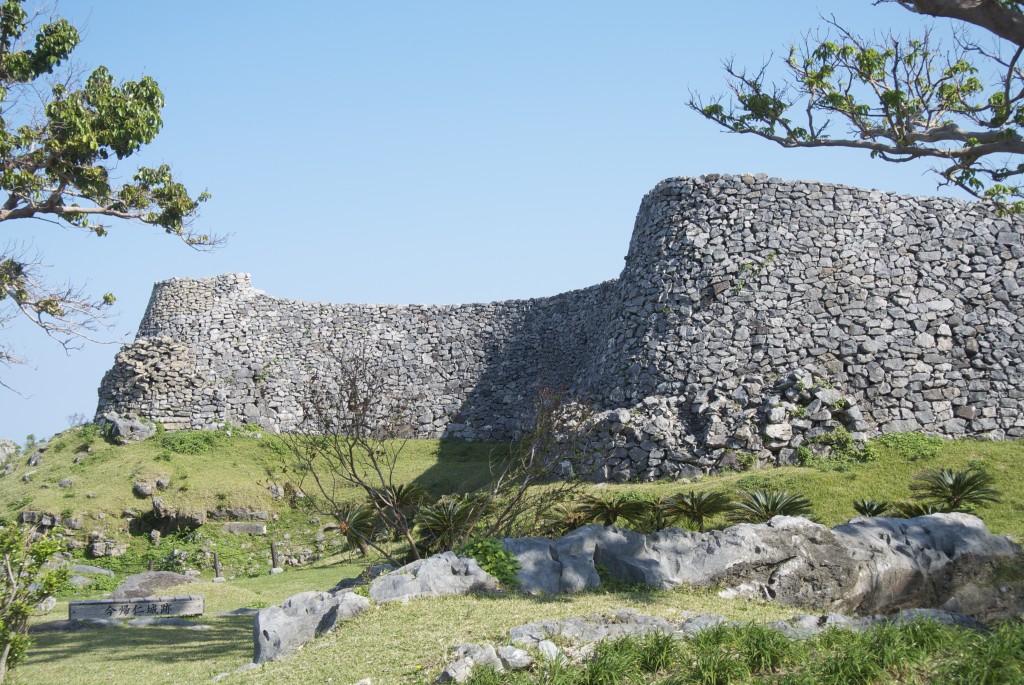
Remains of Nakajin gusuku (castle)


Much of the Okinawan World Heritage registration has to do with castles dating from the fourteenth and fifteenth centuries.  Visiting them reveals how important a role the so-called ‘Ryukyu religion’ played, for sacred sites and altars abound.  These were clearly a religious people, and as elsewhere in East Asia their religion combined ancestral worship with animism.

Spiritual authority was delegated to females, who were responsible in a literal as well as symbolic way for keeping the home fires burning.  Traditionally it was the woman’s job to look after the household gods and ancestral spirits, as well as to pray for the well-being of the family’s males when they were away at sea or at war.  During the time of the Ryukyu kingdom, the arrangement was systematised with a hierarchy of female priests to pray for the well-being of the nation and the king.

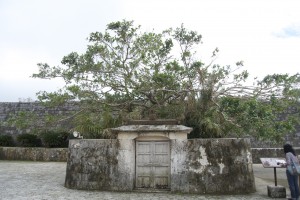
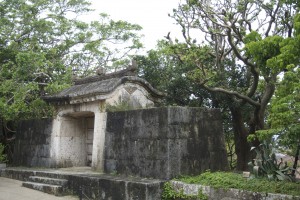
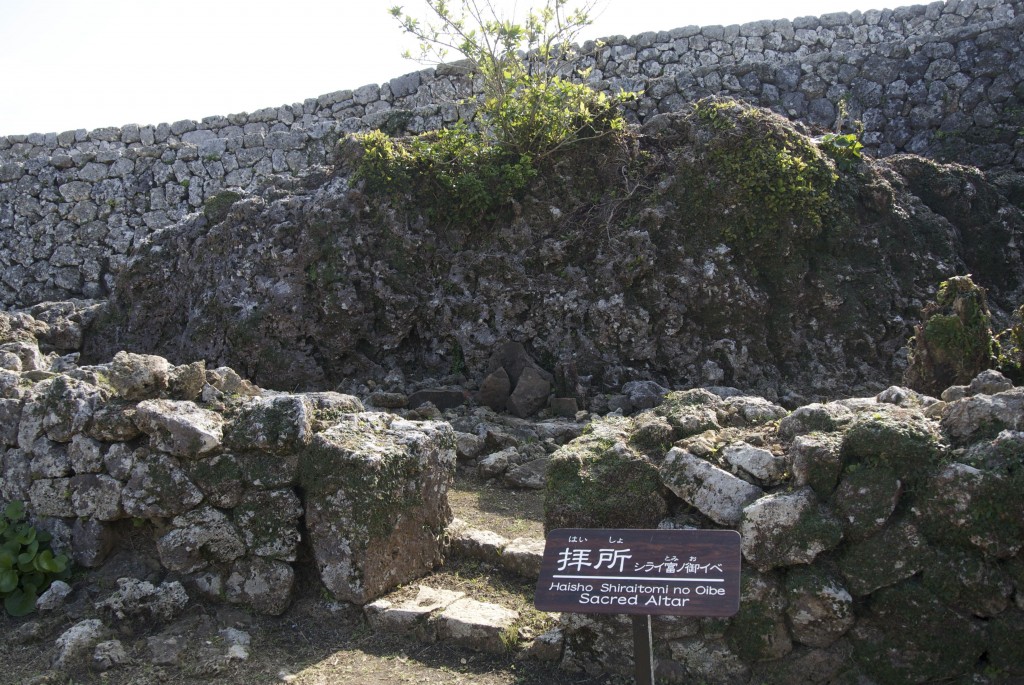
At Shuri Castle the outer courtyard features a utaki (sacred site) housing a sacred tree, while inside the palace is a  space reserved for religious rites.  Outside the palace is a gate which was never opened, for behind it stood a grove inhabited by spirits.  Before departing, the king would stop and pray before it, while on his return he would give thanks for his safety.


Shuri Castle utaki (sacred site)

Sonohiyaun stone gate, which never opened


Space reserved for rites in Shuri Palace


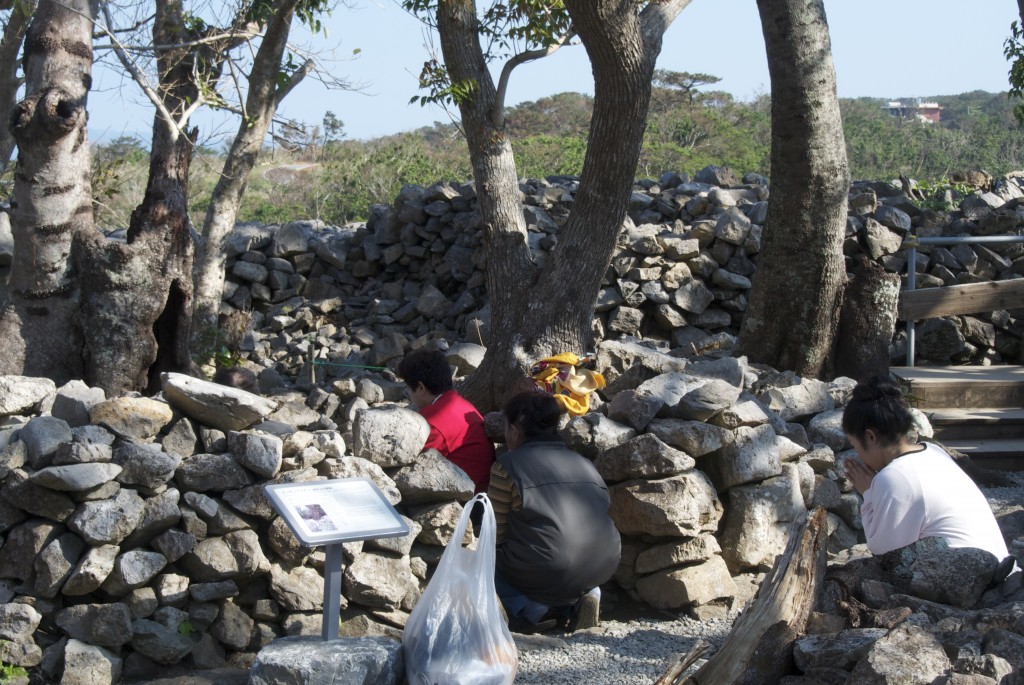
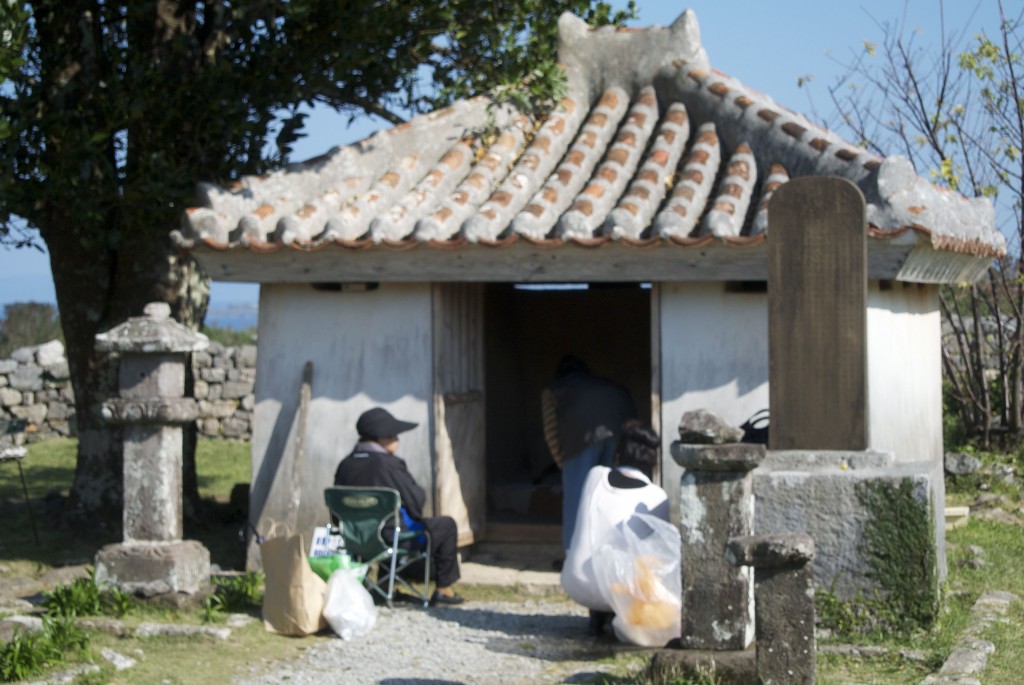
Other castles too had their sacred sites, and I was lucky enough to catch a brief ceremony at one carried out by a local noro (priestess).  It was at Nakijin Castle, a ruined castle in the north of the main island.  First the group of four women honoured the Hinukan, fire god or god of the hearth.  In terms of the wider community, the Hinukan was responsible for the social well-being.  “Worship of the fire god [in Okinawa] is very old and predates worship of ancestral spirits (sorei) at the Buddhist altar, now the center of family ritual,” says the Kokugakuin encyclopedia.

As well as prayers, there were offerings of rice and incense – with one big surprise: the bunch of incense was lit with a blow-torch.  Afterwards a similar ceremony was carried out at the ruins of a utaki (sacred site).  Casual and done in squatting style, the ceremony reminded me of Korean shamanism, also carried out by females. It’s a reminder of how Okinawa lay at the maritime cross-roads of China, Korea, Japan and southern trade routes in times past.  The resulting cultural mix produced the distinctive flowering of the Ryukyu kingdom, which was one of the chief criterion in the island’s World Heritage citation.

Ceremony in the castle ruins at the former utaki (sacred site).  Notice the squatting style.  The noro (priestess) conducting the ritual is in the centre of the utaki.


Two of the attendants at the Hinukan ceremony.  As god of the hearth, the fire god has his own building.  From what I could gather, the woman in white was the apprentice noro (priestess). 


Sacred site at Nakagusuku castle ruins


Former atlar at the Nakagusuku ruins

Okinawa 1: Dragon king

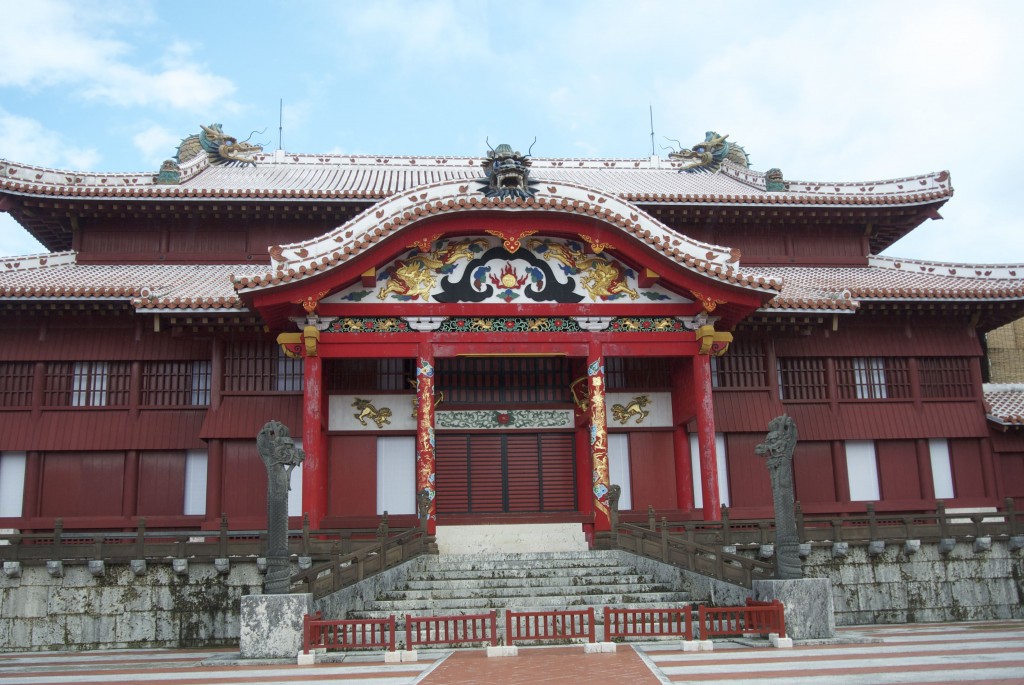
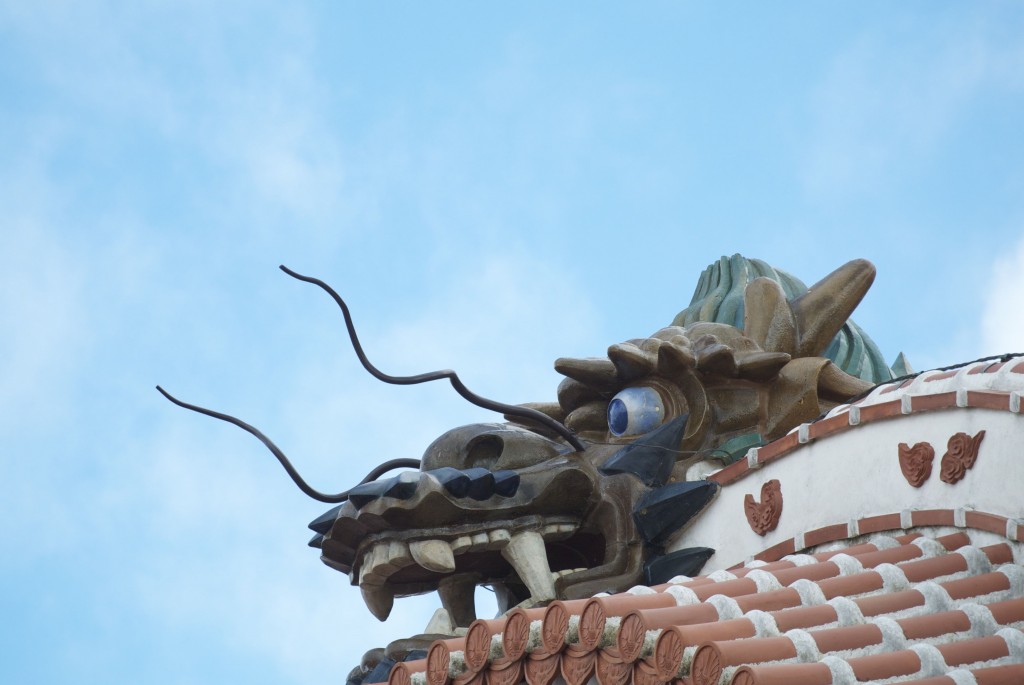
Shuri Castle in Naha City, former seat of the Ryukyu king and guarded by two vertical dragon figures on either sie of the entrance steps, with dragons painted on the pillars and dragon heads on the roof.  The palace was restored in 1992; the remains of the original palace are listed as a World Heritage Site.


Okinawa is special.  It’s got a subtropical climate, its own distinctive culture, and the longest living people in the world.  The hundreds of islands in the archipelago stretch for over 1000 kilometers, as if a bridge to Taiwan.

For long Okinawa was independent of Japan, with its own kingdom, language and religion.  In 1609 it was invaded by the Satsuma domain of southern Kyushu and made a tributary state.  Then in 1879 it became a formal part of Japan, comprising its southernmost prefecture.

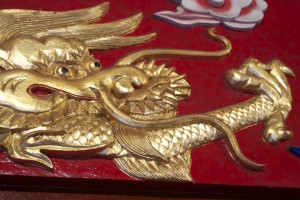
Dragon detail from the interior decor

In WW2 the prefecture suffered terribly in the fighting, and a quarter of the population perished.  Until 1972 it was administered by the US, then reverted back to Japan.  Still today US bases occupy 18% of the main island.

In the past the country was associated with the dragon, and the king adopted it as his symbol. It was a symbol of sea power, and Shuri Castle is covered in dragon decorations, many of which are in A-Un pairs (one with mouth open, and one with mouth shut, to signify yin-yang polarity).  With regard to the dragon connection, Mark Schumacher has this to say on his website about Japanese religions…

In Japanese mythology, the Dragon King’s Palace (Ryūgu) is said to be located at the bottom of the sea, near the Ryukyu Islands (Okinawa), and it belongs to Ryūjin, the Japanese name for the dragon king. The palace is also known as the “Evergreen Land.” In his book Japanese Poetry, Professor B. H. Chamberlain says the Japanese word for Dragon Palace (Ryūgū) is likewise the Japanese pronunciation of the southernmost Ryūkū islands. He writes about one ode in the Man’yōshū (Japan’s oldest anthology of verse compiled in the 8th century), which says the orange was first brought to Japan from the “Evergreen Land” lying to the south. The many-storied palace is built from red and white coral, guarded by dragons, and full of treasure.

The castle is the most famous of the nine properties belonging to the World Heritage Site known officially as “Gusuku Sites and Related Properties of the Kingdom of Ryukyu”.  The Ryukyu kingdom existed from the 15th to 19th centuries, and gusuku is the Okinawan word for castle, of which there are five altogether in the World Heritage registration if one includes Shuri Palace.  The other sites consist of a royal garden and mausoleum, as well as a sacred gate and the country’s chief religious centre.  For the past week I’ve been visiting the sites and learning something about the religious practices of the past (and present).  More of which anon….

Dragon head on the roof of the palace


« Older posts Newer posts »

© 2026 Green Shinto

Theme by Anders NorénUp ↑