Author: John D. (Page 180 of 202)

Setsubun background

An article by Alan Wiren in the Kansai Scene this month provides some interesting information about the Setsubun festival.  (The full article can be read here.)

Image courtesy of Kansai Scene

1) It’s traditional to gather up the scattered beans and eat the same number as your age, plus one for good measure.

2) The date is taken from the old lunar calendar. Because it needed tweaking to keep in alignment with the solar cycle, the year was divided into 24 seasonal sections.  The last day of each section was known as ‘setsubun’ (division).  One of these ‘setsubun’ came to hold a special place, because it marked the end of winter by coming between two sections, ‘Severe Cold’ and ‘Spring Begins’.  It was clearly a time for celebration.

3) Chasing away the demons at this time was originally a Chinese custom. The change of seasons was seen as a time when the border between the spirit and human world was at its weakest, making it possible to cross more easily from one realm to the other.

4) The throwing of beans in Japan began during the Muromachi period (15th-16th centuries).  It may have been connected with a Noh play in which an old woman is visited by a stranger, who turns out to be a demon.  In terror she reaches out for the nearest thing to hand – a handful of dried beans – and hurls them at the devil, who is chased away.  (My own supposition here would be that the beans represent life and growth, as against the negativity spread by the demon.)

5) In the Edo period traditional Daoist yin-yang geomancy, with its notion of a lucky direction for each year, brought in the custom of facing that way while eating an entire role of rolled sushi.  It’s said to have begun when an Osaka geisha performed the ritual to ensure she would be with her lover.  As the rolled sushi combines gifts from land and sea, it’s considered auspicious.  (I’ve also heard that the ehousushi [lucky direction sushi] contains seven different ingredients, in line with the Seven Lucky Gods.)

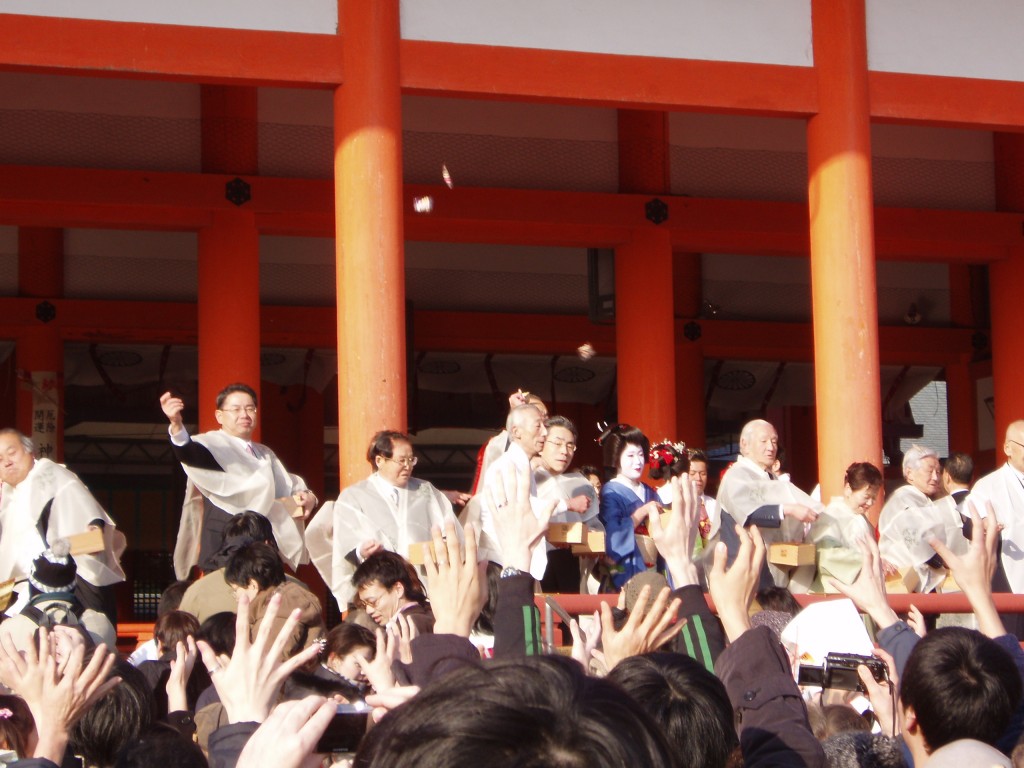
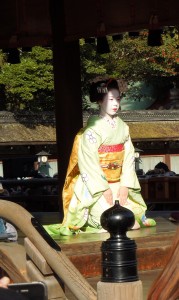
Bean throwing at Kyoto's Heian Jingu; spot the beans (and the geisha)


*********************************************************************************************************************************************

(For further info about Setsubun, please see here.  For celebrations at Kyoto shrines, please see here and here.)

Suwa Lake freezes over

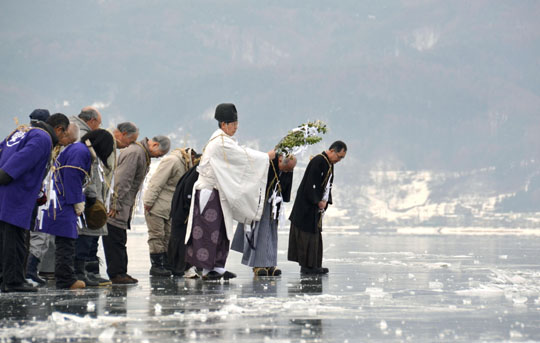
Picture courtesy of Kyodo/Japan Times


Thanks to Gabi Greve for pointing out an article in the Mainichi Daily News, which tells of Suwa Lake freezing over.  This prompted an ancient fortune-telling rite in accord with local lore that the kami Takeminakata (son of Okuninushi) crosses over the frozen surface from one of the Suwa shrines to visit his bride housed in another. (For further details and a report on Suwa Shrine, see here.)

*************************************************************************************

Harumiya, part of Suwa Taisha

NAGANO, Japan (Kyodo) — A Shinto ritual was held Monday on the frozen surface of Lake Suwa to predict the year’s social situations and the prospects for crop harvests and weather from a streak of elevated ice cracks, a natural phenomenon observed Saturday on the Nagano Prefecture lake for the first time in four years.

A priest from the nearby Yatsurugi Shrine and its devotees checked the exact location of the streak on the lake and performed a purification rite. The predictions will be made later at the shrine by comparing the data with past records.

The phenomenon, known as “omiwatari,” occurs after ice on the surface of the lake repeatedly expands and contracts due to the difference in temperatures during the daytime and night. As a result, the cracks on the ice rise.

In mythology, omiwatari is believed to be the path taken by the male god at the shrine on the southern coast of the lake in visiting the female god at the shrine on the northern coast.
*******************************************************************************

(The above comes from Mainichi Japan February 6, 2012.  See also Japan Times article.)

Setsubun at Yasaka Jinja


Each Kyoto shrine has its own attraction for the Setsubun ritual. Some feature special demon costumes. Some invite celebrities. Some prepare extensive gifts and make sure that everyone gets beans. Yasaka Jinja offers dances by maiko (apprentice geisha) for the enjoyment of the gods.

The courtyard at Yasaka was packed with over a thousand people eager to get a glimpse or a photo of the five young maiko. After the dances for the kami, they took part in the bean throwing before bravely making their way through the attendant throng to get their fortunes…

Beans were not as plentiful here as at Shimogamo though there were a lot more people. On the other hand you could take part in a lucky lottery, which produced winners for nearly everyone. Mine was some kitchen cleaning stuff, though the carrier bag with its geisha design had rather more appeal.

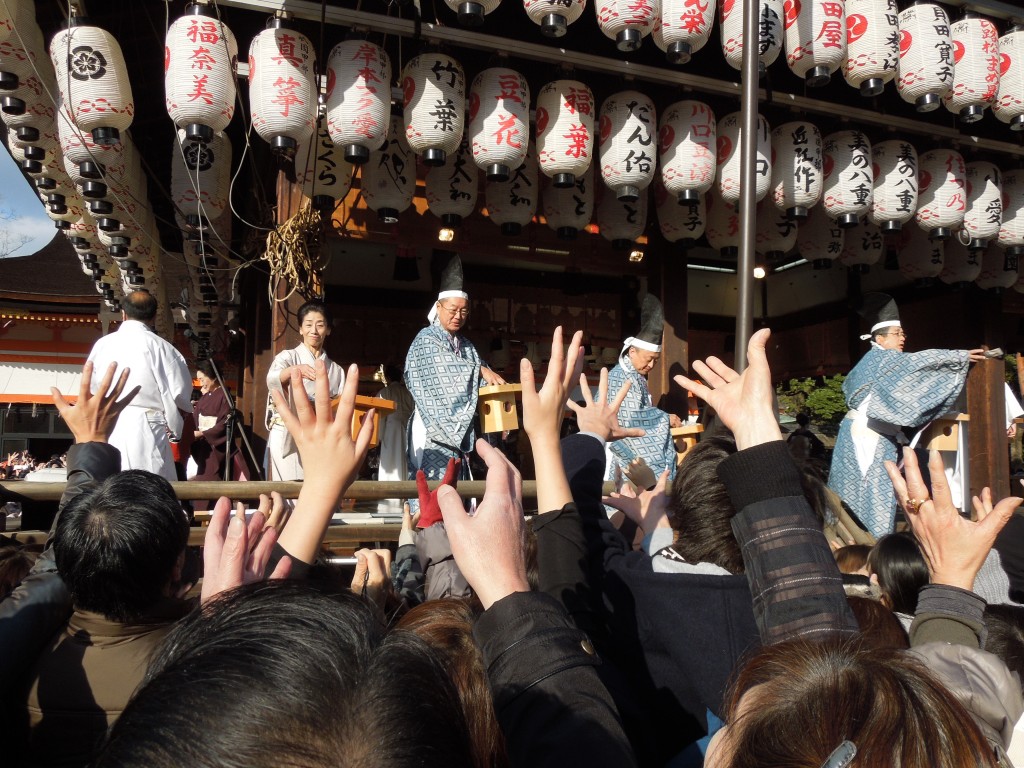
Hands reaching up desperate to get the lucky beans and so disspell the disease bearing demons for the coming year

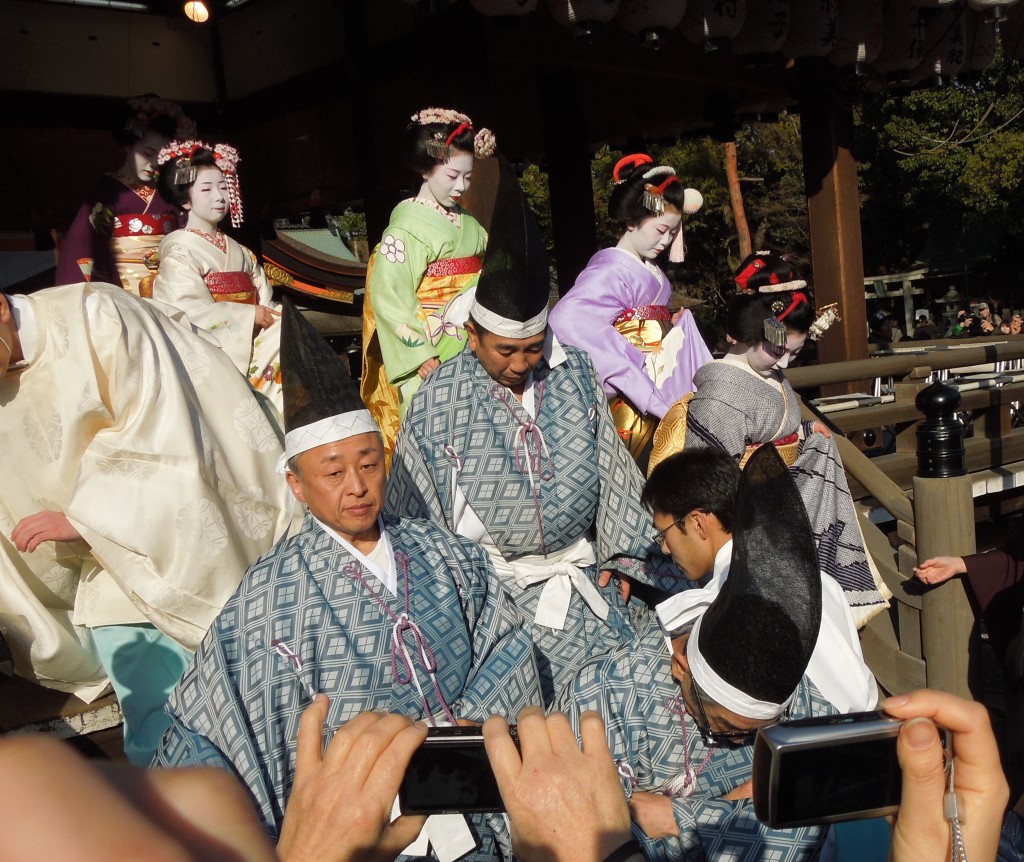
Maiko and priests descend into the throng following the bean-throwing


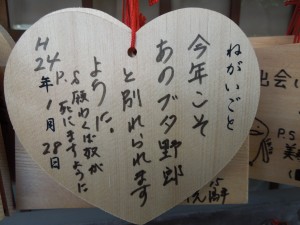
Afterwards I looked around the small enmusubi (good connections) shrine which, as at other places, has been done up in recent years to capitalise on the current boom among young women for praying for luck in love. The shrine has produced special heart-shaped ema (prayer tablets), some of which bore rather unusual requests. The most surprising was from someone asking to separate from her pig of a boyfriend and hoping that he would die. Hardly appropriate for a heart sign, one might think. (There are actually ‘good separation’ shrines for that kind of thing.)

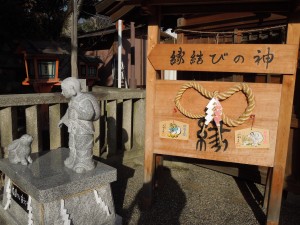
Enmusubi shrine with a statue of Okuninushi, kami of good connections

Heart-shaped ema, asking to split up from her pig of a boyfriend


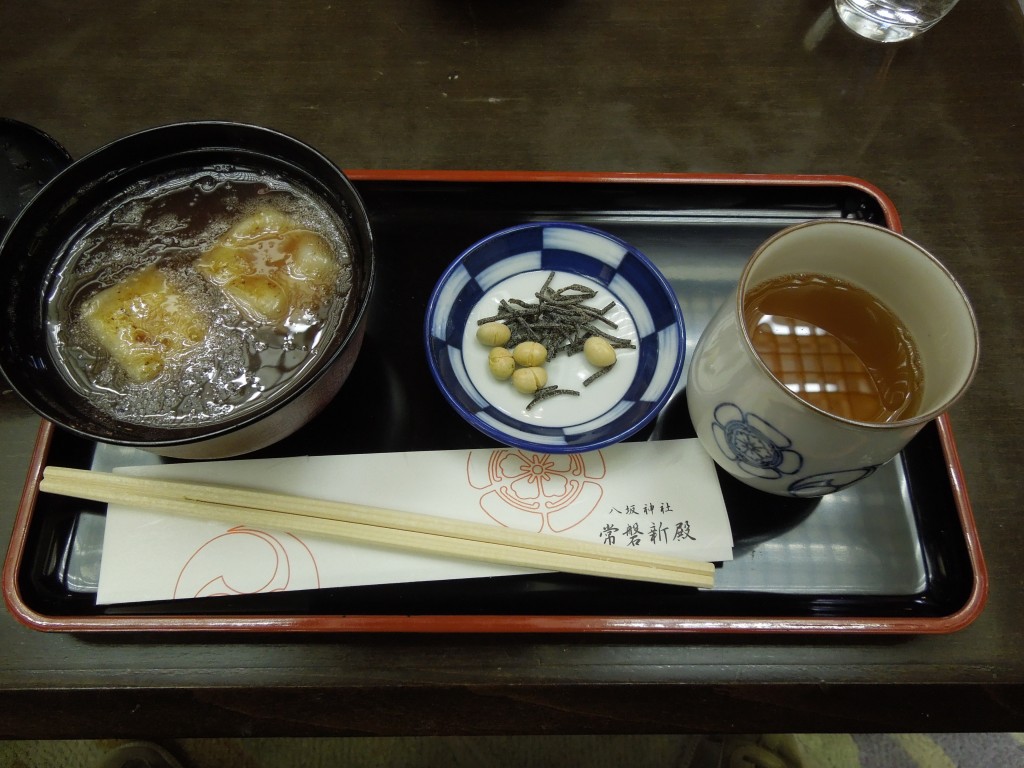
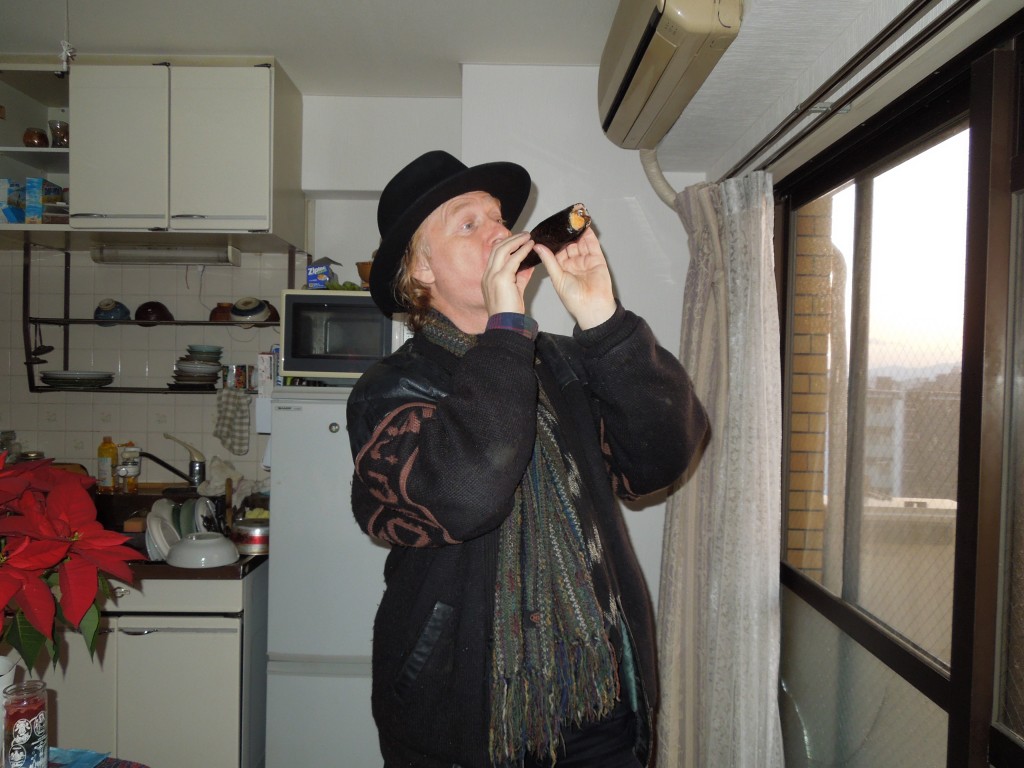
Yasaka Jinja does good business for weddings, and next to the shrine is a large wedding hall with a coffee shop where I stopped off after the festivities to get a Zenzai setsubun set consisting of sweet beans (azuki). Afterwards I returned home for the traditional ‘ehoumaki’, which is a long roll of sushi that you eat in the lucky direction for the year. This year it was north-north-west, which I did my best to face as I downed the giant sushi roll as best I could. You’re not supposed to talk or pause, but those things take a lot of scoffing. One hears of elderly people dying every year from getting mochi (rice cakes) stuck in their throat at New Year… I wonder if anyone ever died from a sushi roll !

Zensai set. Available at the Yasaka Shrine wedding hall cafe, and worth knowing about...

Scoffing down an enormous rolled sushi in a north by northwesterly direction

Setsubun at Shimogamo

Fresh, freezing
White moon on a blue sky –
Eygrets flying home

Yesterday saw Kyoto burst out in a riot of demons and bean-throwing as the city indulged in Setsubun activities.  (For an explanation, click here.)  At Shimogamo the day kicked off in the morning with a priestly ceremony and kyudo archery display, followed by afternoon bean throwing with an unexpected guest and the ritual burning of gomaki prayers in a bonfire.  Pictures of the day follow below…

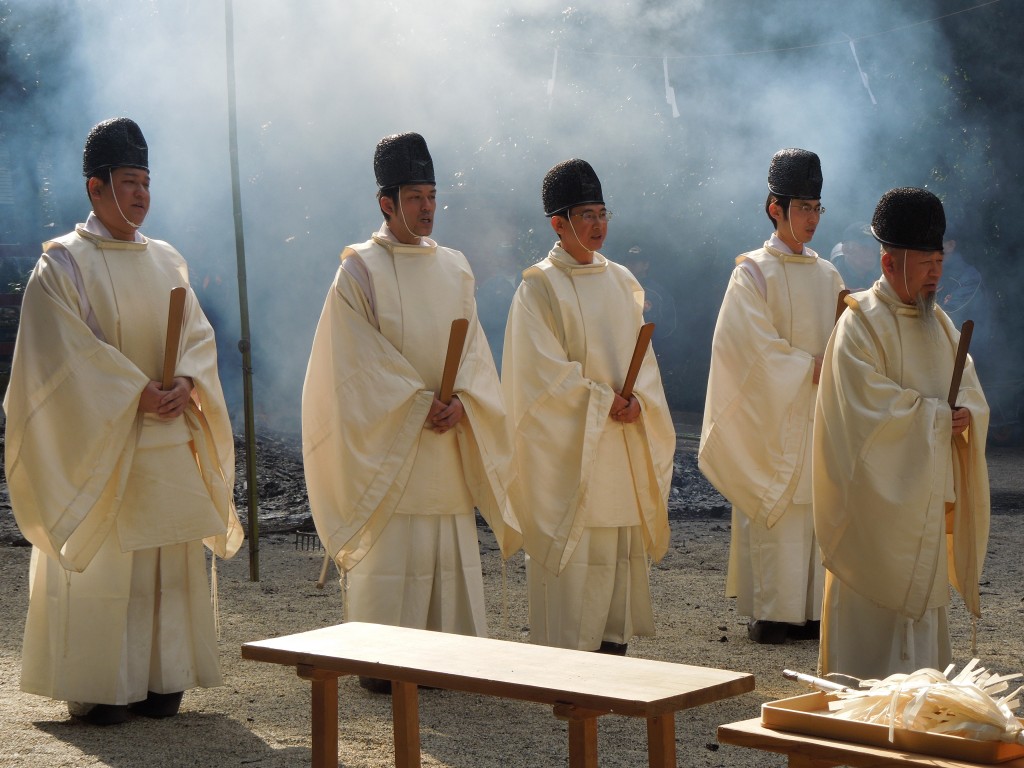
Priests during the rituals to initiate the day's events. The sole priestess is wearing an unusual headdress.

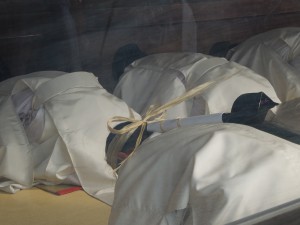
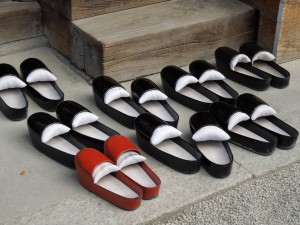
Priests' shoes. Guess which pair belongs to the priestess...

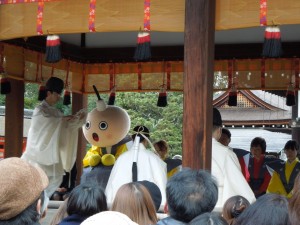
Before the bean-throwing was a short ritual. Look carefully; one of the participants might seem a bit odd.

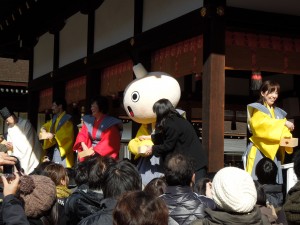
Bean throwing. Disney meets Shinto with the Kyoto Tower character, Tawawa-chan.


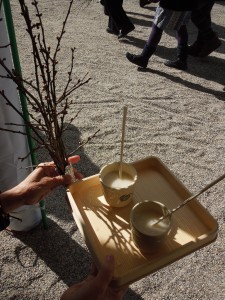
Following the bean throwing participants were given a sprig of plum blossom (nice touch!) and paid Y200 for a warming cup of sweet saké, heavily laced with ginger and totally delicious. I had two!

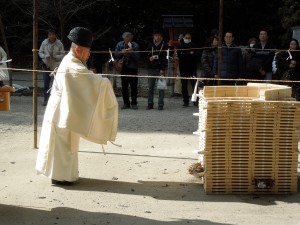
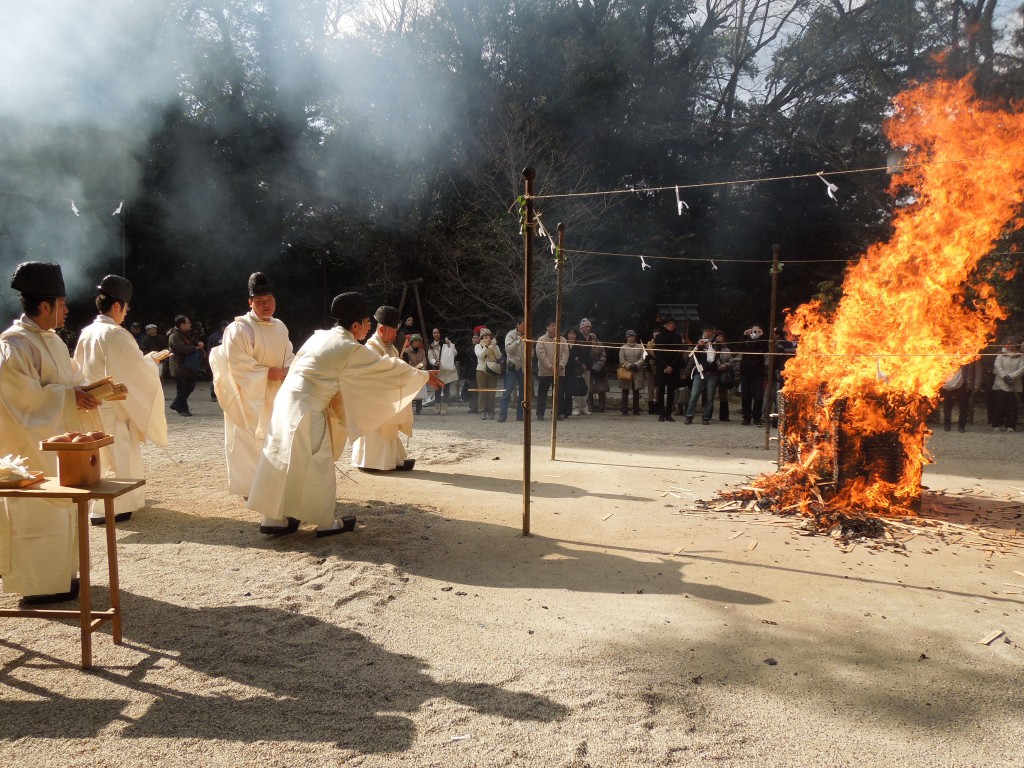
Following the saké there was a fire ceremony to send prayers written on wooden tablets up to heaven

The fire rages as more wooden tablets are thrown on


Smoke rising from the burning ofuda and omamori behind the priests

Recently qualified – at 62 (Sumiyoshi Shrine)

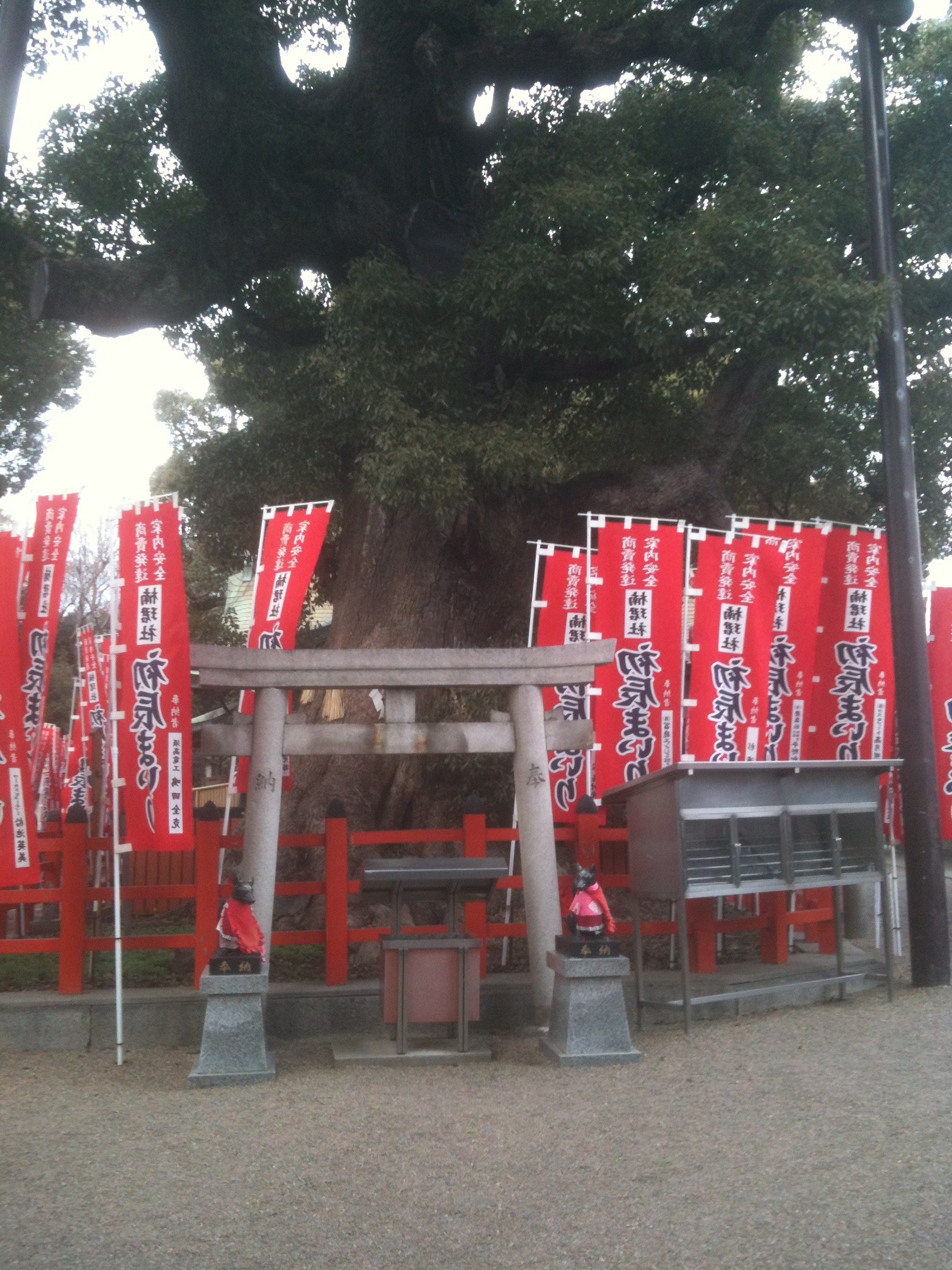
The 'spirit-body' camphor tree of Nankun Jinja

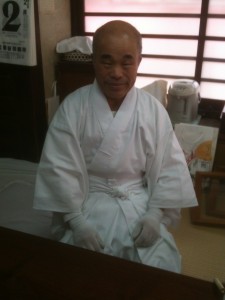
At the back of Sumiyoshi Shrine in Osaka is a small shrine called Nankun Jinja. It seems to be part of Sumiyoshi, yet it’s independent at the same time.  The priest explained to me it was a massha (an auxiliary under the management of a larger shrine) and it has its own ujiko (parishioners).

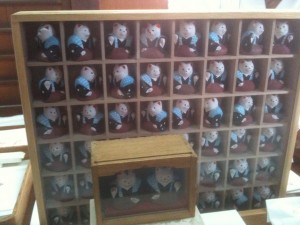
A full collection of 48 maneki cats. Those with the left arm raised are beckoning people; those with the right raised beckon money.

It’s unusual in a number of ways. First because the shrine’s goshintai (spirit-body) is a camphor tree (see picture on the left).

Secondly because the shrine sells small maneki cats, which are collected each month by worshippers at the shrine in a set of 48.  (At Y500 a cat, over four years that works out at Y24,000.)  I was only about ten or fifteen minutes at the shrine, but there must have been four or five elderly people who came in to buy them during that time.  Apparently at least sixty people a day come in to buy one.

But perhaps the most remarkable aspect of the tiny shrine is the resident priest, who took time out from his duties to tell me his life story.  Born in Kyoto, he did engineering at Kyoto University before taking a job with an electricity company for whom he did PR work.  He happened to marry the daughter of the head priest of Sumiyoshi Shrine, but had little interest in the religion until nearing retirement one of the priests at the shrine encouraged him to consider working there and helping out.

Accordingly he did monthly courses at Kogakkan University while doing on the job training.  Cold water austerity, sitting long periods of seiza (on one’s knees), memorising prayers and movements were all rigorous activities for someone who’d worked in comfortable warm offices all his life.  ‘Taihen desu yo,’ (Terrible) he said cheerfully.  I got the feeling, despite the cold, he was enjoying his new work.

Sumiyoshi Jinja is a remarkable place with historical associations and unique features.  Well worth a visit.  It stood once by the sea and was celebrated for the beauty of its beach setting.  Not much sign of that now, though.  Nonetheless there’s a most attractive layout.

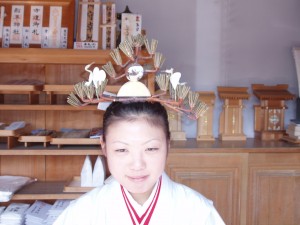
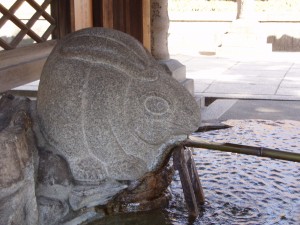
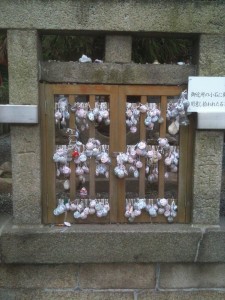
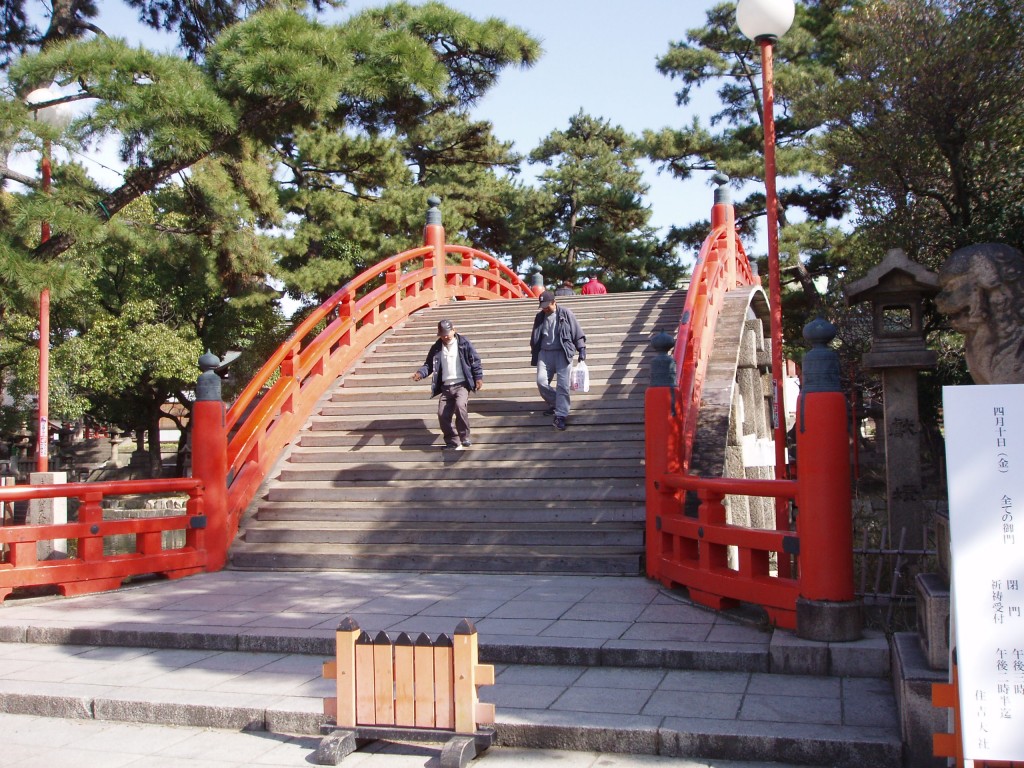
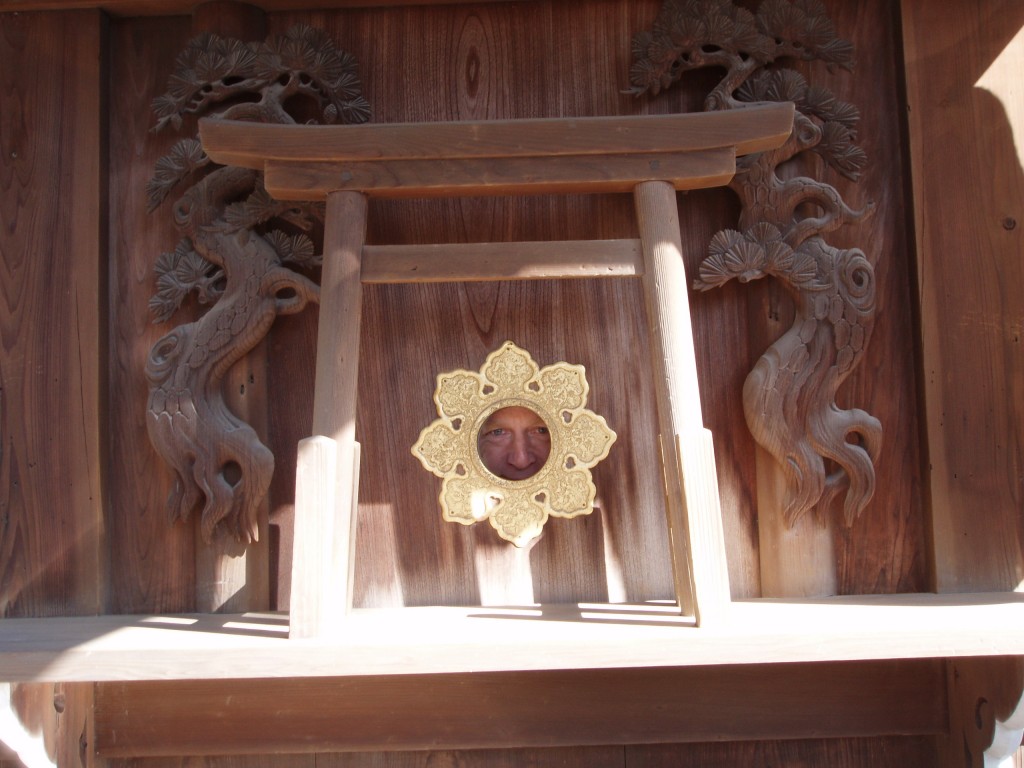
It’s got four separate main prayer halls; a rabbit water basin (after the supposed founding on the day of the rabbit); a fancy headdress for the miko which features pine and crane (celebrated in verse and a Noh play); a taiko style bridge which must be the most exaggerated I’ve seen (to denote passing from one realm to another); a mirror-hole through which one worships towards Ise; and good luck fortune pebbles for which you have to search in order to fill up your good luck pouch.  Pictures follow below….

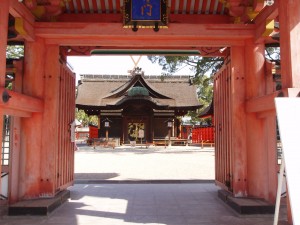
Entrance to Sumiyoshi, and one of the four main shrines

Miko with pine and crane headdress

Rabbit temizuya. Unusual, if not unique, to get water from a rabbit.

Small bags with lucky pebble stones

Taiko bashi: it's a steep climb from one realm to the other

That's no mirror; that's a hole that looks all the way to Ise.

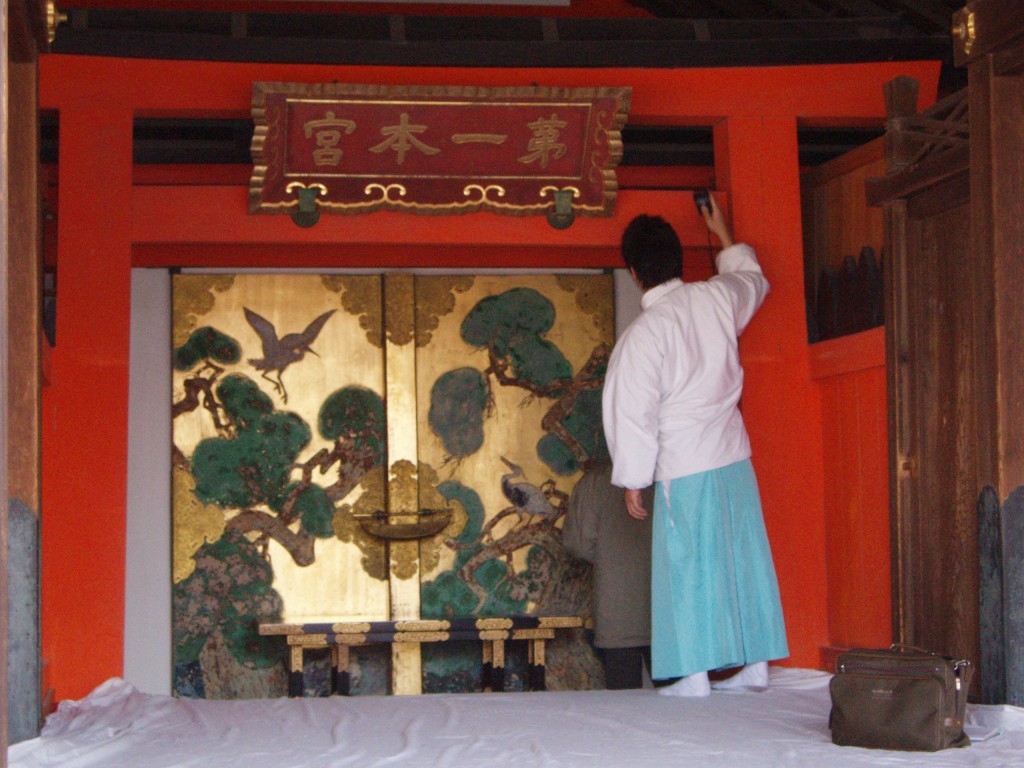
Painted doors inside the first of the Hongu

Rachelle Soto (shrine volunteer)

How and why did you become a volunteer at Kamigamo Jinja (Kyoto)?

When I learned that my husband was going to Afghanistan for 2 years I decided that I would return to Japan during that time.  I packed up my house in Virginia and started planning my immediate move to Kyoto. My original intention was to study Japanese culture at the NCC Center for the Study of Japanese Religions in Kyoto. However, there was some difficulty within the school and they were unable to accept students for the next term.

I reached out to several expats in Kyoto with ties to Shinto and, thanks to Green Shinto, was eventually introduced to an English speaking priest at Kamigamo-Jinja, Mr. Inui. I took a huge risk in coming to Japan without a visa; I secured housing on my own, signed a year-long lease, and was determined to secure a visa studying Shinto. This impressed Mr. Inui at our meeting and, in typical Japanese fashion, weeks went by while he negotiated my case to the Chief Priest who agreed to accept me as a researcher.

What have your duties involved so far?

I am expected to attend as many shrine functions as I am invited to. These range from simple rituals to very elaborate ceremonies. Typically, if there is a lunch hosted for the guests afterward I stay and have lunch with the other guests, the Chief Priest, and the Deputy Chief Priest. I have also helped with clean-up after very busy times at the shrine.

One of several Kamigamo festivals at which there is an English language commentary

How about the language problems?  How do you manage?

Several members of the shrine staff speak English and are incredibly helpful in answering questions and guiding me.  I believe that Kamigamo Jinja has made a great effort at communicating with me and making allowances for my lack of Japanese language skill. At many ceremonies the “MC” will speak in both Japanese and English explaining the ritual. I can speak rudimentary Japanese and I am able to follow directions during rituals that have no English explanation. Afterward I am always encouraged to ask questions on anything I may not have understood.

What is the best experience you’ve had so far?

There are two that come to mind. First, I attended the New Years Eve ceremony and New Years Day ceremony at Kamigamo Jinja. Both were very elaborate and elegant. It was also one of the few times a year that the Honden was opened for food offering to be placed inside. These were very long rituals and the only ceremonies I have attended so far where we visited and prayed at all the smaller shrines (23 total) within Kamigamo Jinja.

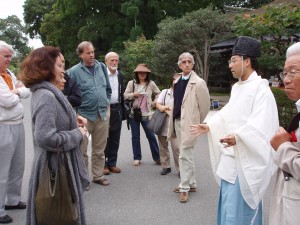
Inui Mitsutaka explaining Shinto matters to a group of interested visitors

The second would be joining the staff and several of the members of Kamigamo Jijna on their pilgrimage to Ise Grand Shrine (approx. 40 people). Because Kamigamo Jinja is the second most important shrine in Japan, our group was accorded special access at Ise Grand Shrine. We entered the inner courtyards at both Geku and Naiku where we were led in prayer by the Chief Priest of Kamigamo Jinja. Due to his high station within Shinto hierarchy, he is one of the few people in Japan allowed to stand in front of the inner torii. We witnessed purifying dances performed inside Kaguraden (Hall of Sacred Music and Dance).

After our visit to Ise Grand Shrine the group dined together and I was given the seat of honor across from the Chief Priest and his wife. He explained in detail the dances that we watched and then invited me to join him exploring Ise City after lunch. He was born in Ise and I was very honored that he spent his time giving me a tour and reminiscing about his childhood.

What difficulties have you encountered?

There have been occasions where misunderstandings arose due to lack of complete communication. I once arrived for a ceremony I had been invited to but apparently when I accepted the invitation they misunderstood my meaning and thought I was declining. When I did arrive, I was unexpected and they had to make last minute adjustments so that I could attend. It caused difficulty for them and embarrassment for me. Now I know to be very clear when I accept an invitation.

What do you think are the strong points of Shinto, and what can it offer non-Japanese?

Shinto is very different from what most Westerners expect in religion, and that difference offers outsiders a great way to expand their perspective.  Personally speaking, Shinto’s ideas of purification and reverence of nature are fascinating for me. Shinto has no commandments, and no codes. You are simply expected to live your life in reverence to the kami and nature.

Rachelle with the Chief Priest of Kamigamo Jinja on the trip to visit Ise jingu

Rachelle off duty from her shrine duties, exploring Kyoto's night life

Setsubun – why beans?

Photo by Makiko Itoh

February 3 is Setsubun when Japanese mark the seasonal break and look forward to the coming of spring.  In Japan’s old lunar calendar, taken from the Chinese, it used to be associated with the New Year which took place around this time.  It’s deeply syncretic, celebrated at both temples and shrines alike.

The main activity at Setsubun is bean-throwing, the idea being that you throw beans at wicked demons to banish them for the coming year.  ‘Oni wa soto, fuku wa uchi,’ (Out with the demons, in with happiness) is the accompanying cry.  But why beans?  What on earth do beans have to do with demon disposal?

An article in the Japan Times last Friday had a full page spread all about Setsubun and the food connection.  History, types, recipes – it was a true feast of Setsubun fare.  The extract below is taken from it, and the full article by Makiko Itoh can be read here.

**************************************************************************************
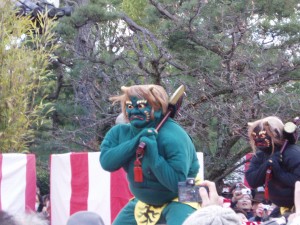
One of the demons that appear at Kyoto's Rozanji

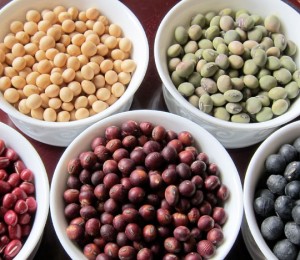
On Setsubun, each household loads up asakemasu, the wooden box in which sake is sometimes served, with roasted daizu, or soybeans. Then the head of the household (or a male in the household whose Chinese zodiac animal matches that particular year) throws handfuls of beans outside of the front entrance while chanting, “Oni wa soto, fuku wa uchi” (“Demons outside, good luck inside”).

Sometimes the rest of the household chants along, “Gomottomo, gomottomo” (“That’s right, that’s right”) as he performs this task; some, especially the kids, play the part of oni by donning paper masks and running from the bean-thrower. This ritual is called mamemaki, or the scattering of beans. Afterward, everyone eats the same number of roasted beans as their age for luck.

(In the north and some parts of the south, peanuts are used instead, probably because they are cheaper and more convenient.)

These days, local temples and their priests perform mamemaki, especially in densely populated urban areas. Perhaps this is for practical reasons: A whole apartment block of people throwing soybeans might be a bit messy. The more likely reason is that the father of any given family is too busy working to be scattering beans, since Setsubun is not an official public holiday.

But why throw roasted soybeans? In Japanese folklore, beans of all types are considered to be symbols of good luck. Stewed kuromame(black beans) are served as part of the New Year’s osechi feast as a symbol of fertility, and osekihan (short-grain mochi rice with adzuki beans that is a bright reddish purple) is a festive dish at many events throughout the year.
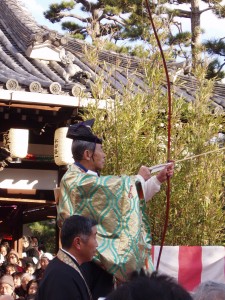
Setsubun ritual at Kyoto's Shogo-in at which arrows are first fired off in the four directions to purify the air

But the use of roasted soybeans for mamemaki is a bit more complicated. Raw soybeans are hard and long-lasting and impossible to eat, just as an oni (demon) or evil is hard to get rid of. But by roasting the beans with fire, they are conquered and become edible — and imbued with special powers. So the throwing of the beans symbolizes the throwing out of evil spirits, and eating them means the person has conquered and digested those demons. It’s a bit complicated, but I’m sure it made a lot of sense to the people of old.

Mamemaki and soybeans are not the only lucky food associated with Setsubun. One that has become very popular in the last decade is the ehōmaki. Each person takes an uncut fat sushi roll, faces the ehō or lucky direction (this changes annually; this year it’s north-northwest), and eats the whole roll in silence. This is supposed to bring good luck to that person for the rest of the year.

The ehōmaki tradition originated in the Osaka area but has spread around the country, mainly due to some convenience store chains heavily promoting the sushi rolls, filling the marketing lull before the big chocolate rush of Valentine’s Day.

Yet another food associated with setsubun is iwashi (sardines). In some regions of Japan, a whole sardine is skewered through the eyeballs on a holly branch, then grilled and displayed outside the house. Sardines are used because they are “blue” fish containing lots of oil, which when grilled emits smoke — believed to ward off evil. Piercing the eyes with the holly, which is considered a sacred plant, symbolizes the piercing of an oni‘s eyes, incapacitating it and making it unable to enter the house.

Occasionally the fish and holly branch are stuck into a knotted rope displayed outside the main entrance. Dried soybean pods are hung with the fish too in some regions. But in some households the bulk of the fish is eaten as part of a Setsubun meal and only the pierced head is hung outside. When my mother was growing up, she and her brothers and sisters would hang the fish heads under the outside porch, since the open underside of their traditional Japanese house was believed to be particularly vulnerable to attacks by evil spirits. Invariably the neighborhood cats would come to make a feast of the fish heads, so they were usually gone by the next day.
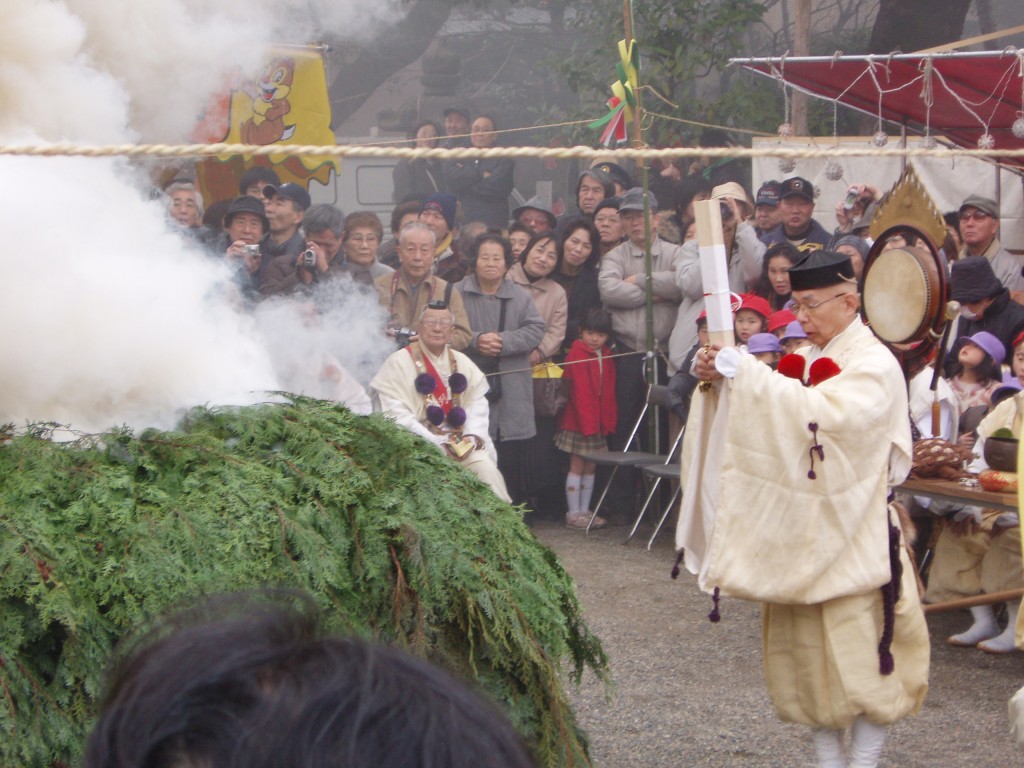
The spectacular Setsubun ritual at Shogo-in carried out by yamabushi (mountain ascetics) with a fire ceremony in which prayers are ritually burnt and sent up to heaven


« Older posts Newer posts »

© 2026 Green Shinto

Theme by Anders NorénUp ↑