Author: John D. (Page 182 of 202)

Dragon baby

A stimulating article from Japan Today….

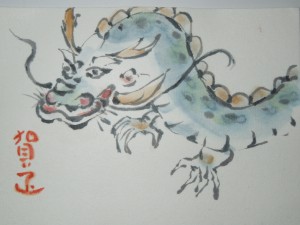
Illustration by Yuriko Suzuki

************************************

The dragon year is regarded as the most auspicious in the almanac because it is the only mythical creature among the dozen animals that represent each year in the Chinese cosmic cycle.

Superstitious Chinese believe children born during the Year of the Dragon—the symbol of ancient emperors—will possess courage and wisdom and bring luck to the entire family.

Past dragon years saw a spike in birth rates in China and other places with predominantly ethnic Chinese populations such as Hong Kong, Taiwan and Singapore, and this year is likely to be no different.

**************************

Despite 2012 falling under the auspices of the dragon, fengshui masters predict a rocky road for the global economy in the coming year in the shadow of the eurozone crisis, together with a prevalence of disease, natural disasters and political reform.

Looking toward a bright future

They say that this is due to the dragon’s pairing with the Chinese water element for 2012, which symbolizes a strong driving force in nature as well as political will and dampens the fire of economic optimism.

But a grim global reality is unlikely to temper couples’ quest for a “dragon baby”, even in Malaysia, where ethnic Chinese are in the minority.

Obstetrician M Devindran, who runs a fertility clinic, expects an increase in pregnancies among Chinese Malaysians.

“The dragon sign is a very powerful cosmic sign and in my practice, I have seen a 10 to 15% increase in Chinese couples who are trying to conceive a dragon baby,” he told AFP.

Popularity stakes

Yahoo Travel has come up with an eyebrow-raising list of the world’s most popular spiritual sites.  Places that spring to mind might include the Vatican, Stonehenge, Varanasi….  but the world’s no. 1, according to the site, is Meiji Shrine in Tokyo!!  Now that’s a surprise…     Of course we know that shrines get packed at certain times, and Meiji Shrine is the most popular shrine in the country at New Year, so perhaps the more than 3 million visitors then are enough to propel the shrine to the top of the popularity stakes.  As well as Meiji Jingu at no. 1, the Top Ten includes Tsurugaoka Hachimangu Shrine at no. 7 and Ise Jingu at no. 10.  There are Japanese temples too in the Top Ten: Narita Shinshoji at joint no. 7, Kiyomizu and Kinkakuji too at joint no. 7.  Amazing…. and they say the Japanese are not religious!

[Altogether 43 sites are listed.  Please click here for the full list.]

World’s Most-Visited Sacred SitesThe Meiji Shrine in Tokyo (Julie Nassiet)

The Meiji Shrine in Tokyo (Julie Nassiet)

Tokyo‘s Harajuku neighborhood is famous for its loud street fashion (embraced by singer Gwen Stefani, among others), but it’s most popular attraction is hardly a household name. The tranquil Meiji Shrine attracts roughly 30 million annually, as does the Sensoji Temple, making them the world’s most-visited sacred sites.

While each religion has its holy seasons, there’s always a reason to visit sacred sites, whether you’re intrigued by the history, art, or simply following a packaged tour. Whatever the day, you’ll find Catholics attending mass at Mexico City’s Basilica of Our Lady of Guadalupe (No. 3), among casual tourists and others who’ve traveled here expressly to pay their respects to an image of the Virgin Mary.

Pilgrimage is indeed one of the oldest motives for travel—and going strong. But that doesn’t mean pilgrims’ destinations are necessarily the most-visited sacred sites. Some of the popular spots may surprise you. And the huge number of visitors they attract will make you a believer in their power.

No. 1 Meiji Shrine and Sensoji-Temple
Tokyo

Annual Visitors: 30 million each

Built 100 years ago to honor the divine souls of Emperor Meiji and Empress Shoken, the tranquil Meiji Shinto shrine is surrounded by a holy forest of 100,000-plus trees. Gardens feature spring azaleas, summer irises, autumn foliage on Japanese maples and gingkoes, and black pines dusted with winter snow. Sensoji, also in central Tokyo, was dedicated to Bodhisattva Kannon, the most compassionate Buddha, in 628. Its five-storied pagoda is dramatically lit at night. Continuing centuries-long tradition, stalls along the temple’s Nakamise Street sell food and goods to visitors—whose numbers swell around New Year’s.

No. 2 Kashi Vishwanath Temple
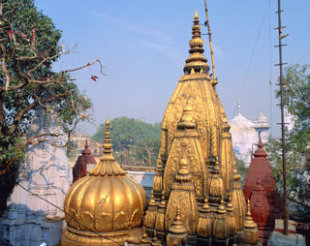
Kashi Vishwanath Temple, India (Robert Harding Picture Library Ltd / Alamy)Kashi Vishwanath Temple, India (Robert Harding Picture Library Ltd / Alamy)

Varanasi, India

Annual Visitors: 21.9 million

This temple with its two golden domes sits along the western bank of the Ganges River and, with the Ganges, is the most holy site for all sects of Hinduism. Believers bathe in the river to cleanse their souls and reduce or eliminate the need to be reincarnated. Recently the government has worked to improve the quality of the water, where many millions also make offerings of flowers, food, and floating oil lamps.

No. 3 Basilica of Our Lady of Guadalupe
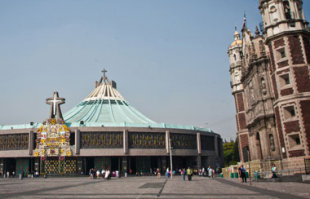
Basilica of Our Lady of Guadalupe, Mexico City (Jayda Tham)Basilica of Our Lady of Guadalupe, Mexico City (Jayda Tham)

Mexico City

Annual Visitors: 20 million

The Old Basilica, begun in the 1500s and completed in 1709, stands in stark contrast to the massive new basilica that was built in the mid-1970s and looks like a sports arena. It is, in fact, designed to hold 50,000 people, who come for mass—celebrated several times daily—and to see an image of the Virgin Mary that is said to have appeared on an apron in 1531.

No. 4 Tirupati Tirumala Devasthanams Temple
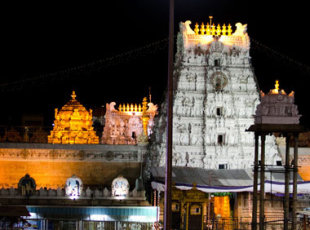
Tirupati Tirumala Devasthanams Temple, India (Buddha Dilip Murthy)Tirupati Tirumala Devasthanams Temple, India (Buddha Dilip Murthy)

Andhra Pradesh, India

Annual Visitors: 18.25 million

A Hindu sect called Vaishnavism that emphasized equality and love began this imposing temple perhaps 1,200 years ago. Legends mentioned this area, and pilgrims and visitors still come to see or worship at the many shrines, halls, and statues throughout the 10-square-mile complex on the 3,200-foot-high Sacred Hill.

No. 5 Notre Dame Cathedral

Notre Dame Cathedral, Paris (Sathish Jothikumar)Notre Dame Cathedral, Paris (Sathish Jothikumar)

Paris

Annual Visitors: 13.65 million

The most-visited tourist attraction in France(see the world’s top tourist attractions) hardly has a space that’s not filled with statues of saints and angels, 30-foot-diameter stained-glass rose windows depicting Bible stories, or symbolic geometric shapes representing both limits and boundlessness. It’s weathered evolving styles and renovations since its 1345 debut and today is as much an art gallery as a place of worship.

No. 6 Sacré Coeur Basilica
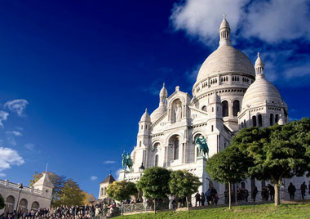
Sacré Coeur Basilica, Paris (Cristina Dawson)Sacré Coeur Basilica, Paris (Cristina Dawson)

Paris

Annual Visitors: 10.5 million

Druids, Gauls, and Romans who once worshipped their gods Mercury and Mars chose this scenic hilltop for their temples. A brilliant white, 19th-century Romano-Byzantine basilica crowns this Hill of Martyrs—with the intent to cleanse it from a violent historical past while wowing visitors with a panoramic view of the city below.

No. 7 Naritasan Shinshoji Temple
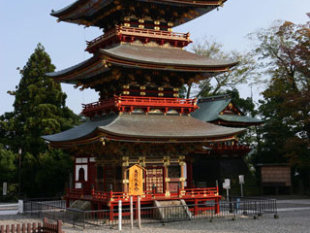
Naritasan Shinshoji Temple, Japan (PRISMA ARCHIVO / Alamy)Naritasan Shinshoji Temple, Japan (PRISMA ARCHIVO / Alamy)

Chiba Prefecture, Japan

Annual Visitors: 10 million

Proximity to Tokyo’s Narita International Airport makes this Shingon Esoteric Buddhist temple, founded in 940, an easy stop for air travelers with long layovers. For a fee, soothsayers and vending machines promise to reveal your fortune. The temple itself is dedicated to the god of fire, and fire rituals are carried out several times each day.

No. 7 Tsurugaoka Hachimangu Shrine
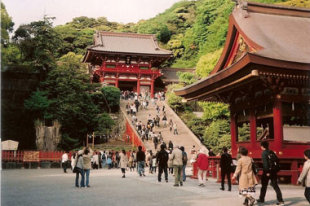
Tsurugaoka Hachimangu Shrine, Japan (Ryuji Yamamoto)Tsurugaoka Hachimangu Shrine, Japan (Ryuji Yamamoto)

Kanagawa Prefecture, Japan

Annual Visitors: 10 million

The pleasant walk through gardens, beside cherry trees, under torii gates, and past two ponds with three small bridges and seven islets belies the Shinto shrine’s 12th-century origins as an homage to the god of war. The site’s two-and-a-half-acre Peony Garden is at its most vibrant from mid-April through May, but it also nurtures 500 peonies that actually bloom during January.

No. 7 Kiyomizu-dera and Kinkaku-ji Temples
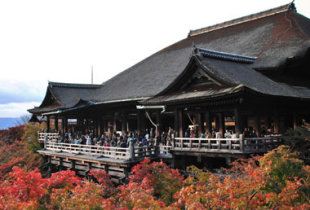
Kiyomizu-dera Temple, Kyoto (Griselda Alvarez)Kiyomizu-dera Temple, Kyoto (Griselda Alvarez)

Kyoto

Annual Visitors: 10 million and 6 million

The ancient UNESCO-listed Kiyomizu-dera or “Pure Water Temple” is on the side of Otowa Mountain. Springs feed the Otowa Waterfall, and Buddhist pilgrims drink the sacred water by following strict ritual. Visitors also take in the panoramic view of Kyoto’s city center. On the opposite side of the city, gold leaf covers the top two floors of Kinkaku-ji, a three-story Zen Buddhist temple originally built in the early 15th century for a shogun. While visitors are not allowed inside to see the statues of the Shaka Buddha, Kannon Bodhisattva, and the Four Heavenly Kings, these can sometimes be glimpsed from the far side of the pond in front of the temple. Bring binoculars.

No. 10 Ise Jingu
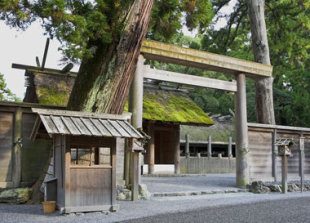
Ise Jingu, Japan (PRISMA ARCHIVO / Alamy)Ise Jingu, Japan (PRISMA ARCHIVO / Alamy)

Ise, Japan

Annual Visitors: 8.5 million

Nearly 14,000 acres of this Shinto shrine complex is a “divine forest” of Japanese cypress, but the trees were worshipped here long before temple construction began in the third century. Three museums covering local history, agriculture, and fine arts are on a hill near the center of Ise Jingu, which the Japanese government has designated as a National Treasure.

Shimogamo Okayusai (Rice porridge festival)

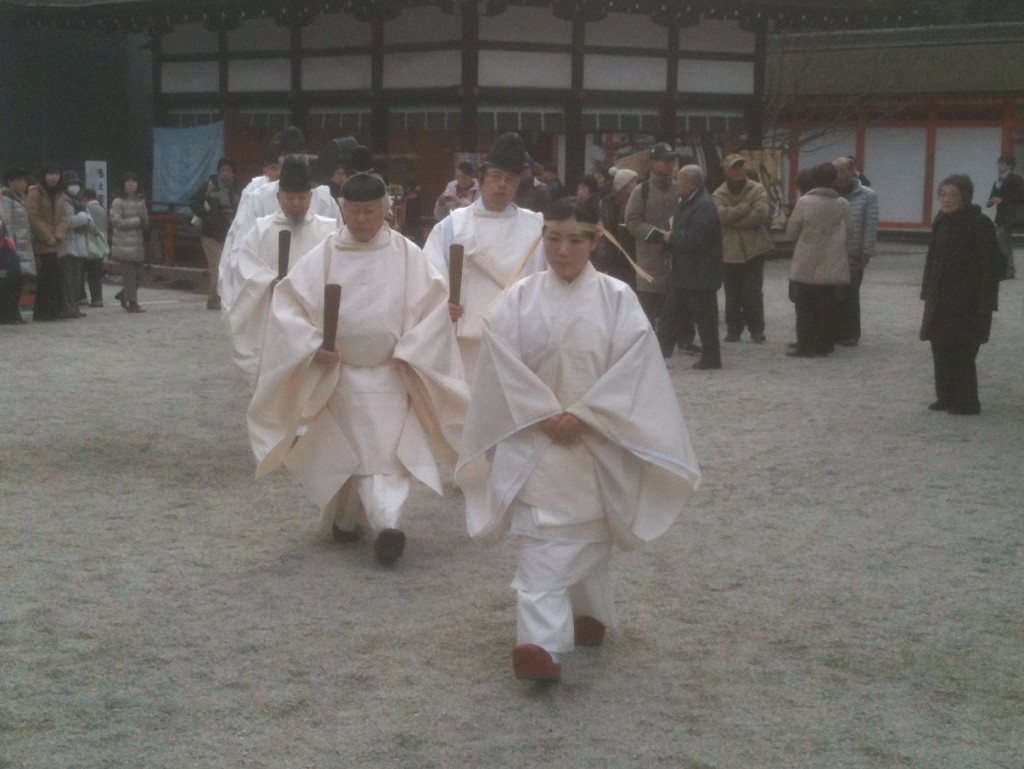
Priests parade to the main shrine for the opening rituals


One of the New Year rites at Shimogamo Shrine is the Okayu Festival, in which visitors to the shrine are invited to eat rice porridge in the belief that it will prevent illness during the rest of the year.  It’s warming and healthy, so no doubt it had a beneficial effect in times past when disease was rife and nutrition poor.

Shoes of the priests while they carry out the rituals inside the shrine

The formal rituals were carried out by priests in the standard manner: purification, offerings, norito prayer.  There were about fifty people gathered to watch, and one unusual feature was that, because of the twinned main shrines the offerings were done simultaneously by two different priests.  As one priest set off on the lefthand side with offerings for the kami Kamo no Taketsunomi, another set off on the right side for his daughter, princess Tamayori.

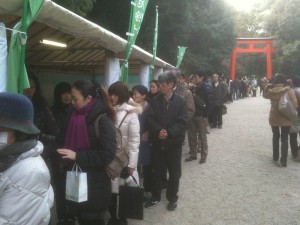
The rituals lasted about half an hour in all, with the four trays of offerings being brought back one at a time before the priests paraded back through the compound.  Afterwards we joined the busloads of tourists who were lining up in a queue to get some of the warming gruel.

It’s an archaic custom, you might say, yet it’s amazing how popular such rites continue to be.  The Japanese retain a strong sense of seasonal awareness, and there’s something comforting and appropriate about marking the calendrical round in these ways.  January’s a busy time as the new year gets underway.  Let’s hope it all helps set us on the right course for the rest of the year!

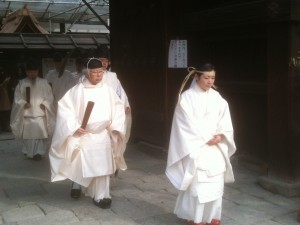
Priests returning after the rituals

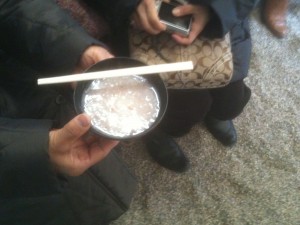
Afterwards a warming bowl of rice porridge

Lining up to get a bowl of gruel

A bright crisp winter's day brought out the best of the Tadasu woods

Celebrating Chomei (Shimogamo Shrine)

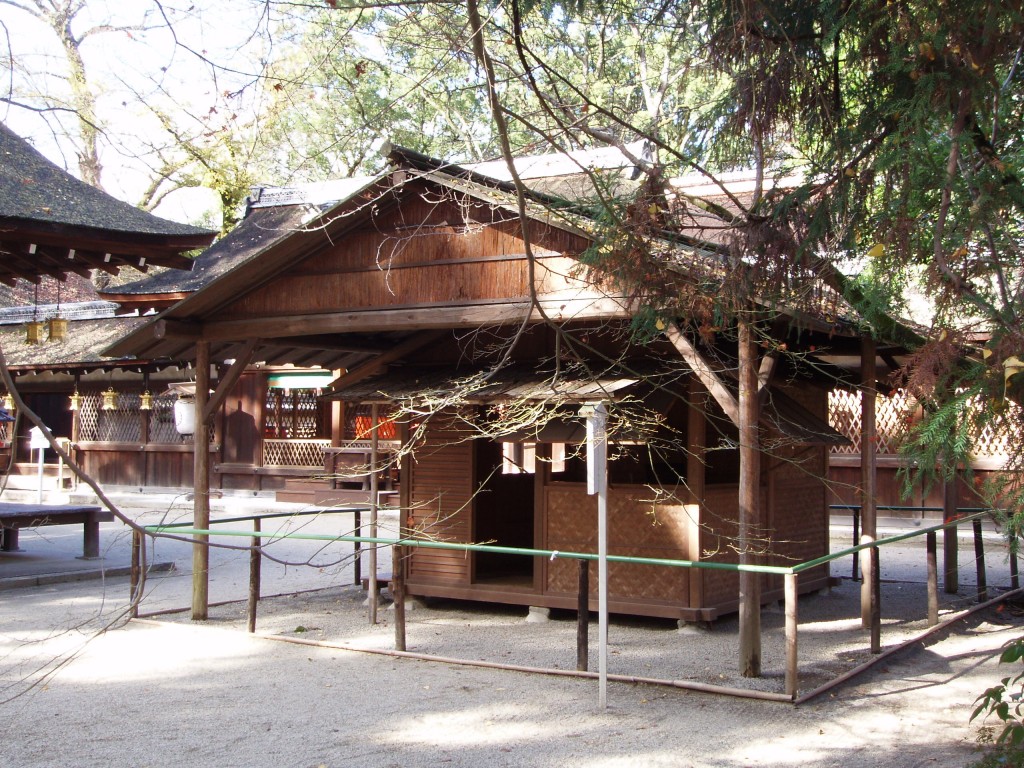
Model of Kamo no Chomei's hut at Kawai Jinja, within Shimogamo Shrine. The hut itself is beneath the large protective roof.


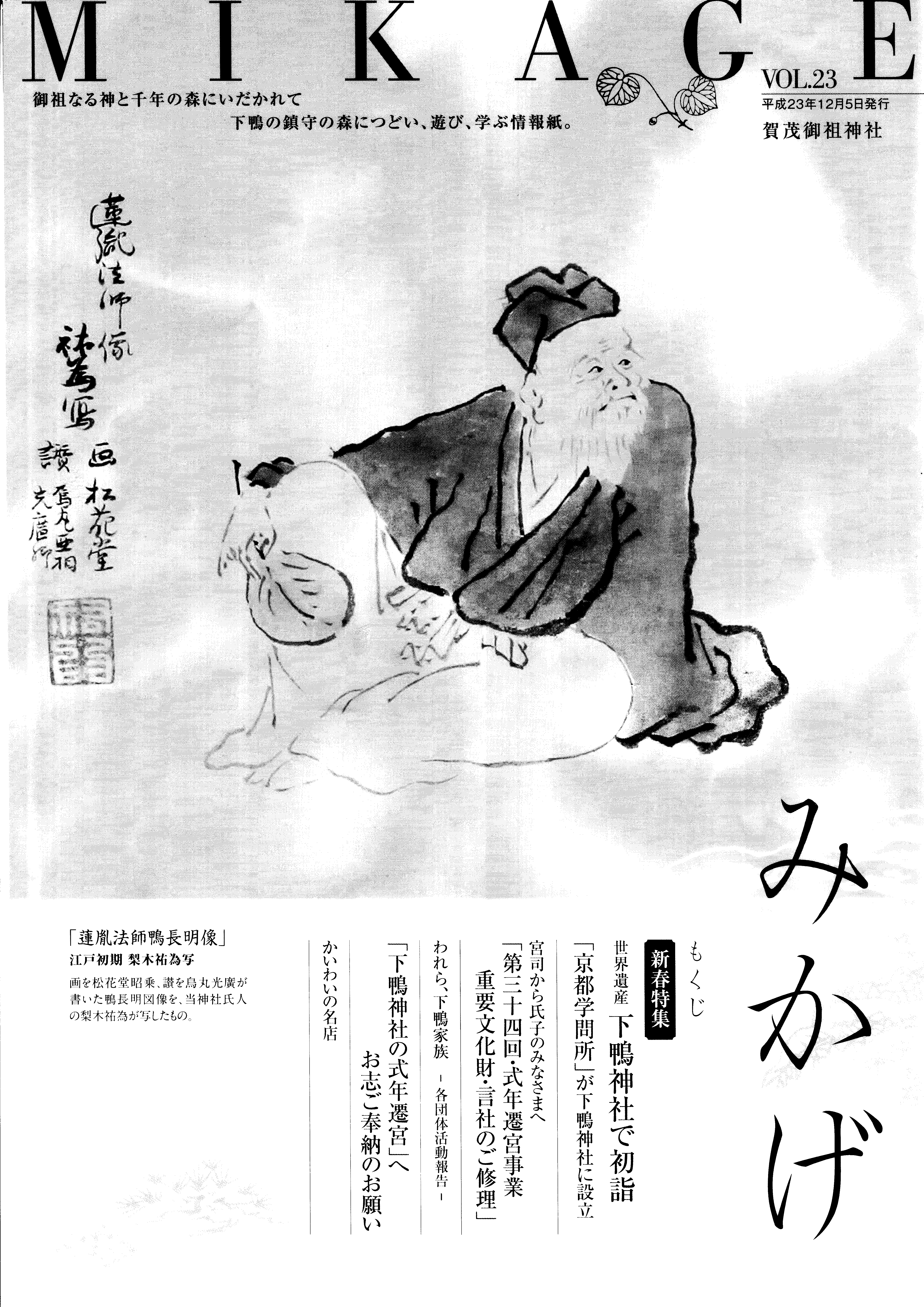
More than 1000 years ago my local shrine, Shimogamo Jinja, used to house a school and museum.  By way of commemoration a panel of local academics has been set up to promote the shrine, and their first initiative is a contest on the theme of Hojoki, the thirteenth-century essay by Kamo no Chomei (1153-1216) who was once a priest at the shrine.

Like others of his age, Chomei was syncretic in religious matters.  Disillusioned by being passed over for promotion (he expected to take over his father’s position), Chomei became a Buddhist recluse and wrote of his solitary life in the manner of Thoreau’s Walden. The competition being run by the shrine is timed to celebrate the seven hundredth anniversary of the book.

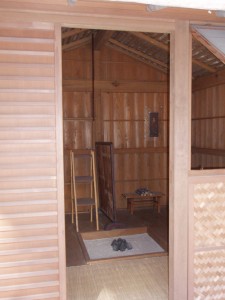
Inside the ten-foot square hut

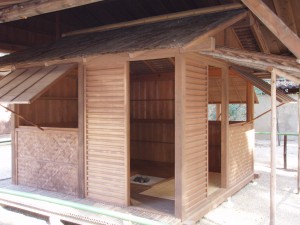
At the age of fifty Chomei left his family life to dwell in the midst of nature on a hill near Uji.  There he built a ten-square foot hut known as Hojoki, a model of which stands in Kawai Jinja, a shrine within the Shimogamo complex. It looks like a glorified summer hut, with a small porch and Heian-style shutters.  In summer it was open to the elements, and in winter a fire converted it into a smoky haven.

“It is a hut,” wrote Chomei, “where, perhaps a traveller might spend a single night; it is like the cocoon spun by an aged silkworm.  This hut is not even a hundredth the size of the cottage where I spent my middle years…  A bare two carts would suffice to carry off the whole house.”

Back to nature

Chomei’s account wanders from topic to topic in the zuihitsu (‘follow your pen’) style and describes his life in the ten-foot square hut. Descriptions of the natural disasters during his lifetime almost beggar belief.  Fire, whirlwind, famine and earthquake follow in quick succession.  Corpses lie in the streets, and infants suck at the breasts of dead mothers.  Thoughts of death are never far from Chomei’s mind, and like Shakespeare he believes that readiness is all.  Indeed, the whole seasonal round seems to him one year-long reminder:

“In the spring I see waves of wisteria like purple clouds, bright in the west.  In the summer I hear the cuckoo call, promising to guide me on the road to death.  In the autumn the voice of the evening insects fill my ears with a sound of lamnetation for this cracked husk of a world. In winter I look with deep emotion on the snow, piling up and melting away like sins and hindrances to salvation.”

The Hojoki model with its shutters and doors open

The author describes his life in appealing terms.  It must have been lonely and at times miserable, but he makes it sound idyllic.  “The best friends one can have are flowers and moon, strings and pipe,” he says of his solitude.

He uses fresh rainwater for tea and soup, eats home-grown mushrooms, herbs and fruit, and for exercise he wanders to a nearby temple, or makes sorties to places of poetical interest.  He plays music too which harmonises with the rhythms of nature.  “My body is like a drifting cloud – I ask for nothing, I want nothing.  My greatest joy is a quiet nap; my only desire for this life is to see the beauties of the seasons.”
You can’t help liking someone who takes such pleasure in the little things of life. “I seek only tranquility; I ask only for the absence of grief,” he writes.  This modest monk even ends his account by wondering if he has not become too attached to his solitary life.  “It is a sin for me to love my little hut, and my attachment to solitude may be an obstacle to enlightenment.”  Freed from the ‘dust of the world’, Chomei was able to muse on life’s many blessings.  The reader is the beneficiary.

************************************************

The photo/essay contest is announced in the current Shimogamo magazine, Mikage, and is open to people of all nationalities.  Entries can be photos of the shrine, the Hojoki hut or Tadasu woods.  Essays or poems can be on the theme of Kamo or Kamo (Kamo River or Kamo no Chomei).  The fee for each entry is Y800, and prizes range from Y10,000 to Y300,000.  Details of application can be had from the shrine.  Deadline is the end of June, so plenty of time to plan your Shimogamo visit and get creative.  Good luck!  I’ll be putting in an entry myself so you’ll be competing against me too…

Shimogamo shrine magazine with picture of Kamo no Chomei

Shimogamo First Zodiac Festival (Hatsuetosai)

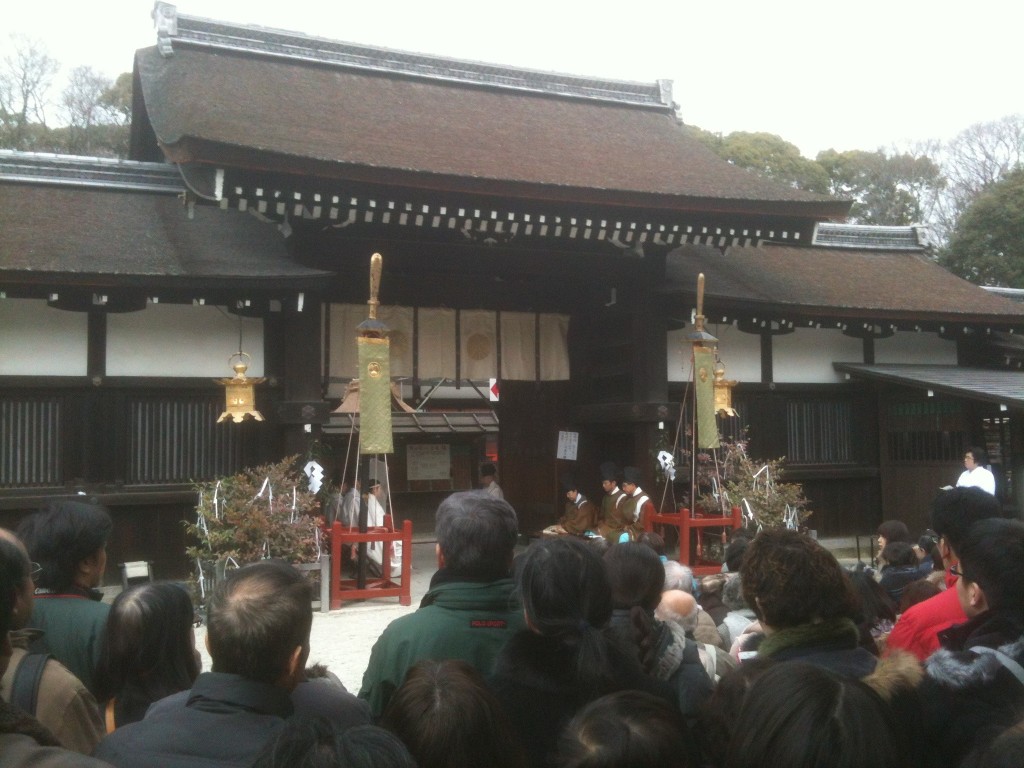
Gathered for the ritual at the entrance to the inner courtyard

My local shrine, Shimogamo, welcomes in the new year with a series of rites, one of which is kicking a football around (kemari) and another of which is kicking off worship at its zodiac shrines. The latter are unique as far as I know: at least I’ve never come across their like elsewhere.

Shimogamo’s main shrines are dedicated to clan founder, Kamo no Taketsunomi, and his daughter, Tamayorihime (see previous article).  in the small courtyard in front of them stand much smaller shrines known as hokora, each of which is dedicated to one or two of the animals in the Chinese zodiac year.

Two of the zodiac shrines, with miko (shrine maiden) in the foreground

There are seven shrines in all, five of which house pairs of animals.  The dragon is paired with the monkey, the cow with the boar, the rabbit with the cock, the sea horse with the sheep, and the tiger with the dog.  The horse and the rat get one each, making a grand total of twelve animals in all.

So why seven shrines is the obvious question? According to a shrine leaflet, they correspond to the seven manifestations of Okuninushi (Great Land Master), a kami associated with Izumo Shrine.  Okuninushi, it turns out, has seven different names for the various guises in which he appears.  All very interesting, but what’s Okuninushi got to do with the Chinese zodiac?  Or indeed with Shimogamo?  ‘The shrine is very old, there are many legends and stories which have been handed down since ancient times,’ a priest told me.  ‘Actually we don’t know why.’

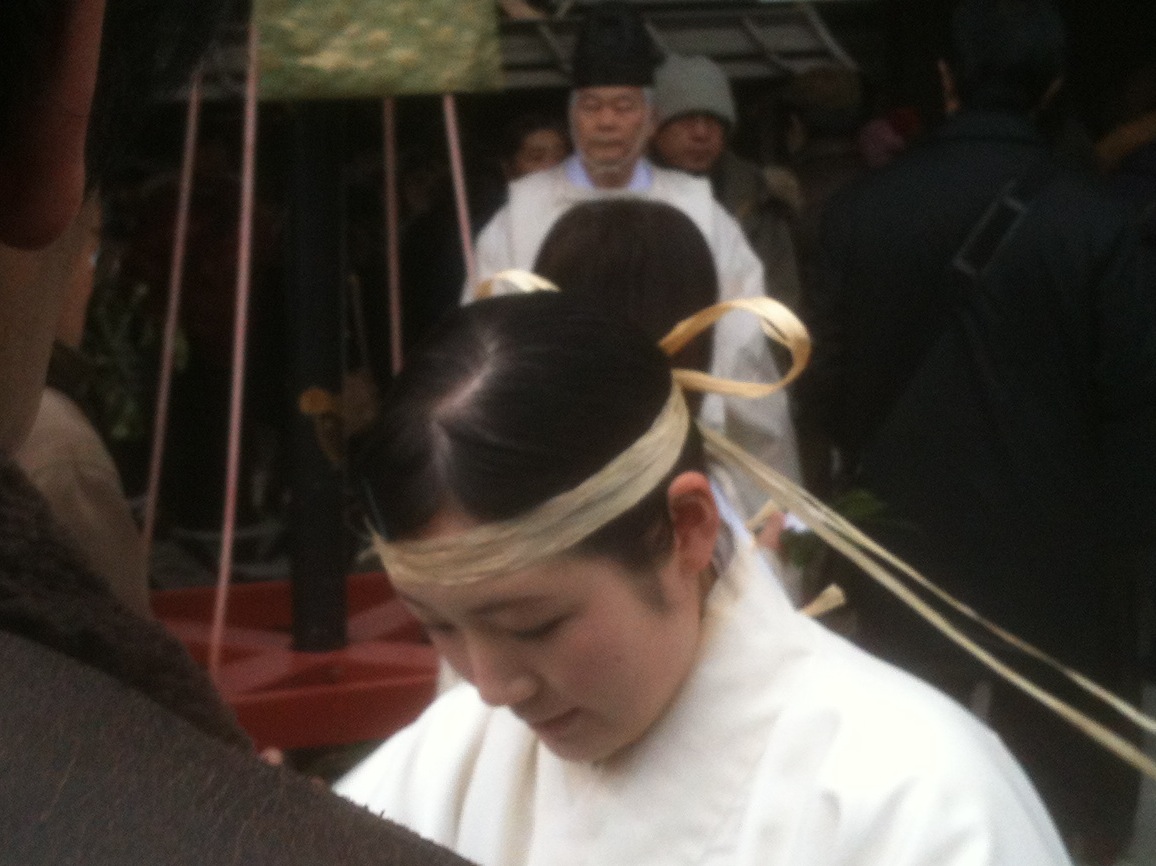
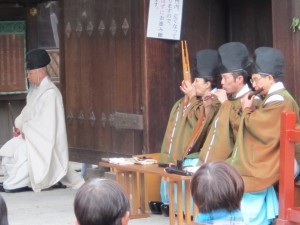
The ceremony took place at the entrance to the inner courtyard, and I guess there were about a thousand people in attendance.  There was live gagaku music, and a priestess with a most unusual head dressing (rice twine tied round the head with a large bow at the back: see the photo).

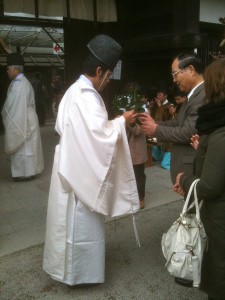
Receiving the tamagushi sprig

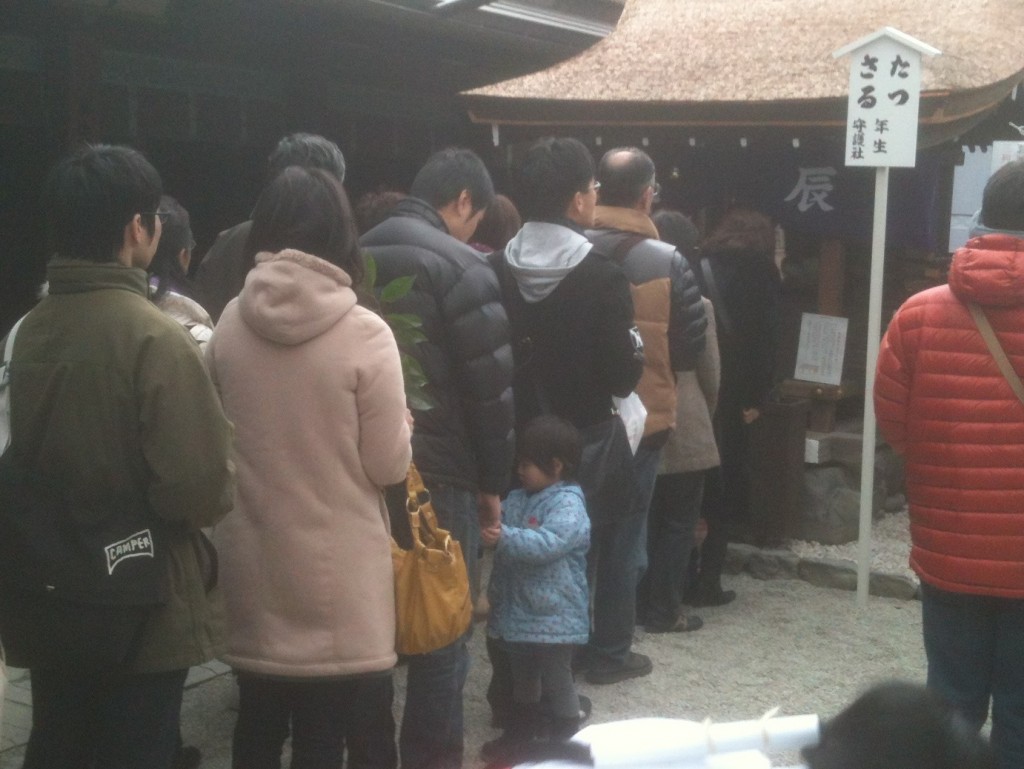
The short rites comprised offerings, purificatiion and norito prayer, before each of us were presented with a sprig of the sakaki tree (known as tamagushi) which we offered to our respective zodiac sign.  Not surprisingly, the queue for the dragon was by far the longest, no doubt because people born in that year made a special point of attending.

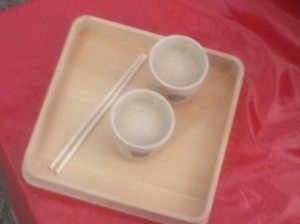
Afterwards there was some delicious warm ginger-laced saké on sale and a chance to saunter around the Tadasu woods.  There were a large number of saplings bearing labels, which I assumed to be identifications of the type of tree.  However, they turned out to be the names of donors.  At this rate every tree in the wood will pretty soon be identifiable by its donor – kind of strange for ancient woodland, I couldn’t help thinking, but managing woods in Japan is more costly and time-consuming than one might imagine.

This New Year ritual, like the others that precedes it, gives one a real sense of starting off something new.  It’s that sense of renewal and revitalisation that Shinto is so good at cherishing.  Let’s hope that launched in this way the year of the dragon proves to be reinvigorating for one and all!

Some soul-warming sweet saké laced with ginger

Gagaku musicians adding some mood music

Queuing up at the dragon shrine, where as the sign indicates it peacefully coexists with the monkey

Shimogamo New Year

Kamo kami

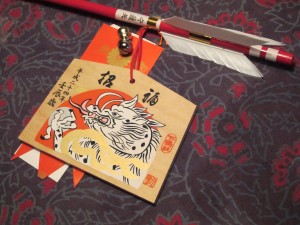
New Year arrow for good luck in the year of the dragon

Living next to a World Heritage site has its advantages, one of which is being able to pop across the road to make the first shrine visit of the new year.  I did it rather late this year, on Jan 7, but there were still crowds of people and in front of the main shrine more than 100 in a long queue to pay their respects to the kami: legendary Kamo clan leader, Kamo no Taketsunomi, and his daughter, princess Tamayori.  And thereby hangs a tale…

It’s said that Princess Tamayori (whose name means spirit caller i.e. a shamaness) was doing purification at the river one day when a red arrow came floating past.  She picked it up, took it home and placed it by her as she slept (one variant has the arrow manifesting as a shining young prince).  Lo and behold, she became pregnant and her child turned out to be a young prodigy, Wakeikazuchi.  When asked one day about his father, he proclaimed that he was in fact a thunder deity and shot up into the sky.  He is now enshrined at Kamigamo Shrine.

In one of the Shimogamo leaflets it explains the spiritual characteristics of their kami.  Princess Tamayori, understandably, is a deity of childbirth and parenting.  Her father, Kamo no Taketsunomi, is a guardian of Kyoto and by extension of the country as a whole.  He also, oddly, is a kami of world peace, which makes one wonder why Emperor Komei in 1863 should have come here to pray that no foreigners be allowed to despoil the sacred soil of Japan.

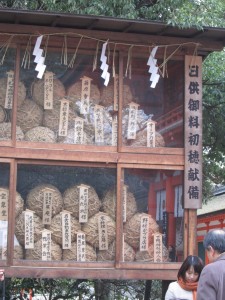
Rice bundles donated by various companies

In shrine lore, Kamo no Taketsunomi is associated with yatagarasu, the three-legged crow of Japanese mythology (now used as a symbol for the Japan’s soccer team). The crow was an emissary of the sun-goddess sent to aid Emperor Jimmu as he battled his way across the Kii peninsula.  My supposition is that a Kamo ancestor – a shaman of the crow clan – aided the Yamato invaders and that sometime later a descendant settled on Mikage hill in Kyoto’s eastern mountain range (Mikage shrine marks the site of his palace).  The two figures were possibly conflated in the figure of Kamo no Taketsunomi – but that’s mere supposition.

Later it seems the family moved to the site of the present Shimogamo shrine, where princess Tamayori got herself pregnant. The early death of her son prompted the clan to deify him as a thunder deity, and a split in the Kamo clan led to the setting up of a new shrine in his honour at Kamigamo, followlng a vision that the thunder deity had landed on a stone altar (iwakura) Mt Koyama towards which the shrine is oriented.

(The above is simply my attempt at a literal reading of the mythology, so I hope no one will take it for historical fact.  For one thing the priests at Kamigamo assert the primacy of their shrine and claim Shimogamo is an offshoot, so I may be getting myself in hot water!)

Changes

Shimogamo is noted for its antiquity, and no one knows for sure when the shrine was founded.  It was here before the capital was established in 794, and remains from Jomon times have been found on the precincts. The pride of the shrine is a forest called Tadasu no mori mentioned in the Tale of Genji (c.1000) and supposedly a remnant of the original primeval forest that once filled the Kyoto basin.

I’ve been living next to the shrine for fifteen years now, and surprisingly there have been some dramatic changes during that time – including to the Tadasu woods.  Replanting, path making and restoring an ancient waterway have meant constant activity. It seems every time I visit Shimogamo there’s an innovation of some kind, for the shrine is constantly striving to attract more visitors.  It’s a reminder of how even the biggest shrines have to pay for themselves and earn their way.

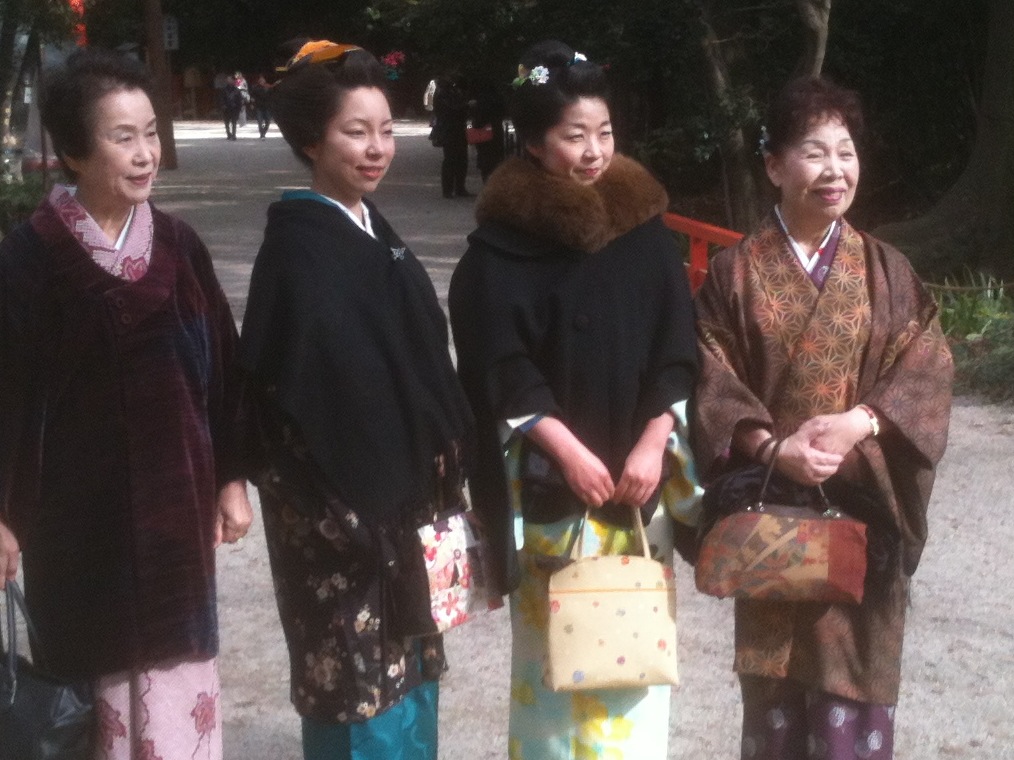
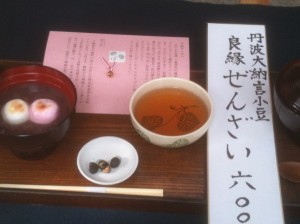
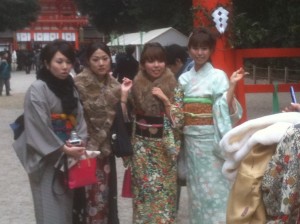
In recent years I’ve noticed a number of improvements.  More noticeboards with explanation and historical information.  More leaflets and literature.  There’s even a new pavilion for visitors to enjoy a green tea set.  It’s said that large shrines like Shimogamo can earn enough for the whole year’s expenditure from the New Year period, so hatsumode (first visit of the year) is big business.  It’s an opportunity too for folk to show off their finery…

The shrine offers good photo opportunities

There's a nice tea set too to enjoy


The new tea pavilion in the grounds

Posing for a New Year pic before the torii


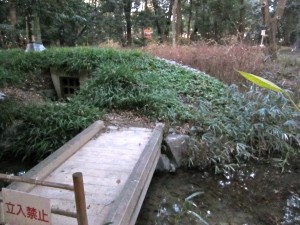
This time I made an interesting discovery in the woods, where a pathway has been cleared.  Excavations have unearthed a small island shaped like a boat, dating from early Heian times.  A noticeboard in English says that in shrine lore it’s known as the Heavenly Bird Boat and is thought to be where the kami descended.  Ceremonies were held before it in the woods – nice!  On one side is a well, which was the site of rain dancing rituals right up to the Edo period and pre-modern times.

Heavenly Bird Boat Island

The shrine’s currently undergoing its 34th cycle of the shikinen sengu rebuilding, which means buildings being temporarily out of action.  The rite is carried out every 21 years, as at Ise, and is due for completion in 2013.

Only about ten shrines still keep to the practice, which originally meant complete rebuilding but at Shimogamo is limited now to repairs.  It’s a fundamental part of Shinto’s belief in renewal and revitalisation, and it’s thought that the 21 year cycle is generational in allowing a new breed of craftsmen to learn from their predecessors in the many skilled jobs involved – nailless carpentry, thatching, weaving, etc.

Good connections

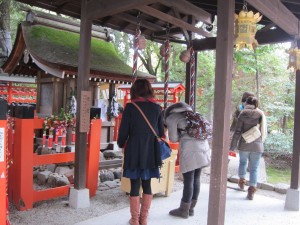
One feature the shrine has eagerly promoted since I moved into the area is the Aioi Jinja – a subshrine dedicated to ‘good connections’ (enmusubi).  There’s been a boom in recent years for such shrines among young Japanese women, a demographic which is said to have the biggest surplus spending capital anywhere on earth.  When I arrived fifteen years ago, the subshrine was in a poor state and pretty much neglected.  Now it’s been nicely fenced, prettified with bell ropes, and a small walkway made around the ‘renri no sakaki‘ tree whose intertwined trunks are a symbol of conjugal devotion.  I noticed that for the New Year there was an extra touch: flowers decorating the perimeter fence.

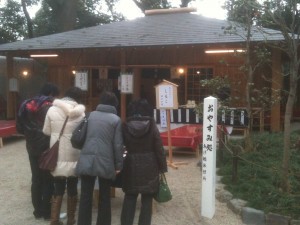
Praying for a 'good connection'

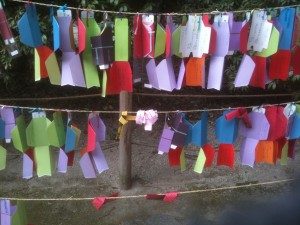
Colourful Genji-themed fortune slips

The shrine leaflet points out that prayers here need not be limited to the young, for parents can make requests of on behalf of their children.  Nor need the ‘good connections’ be limited to love, for they could also affect other areas of life.  But couples who are brought together by the kami in this way are welcomed to celebrate their wedding at Shimogamo – good business for the shrine.

Brightly coloured fortune slips have been made specially for the shrine with a Genji theme, since the Tadasu woods are mentioned in the novel.  The colours mirror those of the elegant kimono worn by the aristocrats of those times, and each fortune slip is titled after a character in the book.  Mine was no. 50 amongst the males and was named after Azumaya.  Apparently if I’m patient, something or someone good is going to turn up, so it looks like I’ll have to bide my time.

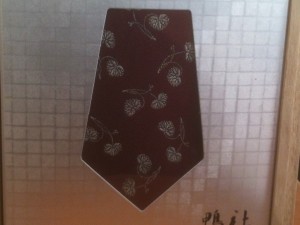
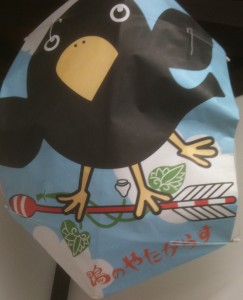
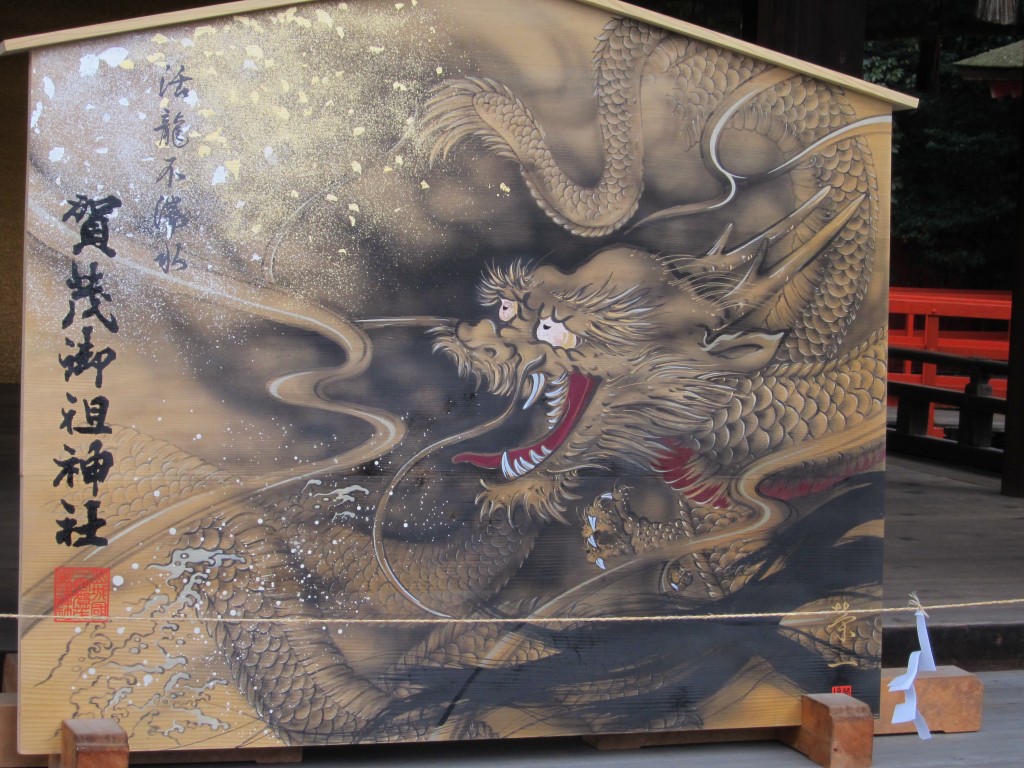
The shrine is doing its best in terms of outreach, even to those unable to visit the shrine for some reason. You can simply phone in your request and the priests will pray on your behalf and send you the relevant amulet. This time too I noticed quite a few extra goods in the shrine shop.  Dragons were much in evidence of course, as well as the shrine’s motif of the aoi leaf after which its most famous festival is named.  One popular motif is that of yatagarasu, the three legged crow associated with Kamo no Taketsunomi.  All in all, this New Year, I got the impression things were flourishing at Shimogamo.  Perhaps it bodes well for the year ahead…..

Tie for sale featuring the aoi leaf

Children's kite featuring a happy crow. Count the feet...

Large dragon ema board on display for the New Year


***********************************************************************************************

Both Shimogamo and Kamigamo have websites with some English information provided. Kamigamo also offers English-language tours and purification for visitors to the shrine.

The awesomeness of C.W. Nicol

In an inspirational article in the Japan Times, Welsh-born C.W. Nicol, now a leading Japanese conservationist, talks of the spiritual strength he derives from the country’s woodlands.  Below is an extract… (the full article can be seen here.)

************************************************************************

C.W. Nicol (photo by Simon Wearne)

It’s reckoned that 67 percent of the country is covered in trees, most of which are neglected, secondary-growth mixed woodland or single-species plantations of conifers — and here in Nagano Prefecture [Nicol lives near Kurohime] it’s almost 80 percent woodland and forest. Yet despite such abundance, Japan imports 80 percent of its lumber and employs only 50,000 people in the forestry business…

Speaking of great unknowns, though I was raised as a Christian and enjoyed singing carols in the church choir as a boy, I feel no deep sense of reverence in a church, a cathedral or a Buddhist temple. I’ve never been inside a mosque, so I don’t know about that. However, in a great, ancient forest, I feel a deep sense of awe and wonder. In our woodlands I feel gratitude and a confirmation of life.

I’ve spent a lot of time with the Canadian Inuit, and learned more from their elders than I ever have from any vicar, bishop, preacher or priest. So when I first heard about Ainu beliefs from the great Ainu leader and linguist Shigeru Kayano (1926-2006), Inuit chords were strummed in my heart. I felt that here in Japan, there also still lived a vibrant and genuine respect and reverence for sustaining nature.

Twenty-five years ago, on a freezing winter day in Hokkaido, I sat around a fire outside going through an Ainu ritual with a group of elders who had urged me to take part. Not long after, a photograph of us all garbed in Ainu robes and headdresses appeared in The Japan Times — with a caption indicating that I was one of the Ainu elders. Oh, how my head swelled! I was proud.

Woods were mankind's earliest temple

In traveling many times to Hokkaido, and having made several documentaries there, I have taken part in many Ainu rituals. However, it was particularly special for me when, at his home in Nibutani on Jan. 17, 2006, Shigeru Kayano declared that I was an “honorary Ainu,” and handed me an Ainu kimono his wife — who’d prepared a delicious venison stew — had made and embroidered for me.

It was the last time I would meet and talk and laugh with that wonderful elder. In the evening, when I gave a public lecture, the Kayano family told me to wear the kimono, and ever since I’ve started going into our woods on New Year’s Day, I’ve worn it. With the kimono I remember him.

I never forget that the woods, the streams, the lakes, the shores and all life are a part of us and that we are a part of them. This is, as far as I am concerned, an indisputable truth. Therefore, are we to be a healthy, renewing part of the body of life — or a cancer destroying it?

The choice must be made by each and every one of us. The planet itself is not endangered; Earth has gone through many trials before and has immense time on its side. But we humans, and everything altered or created by us, could easily wither and vanish. Let’s not keep on doing the same old things, challenging and presenting futile barriers to nature. Let this Year of the Dragon be the year of a happy dragon, not a rejected and angry one.

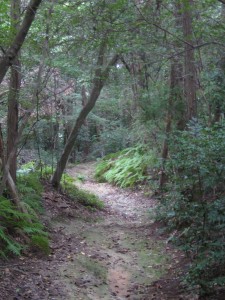
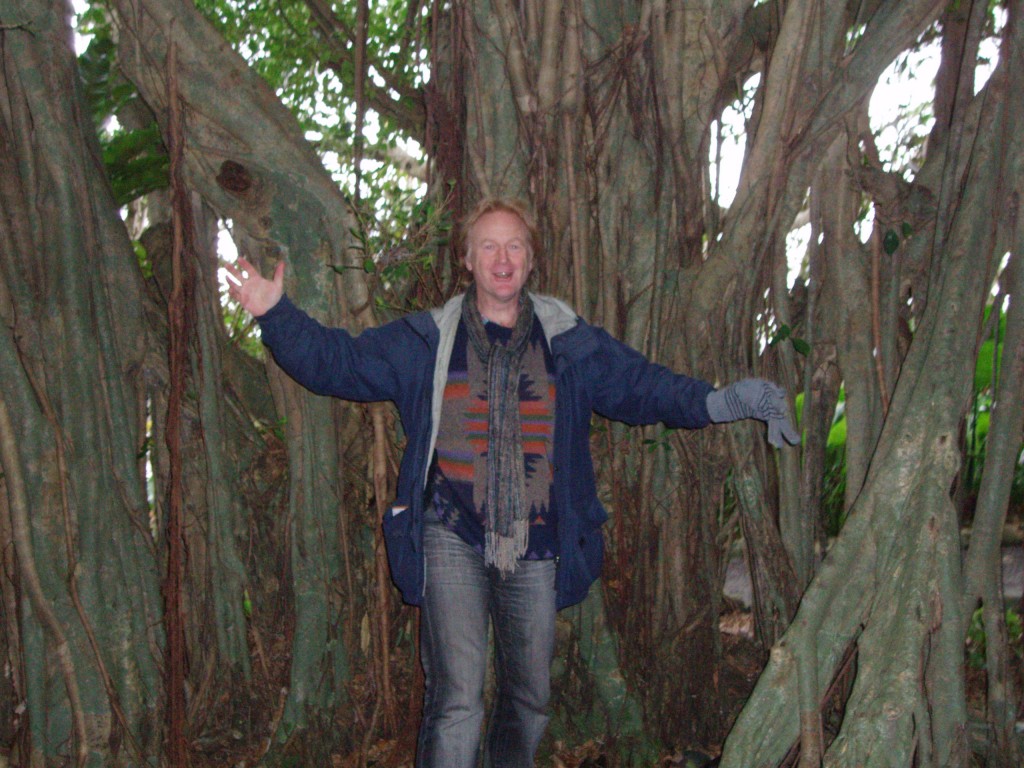
Celebrating the awesomeness of trees on the island of Yakushima, whose ancient woods inspired the spiritual content of Miyazaki Hayao's animated film Princess Mononoke


« Older posts Newer posts »

© 2026 Green Shinto

Theme by Anders NorénUp ↑